Hacker News new | ask | show | jobs
by dakrisht 2281 days ago
Some interesting data here.

- Mean age of 79.5 sheds light on Italy’s extremely high fatality rates; in essence, it’s the (very) elderly that are dying due to complications from viral pneumonia. Which begs the next question...

Why are they overwhelmingly treating patients with antibiotics in cases of viral pneumonia and not antivirals (Remdesivir)/ chloroquine?

Sure, these are “experimental” therapies but decent data out of China/South Korea shows these therapies work. Perhaps they found out too late?

- The younger fatalities (17) show multiple, serious co-morbidities and smoking is not listed; an assumption can be made a fair amount of these younger patients smoke. But again, an assumption.

- Almost 50% of patients showed 3 or more co-morbidities - this is high and important to note. 25% of patients showed 2 co-morbidities. Roughly 75% of patients had 2 or more co-morbidities (!).

- Sample size (2003) is good given their current 3,500 fatality numbers.

Not a medical doctor but a few things I’m struggling to figure out:

- How did so many elderly get infected? Did the disease simply spread in close quarters where many elderly live? Elderly folks aren’t necessarily out and about drinking espresso and touching surfaces yet alone having younger asymptomatic carriers cough on them.

I wonder if Italy is similar to a Kirkland, Washington situation. High density of elderly folks spreading infection.

It’s obvious that SARS-Cov-2 is highly, highly contagious but it’s interesting how we’re seeing these somewhat “bomb” explosions of infection: Wuhan > Daegu > Kirkland > Lombardy > NYC next.

Sure, quarantine works but the rate of new infection stays rather localized and then just annihilates everyone around it.

Perhaps it’s a viral load issue; viral load increases exponentially the more we have infected. Why you see doctors and nurses infected / critical and dying even with full PPE.

Let’s hope the Italians figure out a way to get this curve to fall of ASAP. Hoping they have a similar effect to Wuhan’s curve and just drop down rather than flatten.

11 comments

> Elderly folks aren’t necessarily out and about drinking espresso and touching surfaces yet alone having younger asymptomatic carriers cough on them.

From what I understand about Italian culture, they kind of are. Older Italians seem to have much stronger social lives than in the US.

There’s truth to this and perhaps I jumped to an invalid American based assumption, stupid given that I’m European.

In Europe, the elderly are out and about, walking, sitting at parks, drinking coffee, the works. They’re actually still doing this as we speak in countries, from what friends and family tell me. Go figure.

However, even if they are in cafes, grocery stores, parks - the numbers are still very high.

This virus is either incredibly efficient and contagious (spread by totally asymptotic carrier pigeon patients > elderly) and/or it’s been there for a long time. Months.

If my experience with 'southern' cultures is anything to go by, the amount of interaction between young and old people probably plays a huge role.

For comparison, I live in NL and for me and the vast majority of my 20-30-something friends, visiting grandparents is relatively rare. For many of us even visiting parents is a 'once every x months' kind of thing.

On the other hand, when I lived around the mediterranean, not only was it expected to regularly interact with parents and grandparents, but it was often the case that they lived together, or at least close by.

Perhaps the 'quarantining'/neglect of the elderly in Northern-Europe that I've often criticised as inhumane is actually saving them in this particular situation.

> This virus is either incredibly efficient and contagious (spread by totally asymptotic carrier pigeon patients > elderly) and/or it’s been there for a long time. Months.

It's incredibly contagious. Infection rate doubles every 2.5 days.

> and/or it’s been there for a long time. Months

I believe this to be accurate and have argued for it elsewhere.

Plus lots of Italians live with their extended families well into their 30s.
Good point and totally unnoticed.

The young who live with extended families are the perfect carriers as they’re asymptomatic and elderly are close by, infected surfaces, etc.

> Why are they overwhelmingly treating patients with antibiotics in cases of viral pneumonia and not antivirals (Remdesivir)/ chloroquine?

My guess is that they try to avoid an additional bacterial super infection with antibiotics. Also these antivirals can be dangerous to (very) old people. I think because of liver malfunctions. But take all I say with a grain of salt.. this is all stuff in the back off my head that I remember vaguely from my father (a doctor).

My understanding is that the virus greatly hinders your immune response in the lungs and that opens the door to microbial infections. This is what causes the severe pneumonias that kill people. Kurzgesagt did a nice video explaining this: https://www.youtube.com/watch?v=BtN-goy9VOY
Something else to keep in mind is this part:

> The figure 5 shows, for the patients who died positive COVID-19, the median time in days, who spend from onset of symptoms to death (8 days), from onset of symptoms to hospitalization (4 days) and from hospitalization to death (4 days).

At this point, we know the elderly and people with pre-existing conditions are dying fast; it is also not unreasonable to think they're more vulnerable overall.

But not enough time has passed to say yet whether younger people without pre-existing conditions are not particularly susceptible or are just a little less susceptible but take longer to succumb. If the statistics are a week for someone over 65, from onset to death, and a month for someone under 40 w/o pre-existing conditions, it's going to skew the hell out of the statistics this early in the outbreak.

> How did so many elderly get infected? Did the disease simply spread in close quarters where many elderly live? Elderly folks aren’t necessarily out and about drinking espresso and touching surfaces yet alone having younger asymptomatic carriers cough on them.

Ha. Italians in N. Italy often living multigeneration in close quarters. Spanish and italians, men and women, ritually kiss on the cheeks as a greeting. Brits and Germans don't so much.

Italians are very social to an old age and live longer than many nations.

https://www.sciencedirect.com/science/article/pii/S120197121...

> We estimated excess deaths of 7,027, 20,259, 15,801 and 24,981 attributable to influenza epidemics in the 2013/14, 2014/15, 2015/16 and 2016/17

Italy always has this problem

> How did so many elderly get infected? Did the disease simply spread in close quarters where many elderly live? Elderly folks aren’t necessarily out and about drinking espresso and touching surfaces yet alone having younger asymptomatic carriers cough on them.

I was wondering the same thing, but judging by my own country crowds of elderly people is a thing. For example they do not use technology as much as others and tend to concentrate in places that provide alternative means to function without technology.

Another assumption is that touching surfaces is not how the virus spreads. Being within a few meters of carriers, not necessarily coughing, just talking and breathing, is how people catch it. And since masks are not available and dumb propaganda discourages people from using even a piece of clothing to protect them from inhaling droplets, people catch the virus so easily.

> Why are they overwhelmingly treating patients with antibiotics in cases of viral pneumonia and not antivirals (Remdesivir)/ chloroquine?

Because a bunch of these patients are people with suspected, not confirmed, covid-19 and so they're treating pneumonia which they think is probably bacterial but possibly viral.

Also, they were thinking that covid-19 in already vulnerable people was damaging the lungs and making bacterial pneumonia much more likely, so they were treating preventatively.

> yet alone having younger asymptomatic carriers cough on them.

Droplets in the air are one route of transmission, but there are others. It's likely that most people are not infected via this route, but via fomites. Infected people cough onto a surface, and later someone touches that surface and then their face.

> Infected people cough onto a surface, and later someone touches that surface and then their face.

And then what? How does the virus get from their face into the lungs in enough quantity to infect them?

> And then what?

They touch their mouth, or eyes, or nose.

> How does the virus get from their face into the lungs in enough quantity to infect them?

They're already infected. I don't understand the question. Are you asking how the virus replicates? It's a strand of RNA that takes over human cell replication. It binds to ACE2, which is how it targets lungs. https://blogs.plos.org/dnascience/2020/02/20/covid-19-vaccin...

People touch their face all day everyday, even when they've been told not to. Even when they're telling other people to stop doing it. https://twitter.com/Kojoanan/status/1235275598697771011

It's unusual for people in public places to be coughed on. I can't think of it happening to me in the past 5 years.

Healthcare professionals wear masks (and goggles, and protective clothing, and sometimes gloves) because their work involves close contact with ill people who are coughing over them.

On the elderly infections: https://www.wired.com/story/why-the-coronavirus-hit-italy-so...

On antibiotics, aside from secondary infections, there’s a paper out talking about azithromycin: “Our preliminary results also suggest a synergistic effect of the combination of hydroxychloroquine and azithromycin. Azithromycin has been shown to be active in vitro against Zika and Ebola viruses [20-22] and to prevent severe respiratory tract infections when administrated to patients suffering viral infection [23].”

Not sure of they used azithromycin but would’ve been good to see that verified.

Yeah, I remember reading this as well.

MedCram did a good video showing how Zinc, for example, actually impairs viral replication but Zinc cannot enter the cell... without chloroquine :)

Seems chloroquine has the key to the cell, otherwise nothing goes in.

It is everywhere. The 'pockets' you think you are seeing are an artifact of exponential growth. When infection rate doubles every 2.5 days, the incubation time is 5-14 days and it take 3-4 weeks to die the first 4 weeks look harmless. But by then it is already well out of control.
Asthma is another, this guy prob did not smoke, got antivirals but we’ll never know if it would have made a difference earlier or if they would try it earlier https://www.msn.com/en-us/news/us/glendora-man-34-dies-of-co...
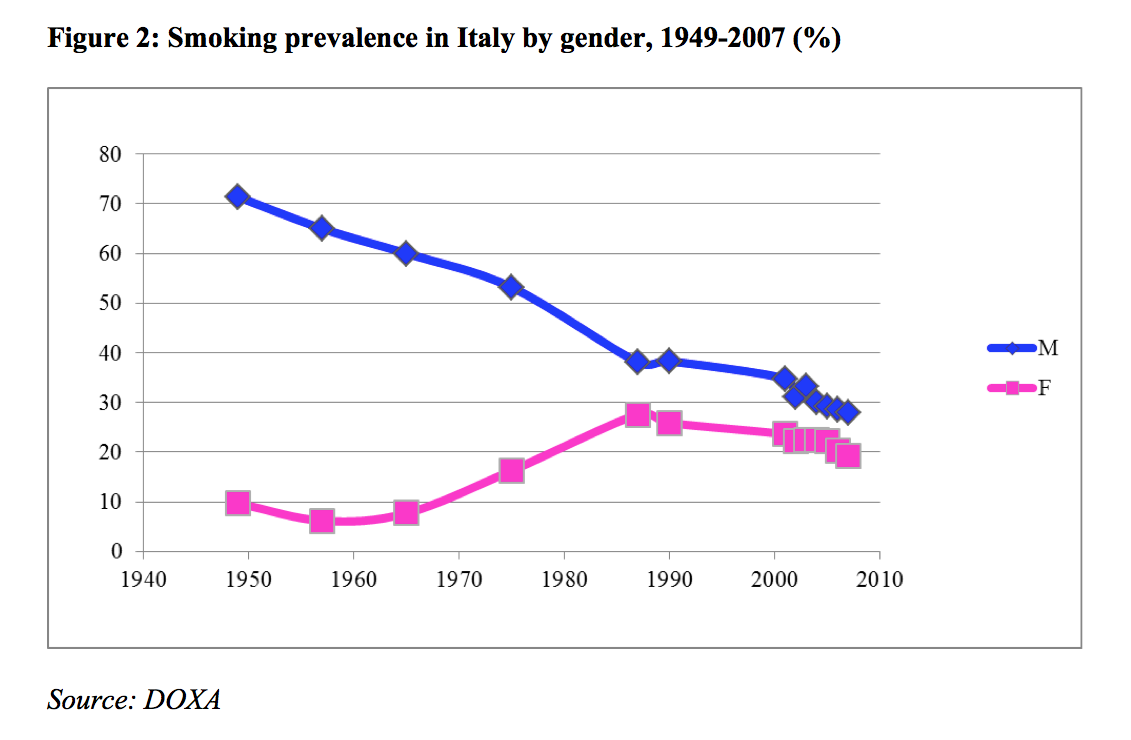
Perhaps it doesn't matter that much how many people smoke right now, but how much lung damage they accrued during their lifetime.

The median age of the deceased is around 80 years.

According to a random source I found on the internets, in the 1950s and 1970s between 70% and 50% of the male population was smoking:

https://www.niussp.org/wp-content/uploads/2016/05/Schermata-...

We all want to live long, and people now often live till 80+, but when a person 80+ years old dies does it make sense to search for a cause of the death? My grandmother died last year from pneumonia. She was 89, which is way above the average life expectancy. Any small infection can kill a person at this age. Is there a statistics that shows the mortality rate in Italy before the pandemic.
> but when a person 80+ years old dies does it make sense to search for a cause of the death?

Of course! We want to know how to prevent the deaths of others in the same condition.