Hacker News new | ask | show | jobs
by alxlaz 2294 days ago
I don't want to argue about the general idea but a lot of the things in your timeline don't really match with history:

* The desktop metaphor with its files was not popular, and not successful on 8-bit machines. It was technically possible to get something with a desktop metaphor running on these machines, with enough clever trickery -- e.g. GEOS ran on the C64 and the Apple II. But it wasn't very useful, because they also lacked the storage to make it useful. Things like GEOS or GS/OS had their users but these things weren't too successful in the realm of 8-bit machines. In fact, many of them didn't even show up on 8-bit machines until way into the "16-bit era", when 8-bit computer users began to covet windows, buttons and icons.

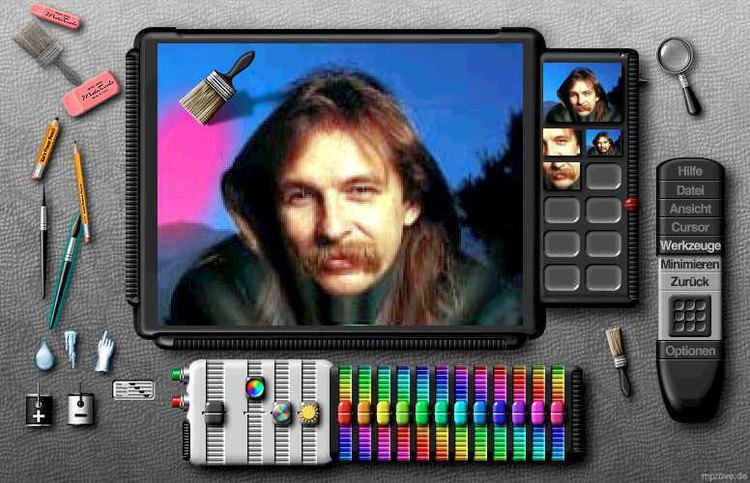
* By the time the iPhone showed up, in 2007, skeumomorphism had been the way to design interfaces for at least 8-10 years. See e.g. Kai's Power Tools, which in the mid-90s looked like this: https://alchetron.com/cdn/kais-power-tools-5461d370-1529-47a... . KPT was, admittedly, an outlier, in that it was more whimsical than average -- but Aqua/OS X interfaces and, later, the iPhone's interface was not fundamentally different from the status quo, they just looked better. In fact, the iPhone came up late enough that, when it did, its interface was seen as a "final word" on the matter because the field was already extremely mature -- the time for experiments was long gone. The iPhone didn't spark a new fashion in UI design, it adopted what was already the fashion in UI design, everywhere.

* Fast-loading and flat are completely orthogonal. Today's websites load way slower than the websites of the Geocities age.

* Early Windows version were very much colourful and whimsical because of the VGA palette. By the time Microsoft could bet on enough users having 256-color screens (in the 3.1 age), two major Windows version had passed. The default background in Windows 2.0 was a retina-piercing cyan.

* Early Macs models were certainly not whimsical in terms of colours, but that had nothing to do with fashion -- it was because they were monochrome.

* Most 8-bit machines certainly used very vivid colours. Most of them could (and most users did) use a TV for a monitor, and the palette choice was deliberately picked with this in mind. The first Amiga Workbench version had an eye-stabbing palette, chosen so that things could be read even on poor quality, black-and-white TVs.

1 comments

I'm sorry but Kai's Power Tools was not some sort of UI design trendsetter. Outside of very niche programs you didn't see skeuomorphic UIs much at all in the 90s or 00s. MacOS X's Aqua UI was very different from Windows and older MacOS versions. The textures aping iMac design elements are superficial differences, the real distinction was the state changes and representations.

In the early Aqua UI things like buttons and selected menu elements were colored and composited on top of their backgrounds. It was obvious that "Save" was the default action because the button was colored blue in the dialog. Document modal dialogs were attached to and animated out of the document's own window and composited over the contents. Icons bounced in the dock to get attention for dialogs. The dock itself animated to make icons under the cursor larger (Fitt's law improvement) and minimized windows got sucked into the Dock with the genie animation.

While Aqua still used the WIMP paradigm it had a lot of UX differences from older UIs. It used a lot more animation to convey information to the user. Animations told the user their action was registered and was caused something to happen. This was in contrast to Windows where sometimes you might see a hourglass cursor if you clicked something but you usually had to look at your drive activity light to be confident Windows registered you clicking an icon.

With the iPhone, it was up against a bunch of phones whose UIs were designed to be use with a stylus and were doing their damnest to look like a desktop's UI. The iPhone's design language was all about making elements large enough to be used with a fingertip and convey the idea that you were even supposed to touch the screen. When the iPhone was released most people had never owned or used a smartphone or PDA. The most popular phones were non-touch feature phones.

After the iPhone skeuomorphic design was everywhere. Android aped a lot of iPhone UX elements as did webOS, they wanted to convey that elements should be touched and interacted with directly. Android's pre-iPhone UI looked a lot more like Windows Mobile and Blackberry. Apple certainly didn't invent skeuomorphic UIs but the iPhone was the first smartphone to make such it the default design language.

> Outside of very niche programs you didn't see skeuomorphic UIs much at all in the 90s or 00s.

We must have lived in very different 1990s then. Everything was "files" and "folders" with icons that looked like files and folders. One of the big features of Windows 95 was the Microsoft Briefcase, and it sparked a big debate back in the day about whether or not we should stop using these real-life metaphors everywhere, because it was a really confusing program -- sort of, but also not sort of like a briefcase. E-mail/PIM programs had task pads that looked like paper pads and contact lists with initials sticking out of a pack like in a rolodex. Media players looked like real-life players. Word processors were full of elements straight of electric typewriters -- not just the icons on the buttons, but the page layout, the rulers...

A lot of these things didn't look as good as they were going to look on Aqua because they were introduced back when you'd be drawing with GDI on -- if you were lucky -- 133 MHz machines. There was no compositing and few consumer machines could do proper OpenGL anyway.

Aqua used colour and animation more plentifully, but other than the degree to which it used them, few things were new. It made it obvious that "Save" was the default action by colouring the button blue just like Windows made it obvious that "Yes" is the default choice using the dashed lines. (Edit: by the way -- that was definitely not the first time someone used colour like that. Since few other styling options were available, virtually all TUI interfaces for DOS indicated the current choice of button using by colouring it in a particular way). Icons bounced in the dock to get attention for dialogs just like taskbar buttons blinked. Aqua certainly did these things way better, but most of them were familiar to us, they just looked so damn good!

Also, FWIW, making icons under the cursor larger had very little to do with Fitts' law -- since the icons were already under the cursor, there was no benefit to making them bigger. Maybe it helped make the current choice more obvious. I don't recall the "official" reasoning -- what I do recall is that most users turned that thing off because it wasn't just distracting, it was pretty hard to get at the icon you wanted. Making icons bigger shifted nearby icons a bit, and the zooming effect wasn't applied uniformly, which led to having to "chase" the right icon. I think Apple turned it off by default after a few years, too (around OS X Tiger or Leopard, I think?). Many people thought that OS X had done a great job at updating the Nextstep interface except for the damn dock, which it kindda ruined.

> I'm sorry but Kai's Power Tools was not some sort of UI design trendsetter.

I certainly never said that. KPT was a trend follower -- it was just a very representative example of one, just like Aqua and the iPhone.

File and folder icons are not skeuomorphic. They were a visual metaphor at best. The whole "desktop" paradigm was a metaphorical concept. It wasn't trying to directly mimic a real physical desktop, just putting visual elements in some sort of context. There was nothing about a "folder" icon that behaved like a physical Manila folder. It was just an icon representing a logical construct that would group individual data items stored in the computer.

The whole desktop paradigm was also completely replaced the moment an application was run. No Windows or MacOS UI widget really mimicked some physical item. Few applications tried to look like a physical item of similar functionality. Word processors weren't themed to look like a typewriter, spreadsheets didn't try to look like graph paper, databases didn't act like card catalogs or filing cabinets.

In early iOS the skeuomorphic elements did try to take on a look of the physical things they represented. The calculator looked like an actual physical calculator. The address book looked like a paper address book. The notes app looked like a pad of lined papers and when you deleted a note it left a small ragged edge at the top of the view to look like ripped paper. The voice recorder looked like an old microphone and had an analog looking VU meter.

The classic MacOS and Windows UIs didn't do that sort of stuff. Neither did Windows Mobile or PalmOS. You didn't see that with CDE, GNOME, or KDE. In fact the few skeuomorphic desktop apps I can even think of are your KPT example and some audio software that let you wire together effects units as if they were physical boxes connected with quarter in audio cables.

> The classic MacOS and Windows UIs didn't do that sort of stuff.

Really? I very distinctly remember note/task pads that looked like spiral-bound pads of lined papers, CD players that looked like a real CD player, and calculators looking like an actual physical calculator. Many computers didn't have the power to do fully-realistic stuff just yet, but those that did went to great lengths to be as close to the real deal as possible. See e.g. IRIX's IVcalc ( https://guidebookgallery.org/pics/gui/applications/office/ca... ), or the NeXTStep CD player that even had the damn volume wheel.

Granted, on Windows & friends many applications that shipped with operating systems didn't take it that far until the very late 90s (e.g. Windows Media Player 7, the one launched in late 99/early 00). But that's because they had to account for the low capabilities of entry-level hardware. And even then, there were exceptions (e.g. QuickTime on MacOS 9). But outside the realm of applications that shipped with Windows, as much photorealism as the hardware could give you was generally thought to be a good idea. Many applications, like that whole generation of "super CD player" and "scientific calculator" apps, didn't do anything that the OS equivalent didn't do, they just looked super futuristic and fancy.

It didn't float that well with most professional tools, like Office or Photoshop (or, heh, Paint Shop Pro). But that was true everywhere. Pages for OS X wasn't all lined papers and calligraphy, either. But outside that particular zone things weren't as somber.

And let's not exaggerate the extent to which skeumorphism was generally applied in early iOS, either. Lined paper pads and book readers that showed shelves of books, most applications just stuck to photorealistic icons everywhere and relief buttons.