- You can only offset a certain amount of warming with it. If you put too much aerosol into the stratosphere it will merge, become larger and precipitate quite fast. The exact possible offset can only be estimated, but is below what we're already committed to.
- You have to keep doing it. As soon as you stop you run into trouble very fast.
- In the models we see drastic circulation changes. For example the jet stream collapses. Do you want to test it in real life?
- The issue of ocean acidification still remains. The additional sulphuric acid in the environment won't help either.
- Ah and of course it's not cheap. We do not have the tech to do it yet in the amount necessary.
The currently easiest, cheapest and safest way to fight climate change remains to stop burning fossil fuels.
(edit: And of course I get you're not being serious.)
As always, also worth noting that this is literally acid rain. Putting it in the stratosphere is intended to lessen the amount of acid rain per warming averted, but it's still the exact same chemicals that caused acid rain. There are very good reasons we removed sulfur from gasoline.
Acid rain is probably better than global warming, assuming it doesnt literally kill the ocean. Its good that we have a potential backstop- we could definitely halt warming in a very short time and it might not kill all life. We can even produce the necessary sulfur for a short while. Or like, we could stop warming without dumping incredible amounts of acid in the air we breathe.
> we could definitely halt warming in a very short time
The limit estimated (from models) here [0] is a decrease of -2 W/m^2 at most.
The IPCC scenarios are equivalent with a number of plausible energy imbalances by the end of the century, ranging for 2.6 W/m^2 (RCP 2.6) in the best and 8.5 W/m^2 (RCP 8.5) in the worst case. [1]
So even in the best case it might very possibly not be enough to halt everything. Maybe it can buy us some time, but I think the only viable path forward is to stop as soon as possible and then carbon-capture it back.
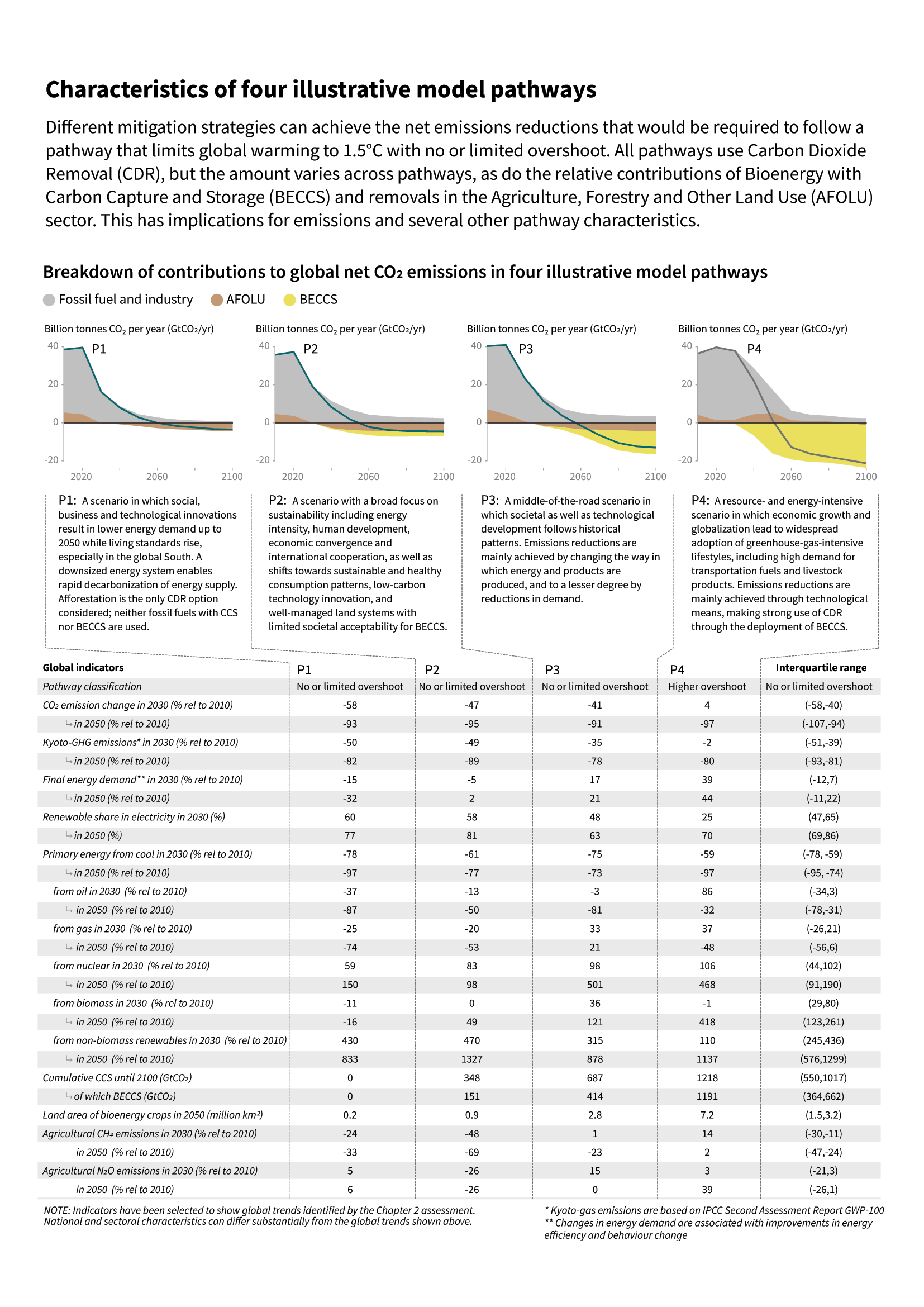
(See also this graphic [2] for possible pathways to stay below 1.5°C warming, all of which include carbon capture, up to half of current emissions starting in 10 years (in the best case by land-use changes, in all others by actively removing the carbon).)
It would require a very large eruption to make a worthwhile dent in the rate of warming; small-ish ones happen all the time with no strong effect. Even if such an eruption didn't have a lot of highly undesirable side effects, we simply don't have any way to trigger something like this. At any rate, the short-term consequences would be absolutely devastating and in no way cheap.
- You can only offset a certain amount of warming with it. If you put too much aerosol into the stratosphere it will merge, become larger and precipitate quite fast. The exact possible offset can only be estimated, but is below what we're already committed to.
- You have to keep doing it. As soon as you stop you run into trouble very fast.
- In the models we see drastic circulation changes. For example the jet stream collapses. Do you want to test it in real life?
- The issue of ocean acidification still remains. The additional sulphuric acid in the environment won't help either.
- Ah and of course it's not cheap. We do not have the tech to do it yet in the amount necessary.
The currently easiest, cheapest and safest way to fight climate change remains to stop burning fossil fuels.
(edit: And of course I get you're not being serious.)