Hacker News new | ask | show | jobs
by cstross 2340 days ago
What is the cost (for Apple) in straight up R&D dollars of building a new model of Mac? And how much does it cost them to tool up for manufacturing and create the logistic chain to put it in customers' hands?

Remember that Apple aims to sell a vertically integrated stack, all the way from their own cases, motherboards, and PSUs up through the OS and core apps. The point of this is to deliver a specific user experience that they control, and also to keep competitors out of their pool (they allowed licensed Mac clones circa 1994-96 and it didn't end well). While they still buy in CPUs from Intel and other components (RAM, video chipsets, SSDs, hard drives) from other suppliers, these are generally low-level components -- as low level as Apple can get -- and even then they're trying to build self-owned stacks so they're not dependent on anyone else (e.g. the A-series processors in the iPhone and iPad) -- a lesson they learned the hard way thanks to Motorola with the 68K and subsequently PowerPC architecture. (I'm guessing Tim Cook personally has bad memories of the failure to deliver a mobile G5 back in the day.)

Anyway ...

Developing a new machine from the ground up has got to cost in the tens of millions, at least. (Look at the sunk costs that went into the new Mac Pro, for example.)

Are there enough "enthusiast" customers with system-building interests out there to make such a beast net-profitable, after taking into account the brand dilution implication of stacking up too many SKUs (as they did in the Bad Old Days of the first half of the 1990s, before the Return of Jobs)?

I'm guessing they've done the calculation and concluded the answer is "no", at least for the time being.

2 comments

I think this is backwards. Who is buying underpowered $6000 computers? An iMac in tower form factor would be popular because it's something people actually want.

The only people excited about the new Mac Pro are people already locked into the Apple ecosystem. It is a fundamentally backwards looking product that attempts to squeeze more money out of already captured customers. It is not likely to attract new customers to the Apple ecosystem.

> I'm guessing they've done the calculation and concluded the answer is "no", at least for the time being.

It's possible but I doubt it. Does Apple know how many of its iMac customers would prefer a tower? Or how many sales they've lost to hackintoshes?

Yes, they do, in part because they opened up previously in the heyday of people building their own systems, and continue to engage deeply on the enthusiast asks right now contra-posed against their broader market understanding. Roughly, they figure out which enthusiast things will appeal to the larger market, and make it all work, fully integrated.

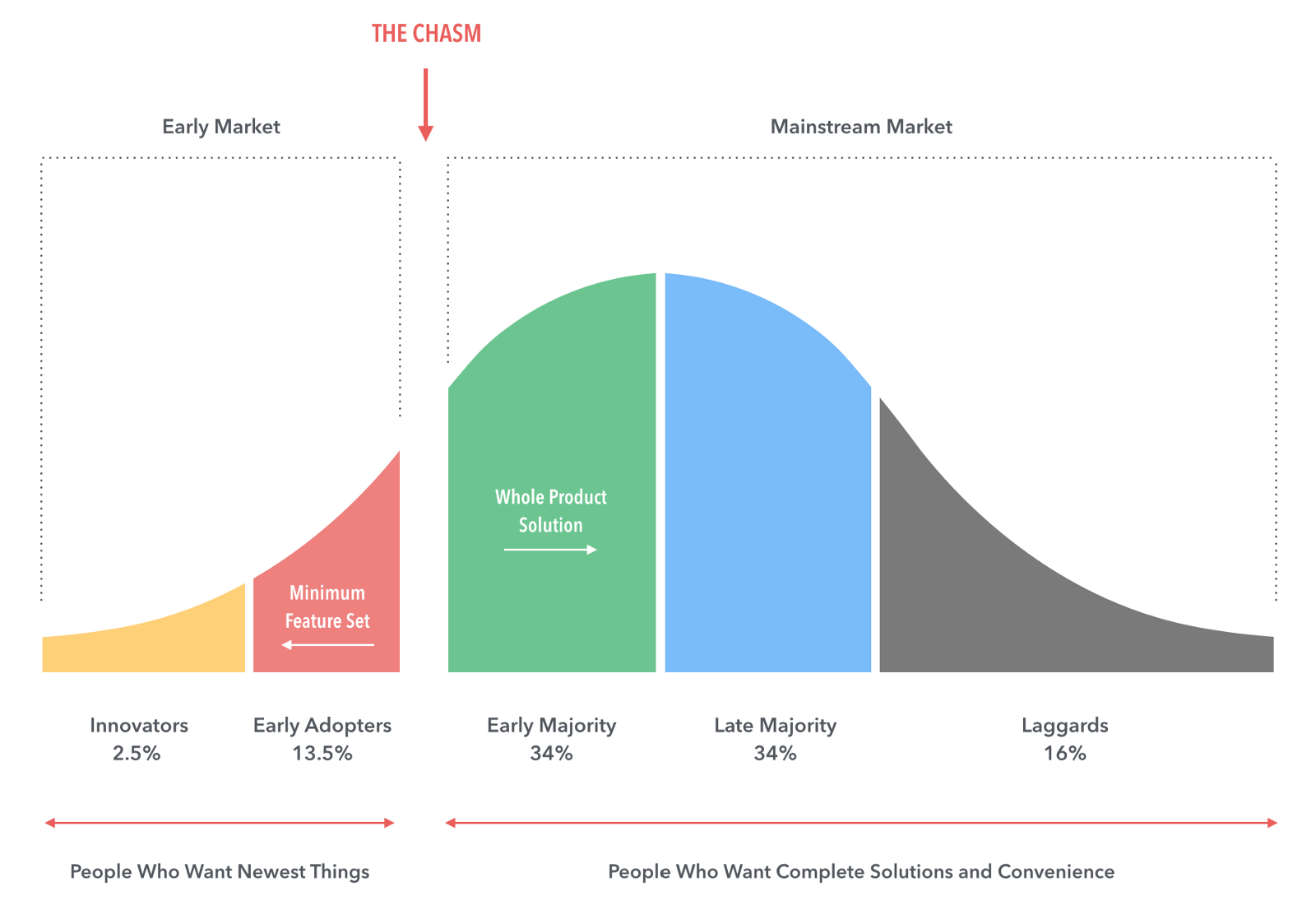
Per the curve shown in Geoffrey Moore’s “Crossing the Chasm”, HN exists largely on the left of the chasm, Apple is a trillion dollar company because it understood how to shift to the right of the chasm.

Visual explanation (.png):

https://smithhousedesign.com/wp-content/uploads/2018/02/smit...

> in part because they opened up previously in the heyday of people building their own systems

20+ years ago?

> continue to engage deeply on the enthusiast asks right now contra-posed against their broader market understanding

Is this speculation or you have concrete evidence of this claim?

> HN exists largely on the left of the chasm, Apple is a trillion dollar company because it understood how to shift to the right of the chasm.

It think it would be the opposite. Having a tower with macOS and consumer specs (no Xeon or ECC) would be pretty boring and conservative. I think that is one of the reasons Apple won't do it.

> 20+ years ago?

Yeah. Back then lots of folks moonlit or ran local PC builder companies as small business PC builders and gaming PC builders. Before gateway and e-machines, and the like.

> speculation or evidence?

first hand knowledge

> think it would be the opposite

The curve is within a market. There are boring computers and exciting computers, workaday computers and toy computers, etc. Each has its curve.

Compare to automobiles, what gets shown at shows or on the track, what is limited edition, and finally what is high end then mainstream then outdated.

The high end buyers want them some of that enthusiast kit — without the high maintenance and visits to the mechanic.

That’s even true within a brand line, buyers want stuff they see getting played with over on the left of the chasm by competing enthusiasts, and they want their brand to adopt it too.

> first hand knowledge

Please do go on :)

The more I think about it, the more I conclude they just cannot afford to support tower or modular designs for the enthusiast market. Not only would they "lose" money from costly upgrades. But it would also become apparent the lack of driver support Macs have; especially as it pertains to video cards.

Maybe the Mac Pro will change the support issue and they will eventually be able to enter this market. But I believe their biggest fear is being compared to Windows or Linux which both have tremendous hardware support.