Hacker News new | ask | show | jobs
by agorabinary 2338 days ago
ZH is unmitigated garbage. It began by pushing the standard tropes of goldbug interpretations of the economy with the banker bad, armchair (amateur) realist good and an unrealized schadenfreude of global economic pandemic. Now it's realized that its early readership is just a subset of the broader misinformed armchair conspiracy theorist and has expanded its message to them as well.

Just as easily as someone in software can bullshit their way through a presentation with a couple years cursory understanding of SWE topics, same goes with "researching" and writing a ZH econ article. ZH does not do meaningful economic analysis, look elsewhere.

2 comments

Bingo. Also this argument in particular is wrong because even if you want to describe the current repo operations as QE, it isn't inflationary or doing much to "prop up the economy" given that none of the other QE rounds were inflationary.

At the end of the day, fiscal policy is extremely important, and almost no amount of monetary policy can do much on its own.

Unless we decide to start actually minting money, like the trillion dollar platinum coin idea.

>> ..."none of the other QE rounds were inflationary."

Earlier QE rounds (and this "not QE" round too) are definitely inflationary, but that inflation is not evenly distributed through the economy.

QE inflates prices of financial assets and related stuff. The further you get from financial assets, and the correspondingly closer you get to the real economy, the less inflation there is. Eg. equities get inflated a ton, housing prices less, the price of a hamburger not at all. The mechanism for this non-flat inflation distribution is straightforwardly derive-able just from supply-and-demand; they increase the supply of capital, but only by bidding up the prices of financial assets, while demand for those assets is approximately constant.

That said, you're right that Zerohedge ranges from "mostly-uninformed" to "intentionally writing nonsensical clickbait lies." On the other hand, it is broadly speaking not any wronger than e.g. what you see on TV or read in major newspapers.

Shifting the definition of inflation this way is misleading and confusing for everyone involved - a better analogy may be that QE is equivalent to price controls on fixed income assets.

The effects of QE become much more clear - since the price of a bond is now fixed above its market clearing price (alternately, rates are artificially pegged low), this actually results in a shortfall of supplied liquidity and a situation that sharply favors strong borrowers.

How were the QE rounds not inflationary? The Fed injected (albeit indirectly via debt instruments) cash into the economy.
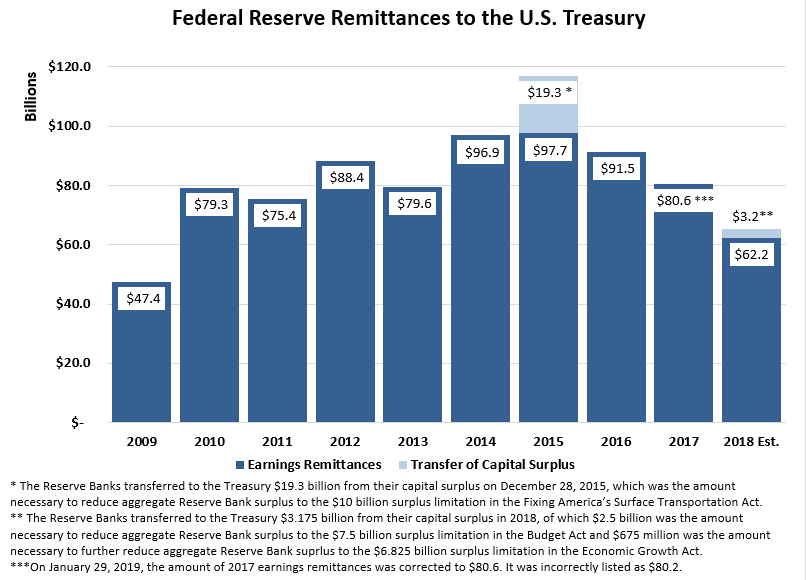
The Federal reserve injected banks with money, not the economy. One would naturally think that these banks would then lend money to the broader economy (because that's how banks make money), but a law passed around that time allowed banks to deposit their money in the Fed itself and extract an interest rate better than they would get from normal lending. The Fed, which normally ran a surplus (money which goes to the Treasury to pay down debt), began to run a deficit from these payouts. Potential inflation just became more debt. This is why over a trillion dollars in "printed money" failed to yield much inflation over the last 10 years, but let's all just keeping reading ZH articles about the looming "inflation bomb"..
The Fed ran deficits? My understanding is that they ran surpluses throughout the recession, and that is confirmed by this chart.

https://www.federalreserve.gov/newsevents/files/other2019011...

Ostensibly, GP means that they were not inflationary to consumer prices. Asset prices were definitely inflated. This is the whole point of QE.
>How were the QE rounds not inflationary?

Reflationary might be a better interpretation, since vast amounts of wealth were destroyed in 2008.

What do you mean none of the other QE rounds were inflationary?
Overall consumer prices and aggregate demand were virtually unaffected by QE. All the individuals who, for ideological reasons, believed QE would be inflationary got wiped out.

Peter Thiel's hedge fund, Clarium Capital, lost huge amounts of money on such a bet.

If you use the original definition of inflation, i.e., increase of the money supply, there has been massive inflation. It hasn’t resulted in a substantial increase in the consumer price index, but you can see huge increases in certain areas such as the stock markets, housing markets in certain areas, health care and education.
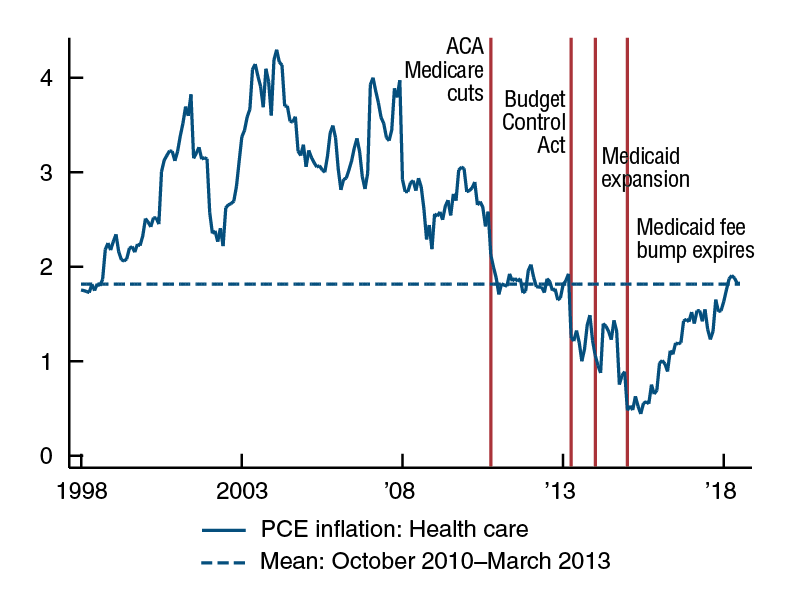
The rate of healthcare inflation declined during all of the QE periods.

https://www.chicagofed.org/~/media/publications/chicago-fed-...

Stocks did increase quite a lot, as it generally tends to do over the course of the business cycle. Although, it generally was tracking actual profits up until recently (when the Fed was drawing down their balance sheet). It was tethered to real profits during the QE periods.
banker bad, armchair (amateur) realist good

As a paranoid rag goes, ZH's faults are many and varied, but come on - the critique that the Federal Reserve doesn't know what the hell it's doing is 100% valid.

The observation that the FRB consistently bats 0.000 in economic outlook and interest rate forecasts (e.g. Bernanke calling housing subprime defaults "contained", or Yellen constantly stretching out the timeline of getting off zero, or Powell cutting rates three times in 2019 after predicting four hikes less than a year prior, or claiming repo operations would be unwound completely by 15 Jan) is absolutely correct, and an absolutely appropriate critique to make, even by armchair quarterbacks.

Just look at the history of FRB dot plots to get a view for how absurd your implied position is that bankers/economists are any better at their jobs than a drunk with darts and an interest rate chart would be.