Hacker News new | ask | show | jobs
by roenxi 2405 days ago
It is pretty simple to formalise - if there is a pool of people who routinely accept positive-expected-value gambles where there is a P = 99.999999999% chance of going broke then we expect everyone in that pool will be broke unless the size of the pool is comparable to 1/(1-P). Tighten up the bounds on 'comparable' a bit and that is formalised.

The mistake is accepting uncritically that expected value is the best metric to optimise. Nobody ever proved that expected value is a strategically superior metric. In fact it would be quite hard to prove that since it is not true. It leaves people vulnerable to making very stupid decisions as illustrated in Pascals Mugging.

Optimium strategy involves at a minimum considering your available opportunities and available resources. Opportunity alone is not enough.

2 comments

> Tighten up the bounds on 'comparable' a bit and that is formalised.

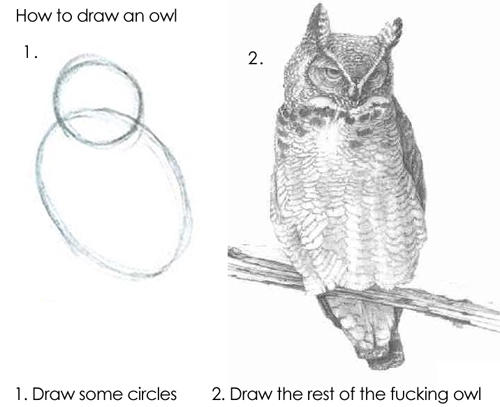
Is this like „draw the rest of the owl“?

What owl?
reddit.com/r/restofthefuckingowl
Linking to examples of the meme without linking the actual meme doesn't really explain what "draw the rest of the owl" means. https://i.kym-cdn.com/photos/images/newsfeed/000/572/078/d6d...
You need to maximize expected utility. In order to avoid this, you need utility to be bounded: there must be some multiple of your current utility that's impossible to ever have regardless of what happens.
Agreed that most people could reject the mugging on those grounds but I think that is more than is needed.

Even if someone being mugged had an unbounded utility function the finite resources argument forces them to rationally reject the deal. We've reintroduced infinities; so now our rationalist must accept that there are infinitely many situations with the same properties as the Mugging (positive expected value, Almost Sure to lose the stake). Their strategy would have to be to reject deals like the Mugging and seek out deals that have positive expected return and probably keep the stake/have a tiny stake compared to their reserves.

I'm basically saying a rationalist with finite wealth is probably using the Kelly criterion [0] and would reject the Mugging on that basis.

[0] https://en.wikipedia.org/wiki/Kelly_criterion

>We've reintroduced infinities; so now our rationalist must accept that there are infinitely many situations with the same properties as the Mugging (positive expected value, Almost Sure to lose the stake).

Yes, in the presence of infinities the decision function is inconsistent.

>Their strategy would have to be to reject deals like the Mugging and seek out deals that have positive expected return and probably keep the stake/have a tiny stake compared to their reserves.

Try formalizing that.

Kelly criterion doesn't work. Your link says it maximizes log wealth. If potential wealth is unbounded, you will still take bets that are positive E(log utility).

> Kelly criterion doesn't work. Your link says it maximizes log wealth. If potential wealth is unbounded, you will still take bets that are positive E(log utility).

Actually Kelly criterion works well, since it would limit your exposure to the game.

In this situation, Pascal as a Kelly-better would bet 12 deniers out of 10 livres (= 0.05% of his wealth), which is a penny.

How are you getting those numbers?

If you're trying to maximize log wealth, someone promising an insane amount of wealth for a trivial investment is a positive value for log wealth. The amount may need to be slightly more insane than it would be if you were just maximizing wealth, but with massive numbers such as used in Pascal's mugging this is easy enough.

> If you're trying to maximize log wealth, someone promising an insane amount of wealth for a trivial investment is a positive value for log wealth.

Nah it does not work in such way.

Mathematically speaking, even if the mugger can propose an infinite large return in this situation, a kelly better would not bet more than 0.1% (= p = 1 / 1000) of his wealth.

It's very sound mathematics and nothing mystifying.

Edit: A Kerry better thinks in term of a long running sequence of bets. If you all of your wealth just because the game is favorable, you'll eventually lose all of your capital with probability one (in other words, betting everything minimizes the expected value of your wealth in long term). The natural conclusion here is that you need to bet a fraction of your wealth to maximize your long term wealth. But how much? Kelly criterion answers this queation formally. Read the Wikipedia article (or better, read Kelly 1956. It's a good paper) for how it handles the question.