GCP is pretty good though. Cold-potato, very fat backbone, and very good presence at a ton of PoPs. When using GCP you basically have the same global, high-bandwidth direct connectivity presence that Google uses for its products, and that is very difficult to match by traditional T1 ISPs.
The origin of which, for those who aren't familiar, is a game called "hot potato" where you try to pass a ball around as quickly as possible as if it was a hot potato
It is the inverse of “hot potato” routing where the network tries to get rid of a packet as soon as possible (that is, drop a hot potato). Cold potato means the network keeps the packet on-network as long as it can.
Cold potato is not necessarily better, actually its often times worse than hot potato and usually used to lower costs so you don't have to pay other people for transit.
For example, a cold potato network may have a link from Dallas to Chicago to New York, while a hot potato network could have a direct link from Dallas to New York.
Cogent uses cold potato and is frequently worse than other transit providers.
So it's hard to value the premium for google cold potato specifically, if it outclasses everything else.
But their hot potato still costs $65+ per TB at medium volumes and $45+ per TB at high volumes. That is still extremely high compared to normal peering costs.
My company was getting massive bills on AWS S3 egress. It was one of the reasons we moved to Wasabi for bucket storage; we then had to deal with a huge one time hit for egress, but in the long run the short term cost was worth it.
I like the Cloudflare/Backblaze duo. Presumably data stays on Cloudflare's network for as long as possible and goes to Backblaze via direct links, so Backblaze can provide free egress to Cloudflare customers (and customers of other serivces like Packet, etc.), while charging others.
This seems more sustainable than Wasabi's model, but there's no way of knowing for sure.
Backblaze has good rates, but it's only really good for storage...which is their main use. I am also surprised GCS (GCP?) is so high. Last a checked AWS was the highest, maybe they cut their rates. I am a pretty happy Azure customer. My only complaint really are their service plans being subpar, but now I've switched over to their IaaS model and it's much better.
Someone should set up a big fat pipe right outside of Amazon data centers with free unlimited transfers, get data on behalf of customers copied to hard drives from AWS, and then attach those hard drives to the Uber pipe. I bet that service could work for a short & glorious moment in time.
A flat fee for the act of a human getting the data onto the physical medium ($200) + the cost of shipping (<$100?) + $15 per day you keep the snowball device past the first + price per GB of data you're transferring ($0.03 per/GB).
So if your getting out 30 TB of data that's $200 + ~$100 + ($0.03 * 30000) = ~$1200
At some point everyone realized they could charge a massive premium per bit and as long as everyone did it, customers would have to pay. So here we are.
Customers are also to blame, when comparing the costs of two services they tend to look at the cost of an instance hour, or lambda execution and often don't look at transfer costs.
Even if a cloud provider had competitive transfer costs they likely wouldn't attract any new customers and would have less margin left over to subsidize the main cost customers look at, $ per instance hour.
The less attention is paid to transfer costs the better for AWS/GCP/Azure. Why hasn't a spot-market for transfer been introduced? Same reason why I can't sell my unused home internet bandwidth to my neighbors, the money is in controlling the means of transportation/communication and the providers want to keep as tight a control on that as possible.
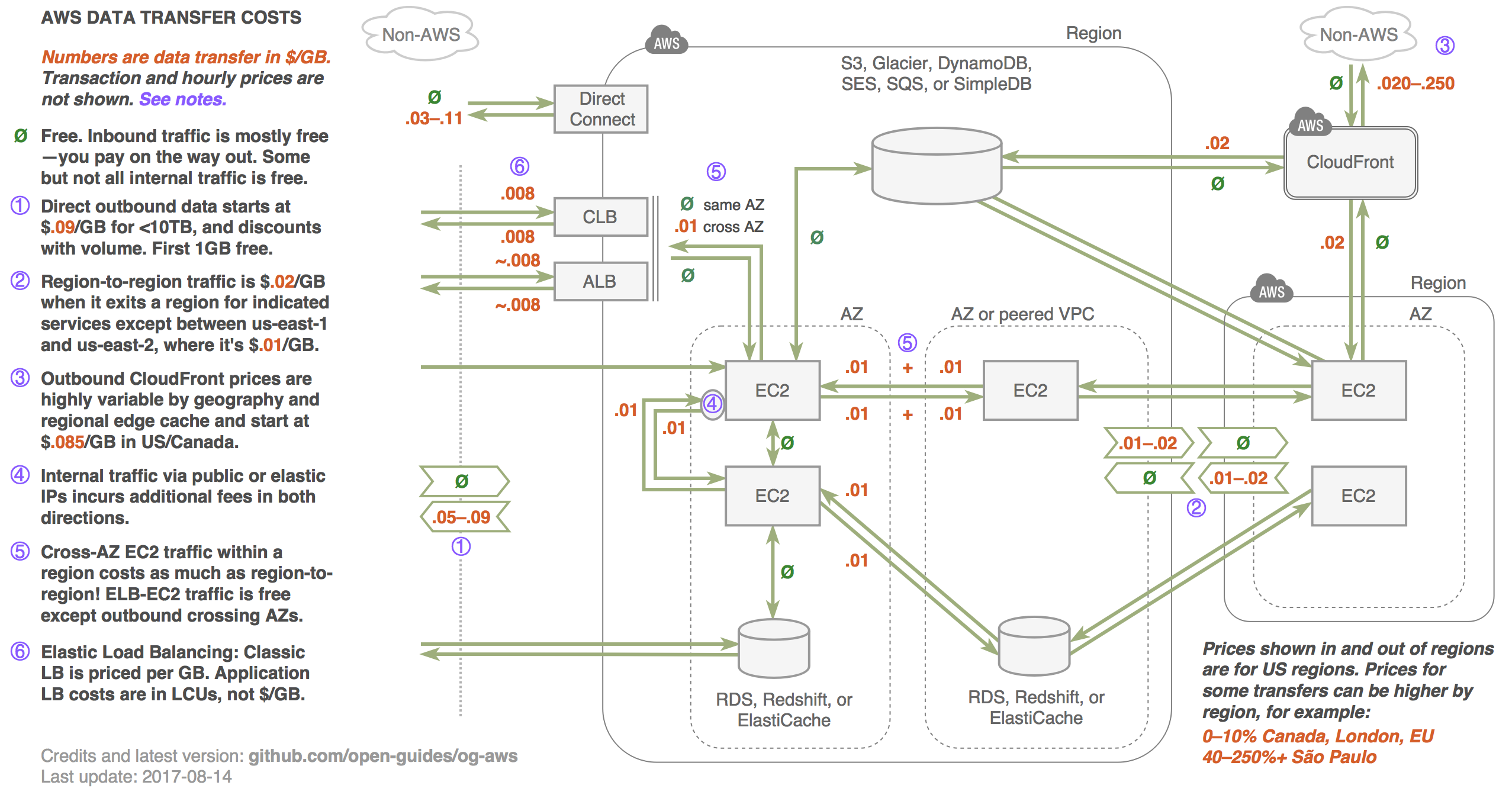
This seems a little deliberately obtuse -- for example, showing two arrows from an EC2 instance to an EC2 instance that exits the VPC. But I generally don't find this too hard to follow? Traffic within an AZ is generally free, but there are some cases where it's not and they generally make sense to me (leaving the VPC, pushing data from your CDN back upstream, etc.)
Then again, I worked for AWS for years, so maybe I'm just used to thinking this way so I'm not really surprised by it.
There was a time when you paid for available bandwidth. Then network operators realized they could oversell their capacity and not spend the money to upgrade their network.
You still see paying for bandwidth with residential connections, though some operators (like Comcast) are trying to do away with it.
I don't think this is true. At $JOB the extent of our cloud cost management is me reading a breakdown by SKU and looking for obvious inefficiencies, and we are very aware of transit fees. I would imagine that anyone in the 5MM+ range has actual models that account for this stuff.
I think this has more to do with collusion than consumer behavior. On average consumers are very rational, even if their rationality is hard to explain.
The issue with per-bit pricing is that a fair agreement for network use would probably look like paying a fee that makes up for the amortization of the network equipment. Anything else is an artificially restricted market created in an attempt to extract more value out of consumers by having them bid against each other.
At some point, yes, we will run out of places to put the switches and routers and then the cost of connectivity will be closer to the cost of land use and will mimic rent, but we are a ways away from that.
Why do you think that bandwidth costs should only cover the hardware? What about the electricity, rent, payroll, sales, marketing, administrative staff, insurance, accountants, lawyers, etc.