Hacker News new | ask | show | jobs
by ddrager 2482 days ago
Having struggled with RSS in the past, I will give a few reasons of why I ended up removing RSS from my blog:

1. RSS traffic trickled down to almost nothing. Hardly anyone uses RSS any more as a daily reader^1.

2. Spammers were using my RSS feed to wholesale copy the content from my blog. Identical copies of my blog went up in several different locations, each with their own copy of ads from the scammers. Some of these blogs ranked higher than mine for certain search terms. Google would eventually catch on and remove them, but it was like playing whack a mole.

3. We did not make any money from the RSS feed. Even if we did find a way to monetize it (injecting ads into the feed, for example), see #1.

As a techie, yes yes yes I would like to have an RSS feed. But from a business standpoint, it doesn't make any sense these days.

^1: https://trends.google.com/trends/explore?date=all&geo=US&q=r...

8 comments

To address #3, provide only the title and a very brief excerpt in your feed with a link to the full monetized post.
Yup. I wouldn’t subscribe to the Athletic without an RSS feed. I stopped reading Players Tribune when they axed their feed. Give me title, tags, and first two sentences so I can categorize the feeds and I’m a happy camper. I got rid of my reddit app on my phone. I was needlessly checking reddit multiple times a day. RSS provides me the same information without having to argue with people who are “wrong online.”
This solves #2 as well, to the extent that copying your content wholesale becomes almost as hard as it would have been had you not had an RSS feed in the first place.
Except now your readers have to click out of the RSS reader, rather than stay in there and read. I find it jarring and obtrusive to do that, and prefer just to visit the site instead if they RSS did this.
I usually prefer that as well, but if the choice is no RSS and headline+excerpt RSS, I’m absolutely fine with the latter. Without RSS I won’t read any regular content.
Most readers embed a browser making this pretty simple.

I prefer content embedded in my reader, but I don’t mind clicking through if it helps the author. Though, in my case I doubt it will since I’m blocking any kind of trackers, which includes many ads.

> RSS traffic trickled down to almost nothing.

Could you elaborate how you measured that?

While Google trends depicts decline in search frequency so it may correlate with actual usage, it could as well mean that the "RSS market" is stable and saturated ("everybody know about it, so no need to search for it").

If you came to this conclusion while looking at your access logs, keep in mind that single request from some web-based reader could "feed" hordes of subscribers. In scenario desktop RSS readers were completely abandoned and everybody used web-based RSS reading services, there would be just ~ services count × their check frequency requests, from which it would be really hard to abstract subscriber count, I guess.

Maybe there is exact way to determine this usage I'm not aware of? Are those services telling back subscribers count in their requests? Or do they publish this information in some standardized way? I really would like to know…

Back when RSS was a thing cloud based readers pass on the number of readers when requesting the feed. Analytics software would use this.

I'd be surprised if this has completely atrophied away.

Which analytics software uses this? We primarily use Google Analytics, the user agent from the web server log file isn't getting passed back to them.
No Javascript analytics software can do this. It has to be log based.
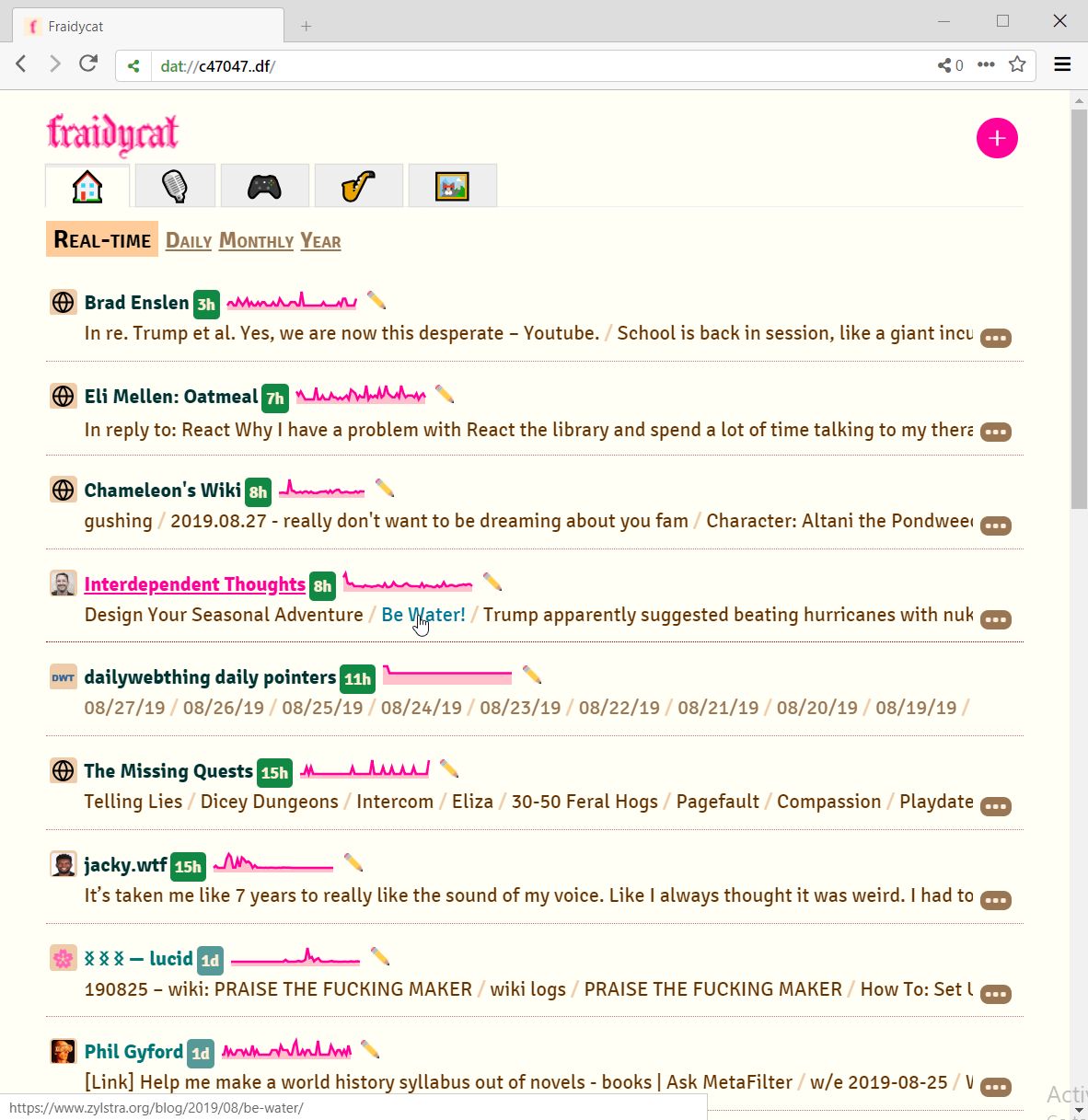
While it's true that RSS has died, I'm using it more than I ever did when Google Reader was around. Many people are using Feedbin or mobile RSS readers. I've been idly working on my own RSS reader that actually answers some of your concerns. It doesn't excerpt blogs, but just gives me an overview of what's happening out there: https://www.kickscondor.com/images/fraidycat-aug2019.jpg

My problem isn't a business issue - it's that I find news feeds chaotic and want to read blogs directly - with their design and layout, focusing on the writer directly, rather than amid a pile of distractions. (To me, even Google Reader had that problem.) But I think it's cool that our separate concerns are both answered if RSS is used for notification rather than for syndication. RSS notifies my reader tool and then I can see an overview of what's happening out there when I make time to read.

I don't think we've quite explored the possibilities that RSS opened for us.

I agree this could be the case. I would love for there to be a 'better way' for everyone to consume RSS feeds, just haven't seen them yet.
You're judging RSS adoption by the number of people who search google for "rss feed"? This seems incredibly wrong. What am I missing?
I mean, if you remove your feed, you probably lose me as a reader.
They explained that RSS traffic was minimal, and what there was couldn't be monetized, so they probably don't care.
Wouldn't lose me though. I don't use RSS, and never have.
"I belong to the common case" is not a very useful or interesting thing to point out without elaboration.
> Identical copies of my blog went up in several different locations, each with their own copy of ads from the scammers.

Tangent but: Does google have any official way to combat this?

It seems like an easy enough problem to solve. As the content-creator, you could submit your content first to some kind of registry, so that google could identify you as the true author. Does anything like this exist? If not, why not?

It seems like this could be open to abuse. Not all content-creators will register their content, so find some unregistered content to copy, and then register it yourself.
This is an old problem and the primary solution is to delay the content in your feeds/sitemaps by X number of minutes so that Google can spider the content on your website first while flagging the spam site as duplicate content. Another tip is to add a canonical link back to your article in the content of feed articles. e.g. rel="canonical"
> RSS traffic trickled down to almost nothing.

How do you meaure this? Since so many people uses online reader, it is very likely that one single request made to your server is in fact some online aggregator which may redistribute it to an unknown amount of readers...

Do rss aggregators report number of subscribers in the user agent? I know that several podcast aggregators do this.
When I looked at using RSS to follow a bunch of blogs, I figured that out "RSS with whole blogpost used by blogspammers".