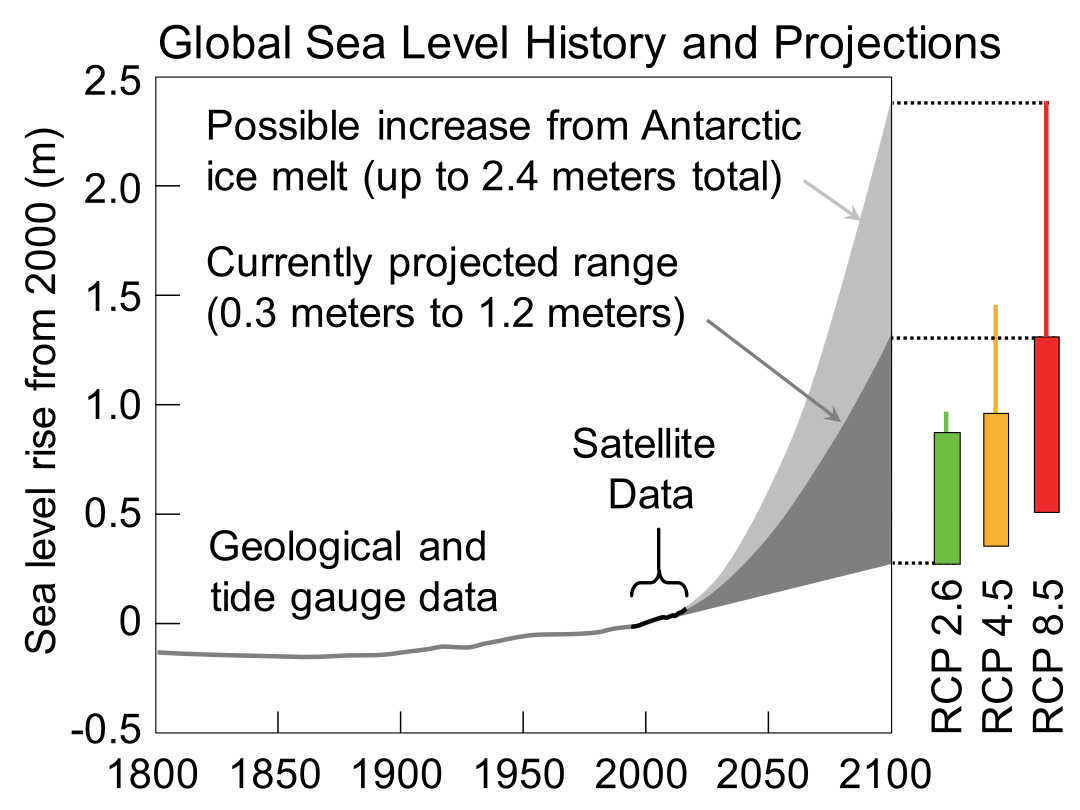
Because the IPCC didn't account for runaway positive feedback loops. So while the rise is slow, it is projected to increase exponentially as more of the Arctic melts: https://upload.wikimedia.org/wikipedia/commons/b/bc/Sea_Leve... which is from a 2017 NOAA study[1].
It's also worth noting that while 3.3mm a year seems low. That is the average, the sea level is not rising evenly across the world. To make this example a bit more real and close to home as HN is mostly US-centric. The current sea level rise is about ~8in/21cm[2], and Miami Beach is already flooding every year. This is because Miami Beach is experiencing almost a 1in of sea-level rise each year according to Hal Wanless, a coastal geologist at the University of Miami[3]. So using NOAA's own maps which show Miami Beach mostly underwater at 3ft we will hit that scenario in about 30 years at current rates[4], but once again sea level rise is not increasing linearly.
> [3] Throughout the record, they found that a combination of two naturally-occurring climate patterns—the El Niño Southern Oscillation (ENSO) and the North Atlantic Oscillation (NAO)—were associated with “hot spots” of sea level rise along the Eastern seaboard, including the southeastern hot spot from 2011 to 2015. (...) the Pacific Decadal Oscillation might also be playing a role.
> we will hit that scenario in about 30 years at current rates
What about all the unaccounted negative feedback loops? Like e.g. increased low lying cloud cover formation. A lot of these aren't taken into account by the IPCC either.
> Princeton University researchers have found that the climate models scientists use to project future conditions on our planet underestimate the cooling effect that clouds have on a daily — and even hourly — basis, particularly over land.
However, note that "the researchers found that inaccuracies in accounting for the diurnal, or daily, cloud cycle did not seem to invalidate climate projections, but they did increase the margin of error for a crucial tool scientists use to understand how climate change will affect us."
The links confirm that the clouds are the part of the models. Moreover, from the actual research paper, which compared the models with their data they collected about the DCC (differences during the day, which are less important than the averages) when we parse the text we find:
"the mean appears to be reliable"
"this model tuning does not seem to invalidate climate projections because of the limited DCC response to global warming"
"it may potentially increase the uncertainty"
So the paper can't claim more than weasel wording: "may potentially increase the uncertainty."
It's the averages that are important. It's good that there's the research, but at the moment it still seems it's about the details which don't invalidate anything. Especially it's nothing that can be called
> we will hit that scenario in about 30 years at current rates
Oscillation =/= Trend
https://xkcd.com/605/