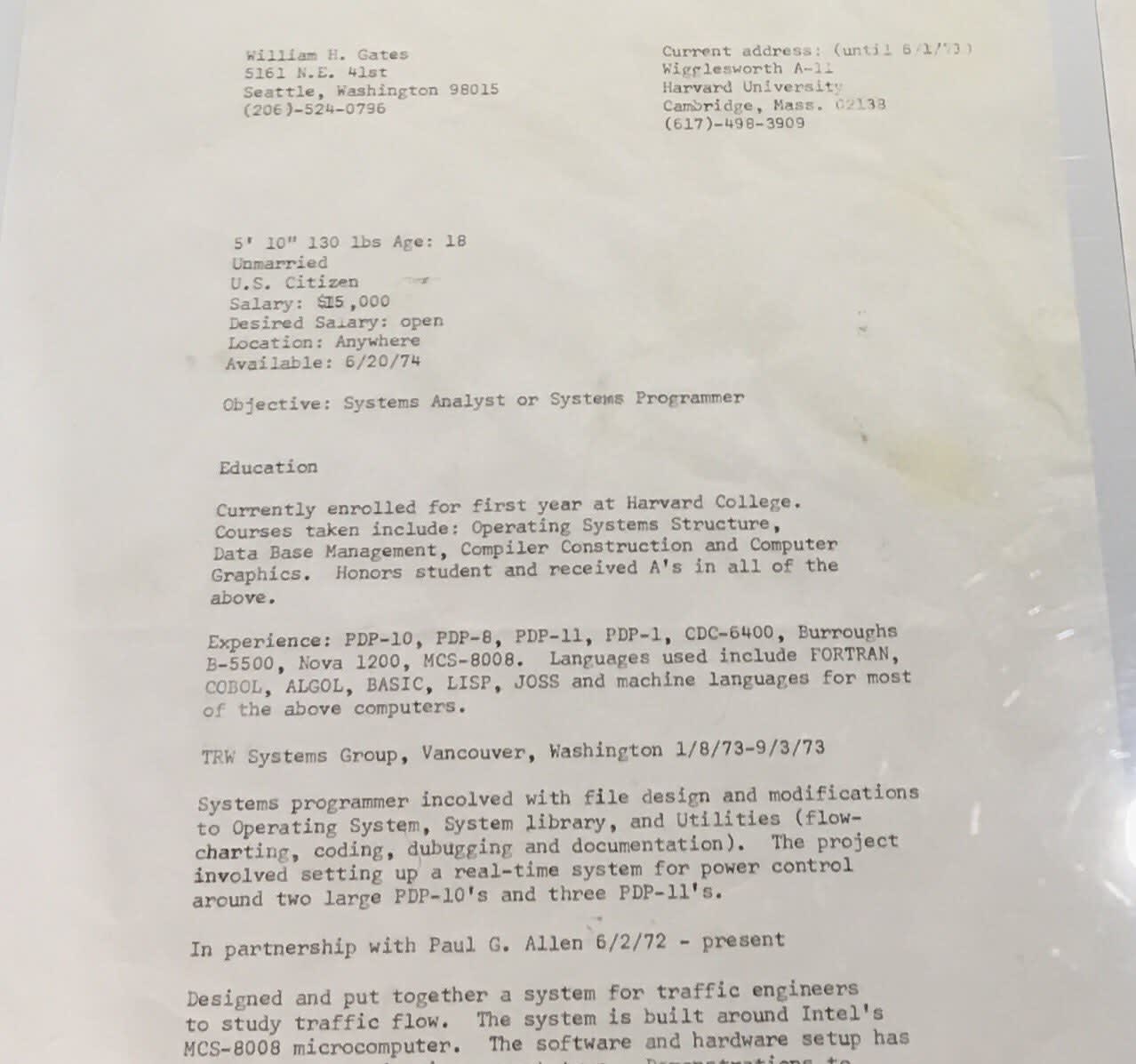
Pay attention to the $15K salary he wants- that's about $75K in today's money. Not much has changed,even though companies nowadays make many tons more money from the dev work...
If we're being pedantic, aside from "Harvard," it wouldn't have screamed much to most people in 1974: "What are all these acronyms, and what on earth is an 'operating system'?" This resume was written three years before anyone normal had access to a computer. I'm not even sure how many bank branches and travel agents had a terminal yet.
Interesting that you paid attention to his salary. What about his course work? What about the hardware and languages he knows? He was more skilled than the average developer today in his freshman year.
Oh,I've seen that part as well, however there were also some very good comments made by other users on that section.Bill was doing stuff on a computer since the childhood,so by the time he walked into the uni he already knew more than an average guy.
His developer chops were why he was making such bank at 18 years old. Still though, his salary is probably the most interesting takeaway from all of this (that, or the whole listing your height & weight thing).
As a data point, the University of Waterloo releases data about hourly earnings for students enrolled in the co-op program. The first co-op term for students in Mathematics (the faculty Computer Science is under) is typically taken after completing 2-3 semesters of schooling.
According to the data for students doing internships in the United States, the average first year Computer Science (or more accurate, first year Faculty of Mathematics) student is making
$30.57 USD an hour [0]. However, going to the States is typically a function of one's experience, and so this is more common in upper years.
If you take the average for work terms in Canada, the average first year (or more accurately, first year Faculty of Mathematics student) makes $18.84 CAD [1].
It's worth noting that Waterloo is probably the #1 undergraduate program (at least in North America) in terms of industry placement and co-op programs. Their students are heavily sought-after.
(This doesn't disqualify any of what you said; it's just worth pointing out for those who are unfamiliar with the program.)
I had a job paying that kind of money when I was in high school working on applications for a large internet provider.
The skills came from learning to program starting in the 5th grade.
So first year students don't make that kind of money but as a first year student you might have skills that were honed earlier which allows for that type of job.
A lot of first year cs students have under a year of experience and can only list python, Java and possibly C++ under proficiencies. What's more sad is when you try hiring at a job fair and 300 4th year / master's students also only have python/Java/C++ with no side projects.
Personally speaking, vast proficiency in any given language or languages doesn't mean that much to me. You'll pick up es6 or go or whatever else. I care about the thought processes behind development choices, their implications on computational efficiency. They teach this in school, at least in the schools I attended.
In fact, many professors were adamant they didn't care about languages at all other than someone grading it can read it. Some classes never wanted to see your source code. Most classes didn't have code at all!
Yep, that’s one of the biggest takeaways I got from observing my friends who got their education from known good CS programs vs. weak CS programs.
Those in good programs had classes that were focused on the actual subject matter (algorithms, OS, compilers, ML, etc.) with the language just being a tool, and in upper level classes, professors absolutely didn’t even care what language you used, as long as it got the job done (within reasonable limits, of course; no one likes grading BrainFuck code, even though some people attempted writing assignments in those as a joke).
Those in weaker programs, instead, had a “Java class”, “C class”, “javascript class”, etc.
$75,000 is a bottom ~15-20% software developer salary in the US today per the BLS figures.
Someone in his ability range today will earn twice that (Gates was clearly at least a top 25% programmer in his day, more likely solidly top 10%), or more depending on location. That's before factoring in the age & experience issues, which can throw that all over the place and would be hard to adjust for today vs 45 years ago.
And why not? A friend of mine called the local IT company enquiring about the position. He told them that he's got experience with x,y,z technologies and can do a,b,c.The guy from the company was so excited( it's a small town with a very limited pool of candidates) that he wanted to get him in for an interview. Before confirming the date, he asked my friend: what's your education? To which,my friend replied: I'll start 11th grade next year..The guy hung up...
Now it's personal pronouns and gender. Seeing more and more on resumes. I didn't ask if you were "genderqueer", don't care and it has nothing to do with our open front end dev position.
I was stating an observation about things people (voluntarily) currently put on resumes (not applications where things have actual questions/predetermined choices) that don't have anything to do with the job. To us, gender is irrelevant in terms of a job, just like height/weight/previous salary, which is what I was responding to. You seem to have a very loose definition of aggressive.
Back then they were quite overtly discriminatory about marriage status, gender, having children or not, disabilities, age, divorce. Indeed, apartment buildings often refused to rent to families with children.
In the 70's, people speaking against race discrimination were viewed as center left but people decrying discrimination on these other grounds were considered far left. Even on otherwise "progressive" period TV shows, these positions would be satirized (eg the characters played by Beatrice Arthur and Rob Reiner were satires much of the time. The Mary Tyler Moore character was originally written as a divorcee)
And though legislation had recently curtailed ethnicity and religion from being _publicly_ discriminated, it was still seen as ok to discriminate for public facing positions: Connie Chung's position as news reader was considered definite proof of media liberal bias. Indeed, advocating equality for public facing positions or for persons with disabilities was viewed as completely unrealistic.
Complexity of each one of those topics also increased a lot. Think about it, at that time a guy could just design the whole computer hardware, and write the software.
“Attractability” of a candidate was not limited to their skills. As in some parts of the world today we know that these things are largely orthogonal to performance at job. As rational and simple as that sounds today, back in the day knowing these details was equally rational and simple. We just find it difficult to get that point of view since we didn’t live in that time. This is the same as ageism today. “Young people are just smarter”. What do you think people will say on hacker news 30 years from now when they read that was the thinking of some of today’s tech leaders
It’s the same issue as gender or race discrimination. There are often differences in means, but because within group differences are an order of magnitude larger than between group differences, from the perspective of any two individuals trying to understand each other, group membership gives you no meaningful information.
Knowing the averages will actually make you worse at assessment.
I've seen that in action. An older dev was an absolute burden on a hack day moving at a snail's pace. But for long term architecture he always had super valuable "oh I didn't think of that" things to say.
He was so awesome to have on the team, at the cost of sometimes having to watch him crawl toward a few lines of code. Not a hard choice in my opinion.
Of course I've seen the whole spectrum. Useless old people. Useless young people. It's best to simply be a meritocracy.
True. But I do just the opposite. Even though they aren’t allowed to ask me if I am married, I go out of my way to mention off handedly that I am married. I want them to “discriminate” against me if they have the type of culture that expects people to work for 60 hours a week regularly.
In India, I remember submitting a passport size photograph with all the resumes I submitted during college/campus interviews. When I moved to US, I realized that was not a requirement.
And yet with the rise of software recruitment platforms this practice seems to be creeping in to the US. Linkedin and Hired for example both "nudge" you to add a photo. From Hired.com: "Adding a photo will help your profile get noticed and improve the likelihood that you receive more interview requests. (Optional)"
Even in countries where it was the norm (like Germany), this is not really true anymore. For tech positions or anything remotely close, the impact will be zero or even negative, don't do it.
FYI I worked for a largish UK recruitment company. A lot of CVs had photos. They made not a whit of difference to the recruiters. When the CV was entered onto the database, any images were stripped anyway. I imagine - though did not see - any especially hot chicks were noticed but I guarantee it did not change their chances of being placed. The recruiters just don't care.
As I understand it, resumes were more like a personal trading card with things like your hobbies and clubs you belonged to. As time went on it, it shed a lot of the details that wouldn't be of interest to employers. So maybe height & weight stuck around in a more standardized resume.
I don't know how much value there is in this kind of stuff, but I am an absolute sucker for this kind of history. Standard, utilitarian, even boring documents that miraculously survived all this time. Granted it's from one of the most famous programmers ever, but it's just so fascinating. Thanks for sharing.
Why is the punctuation so heavy? Would it be too delicate otherwise or is it just that the area is smaller so the pressure is higher when the key is struck?
The Seattle address listed in the upper left hand corner of his resume is in one of the nicest spots in one of the nicest neighborhoods in Seattle. Sweeping views of Lake Washington. From that house he could see the site where he lives now in Medina.
Nobody has written a modern, high quality, comprehensive biography of Gates. I'd recommend these three:
Hard Drive (1993), by James Wallace
Gates (1992), by Stephen Manes
Idea Man (2011), by Paul Allen
Idea Man is available for $5 on the Kindle right now and is an excellent read, however Gates is only a secondary major character for 1/3 of the book. It does cover the early days though. And Gates is available on the Kindle as well.
In Malcom Gladwell’s Outliers he has a section where he discusses Bill Gates’ early life and the lives of a few other software luminaries. Having read that it is not surprising at all to see him taking such advanced classes as only a freshman in college.
;)
Your mission, should you choose to accept it, is to develop a "manual" typewriter that warns the user that they are about to make a spelling mistake, possibly keeping the whole word in a buffer until they handle the warning. The warning itself can be performed via any means, including but not limited to an electrical zap.
At some point there used to be electric typewriters with a 1 or 2 line buffer that they'd show on a black and white LCD. I don't know whether they had a spellchecker, but it wouldn't be hard to add one.
You could correct errors using correction tape: basically pressed dry white-out atop the letter, assuming you lined it up correctly and pressed the same letter - you then type the correct letter. Of course for an important document like a resume you may want to retype the whole thing.
Also it wasn’t really a “printout” since you saw each letter as you typed it.
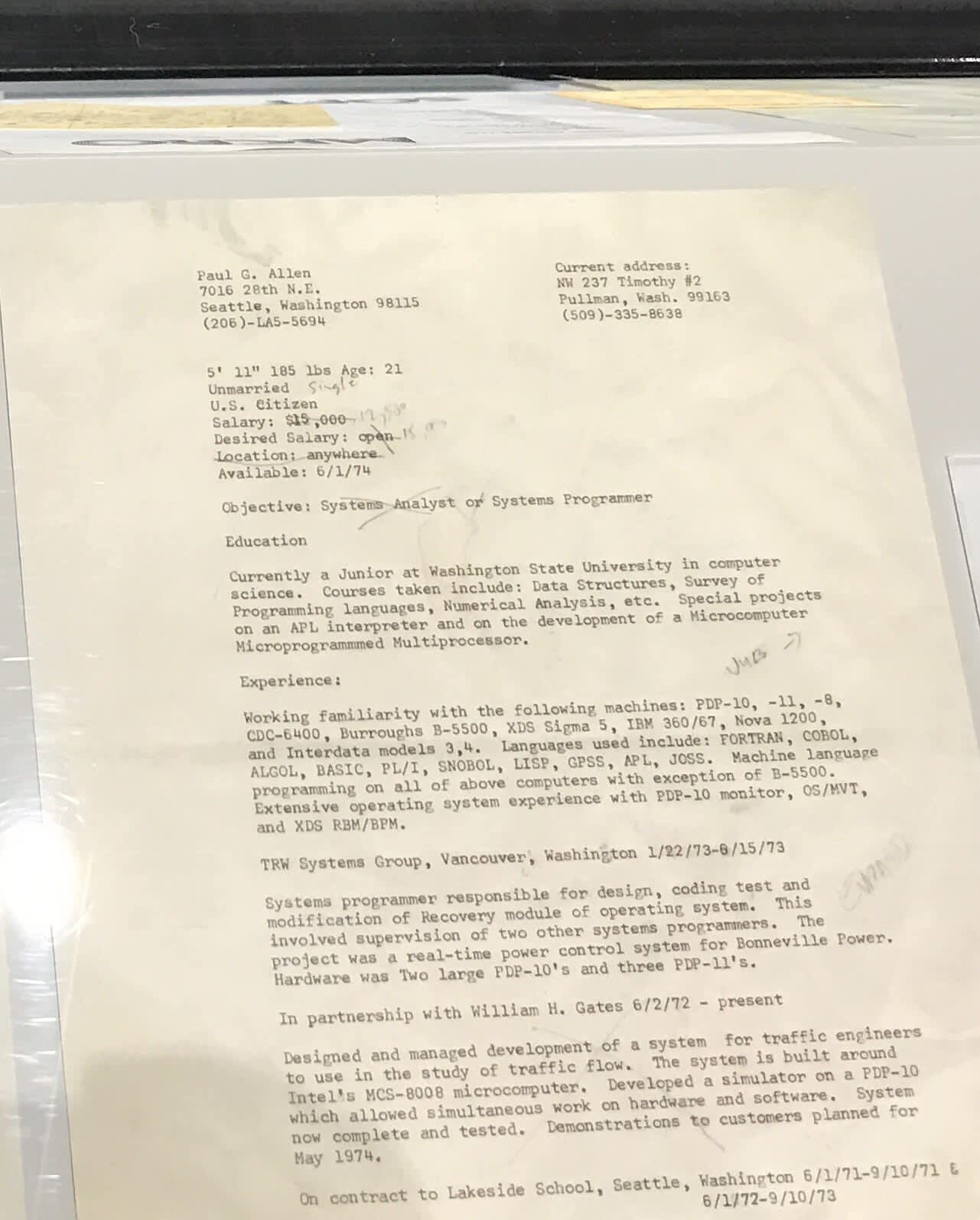
I'm amused that such a resume would be binned by many HR departments.
That is some HR depatments, are so bad at their job, that they will literally lose your company the chance to get a Bill-gates-caliber dev.
I mean obviously if he gets to the technical interview, an engineer can see that he is competent. But they question is would such a resume get past HR?
What do you mean? In 1974 this would have been a state-of-the-art resume. He typed it on a typewriter, and he's got loads of experience with computers. In 1974 thats really going to stand out.
this person is pulling out the old saw of "no mention of new sexy technologies like node graphql etc" about resume from a 1974 Harvard student. lol. newsflash those were all hot tech in 1974 and besides any year in the last 100 (including 2019) a Harvard student gets priority rather than binned.
> newsflash those were all hot tech in 1974 and besides any year in the last 100 (including 2019) a Harvard student gets priority rather than binned.
I'm european, so I don't really see that many harvard grads. But everythign being equal, why would I give a harvard grad priority over someone from L'X, ETH, mines, oxford, MIT..
- not mentioning highschool graduation year (But I suppose this could be hidden in the bottom)
Both these things, I've seen and heard HR employess toss CVs over in real life as well as from people talking online.
But I guess, I migh've been too biased in what I'm saying. since I'm european so there a different standards for resumes.
I've had an argument this week with the head of HR, because an employee threw the cv of a work student which had a Lüke ( a hole) in his resume. I guess I was overprojecting, which made my message too overexagerated. sorry.
"I'm throwing this CV away since our requirements clearly state PDP-9 experience and I don't see that mentioned anywhere. I'm also assuming this candidate is unable to learn anything new."
If you think it’s the company’s loss you are totally missing the point. Due to our economic system and incentives a LOT of companies have gotten “Bill Gates Caliber” people and it’s certainly not the HR or companies loss it’s the worlds and people living in its loss.