| Thiel's IMHO bizarre politics aside, I really agree with him on this particular subject. I have believed for quite some time that we entered a kind of minor dark age around the early-mid 1970s. Virtually everything we're doing now from spacecraft to AI to the Internet was invented before 1970. For some reason around that time we largely stopped making major advancements. There are a few exceptions (CRISPR/CAS9, graphene, Li-Ion batteries) but nothing since then compares to the insane rate of progress experienced in the 50s and 60s. We went from horse drawn carts to moon rockets and supersonic aircraft in 50 years with a great deal of the progress happening between 1940 and 1970. That's 30 years of a rate of innovation orders of magnitude beyond anything in human history. I am not certain of the cause. It's tempting to blame proximate things like the rise of neoliberalism, de-funding of basic research, or bureaucratization of science, but I wonder if the cause wasn't something deeper. It really seems to me that everything went off the rails around 1973. Take this graph for example: https://www.brookings.edu/wp-content/uploads/2017/09/thp_201... Right around 1973 is when the decline of the US middle class really started. The effect just didn't become really acute until after the 2008 super-recession. Here's a few of the ideas I've brainstormed: * Did the collapse of Bretton Woods (a.k.a. the Nixon Shock) break something about the fundamental incentive structure of the economy? * Was the generation that grew up on television less able to think innovatively? Did they start taking power around the early-mid 70s? * Did we get scared? Was the rate of progress during those years so fast that it caused some kind of deep subconscious "future shock" backlash that manifested in things like the luddite wing of the green movement or the rise of fundamentalist religion? * Energy got much more expensive after the oil shocks of the 70s and after US production of the really cheap easy oil peaked. Maybe rising energy costs cut margin from the economy? I'm open to suggestions. I really think "what happened in 1973?" is a historical mystery. |
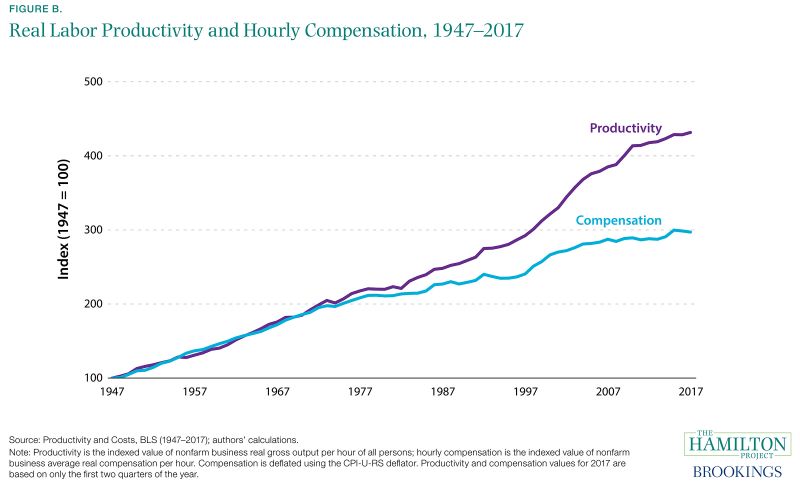
Why was the economy so great for median American workers between 1945 and the mid 1970s?
One factor was that the USA was the world's largest manufacturer and running an export surplus. It was relatively easy to run an export surplus and offer good working conditions to the rank-and-file because there was limited competition (self-imposed isolation from the world market economy by Communist states, various market economies still recovering from the war).
Some of the economically glorious post war Golden Age was also built on environmental debt. Businesses faced less regulation on environmental, health, and safety issues and correspondingly spent less on pollution control, worker protection, and compliance documentation. Just don't drink the water or be "unlucky" on the shop floor. Building a $10 million chemical plant in 1965 counts toward that year's economic growth even if it's going to become a $100 million Superfund site by 1985.
Another factor was that there was a huge prolonged bounty from basic and applied research that came out of the physics revolutions from before the war. Nuclear fission, quantum mechanics, and relativity were all known by the 1930s. By 1970 most of the low hanging application fruit had been plucked. There's still plenty of basic research to do, and we still find new applications over time, but we haven't had another physics revolution like QM that just pops out one delightful surprise after another.