Hacker News new | ask | show | jobs
by skrebbel 2533 days ago
Anyone with more insight into all of this than me who can explain why they went to fight on the Russian side? I mean, there surely were neo-nazis around on both sides of that conflict, right? Just different flavours? I wonder how you pick who to support if your core ideology is that "people different from us are bad".
8 comments

That would be a Hollywood version of the ideology. Right extreme groups are quite a tangled mess. Many of these groups in Europe are looking up to Russia (and Poland, and Hungary, and Serbia) right now. Those eastern european countries are perceived as the possible source for a European nationalist renaissance, as they display a strong stance against both european federalism and mass immigration. Obviously, that vision of Eastern European countries' politics is just as oversimplified as Hollywood's neonazism, but the war between Russia and Ukraine has been largely presented by western supporters as a war between nationalism and european blending.
I think those countries stance against liberal ideas like gender equality, lgbt right and so on as well as a rather authoritarian form of government at least in Russia and Hungary might make western European fascists a bit jealous as well.
Very jealous. Russia is simply considered the "good guy", standing up against the perceived oppression from globalism and European federalism.

The people of the EU often want to see ourselves as progressive, but we're a very diverse lot and there's a lot of people who would like to take a few steps back in regards to LGBT rights, Pan-Europeanism and multi-culturalism.

The actual popular support [or opposition] for whatever ideas [or against] are usually very different than what strongly consolidated power hierarchies show. (That is in countries where one party gained significant power, eg. in Hungary and Poland.)
Of course. EU citizens, on average, have very little information about what's happening in the eastern parts of Europe, no matter the subject, and since many people dis-trust mainstream media nowadays it's easy to spread one's own narrative and use that for one's own purposes, while ignoring the fact that such expressive freedom wouldn't be possible without the system that one is critizizing.
They didn‘t fight on the russian side. For some reason english media mistranslated original press release.

https://www.poliziadistato.it/articolo/225d2c47fb2c9ef299497... It says "avevano combattuto nella regione ucraina del Donbass contro gli indipendentisti". So they were fighting against separatists.

This does not seem to be correct, Forza Nuova seems indeed to be supporting the (Russian backed) separatists. According to the Wikipedia article (with sources) [0], the party used to be allied with neo-fascist Svoboda but switched sides during the Donbass conflict and is in return also backed by Russia.

[0] https://en.wikipedia.org/wiki/New_Force_(Italy)#Presence_out...

Official police report looks like much more reliable source than article in Wikipedia (especially an article about politic and such topics).
And even Google translate:

> The investigations had begun about a year ago when the police headquarters in Turin, coordinated by the Central Directorate of Prevention Police, had monitored some people linked to political movements of the ultra right and who had fought in the Ukrainian region of Donbass against the separatists.

Wouldn't one expect at least that as part of fact checking?

Edit: Damn, so perhaps the poliziadistato.it article got it wrong. At least, according to Wikipedia.[0]

> Forza Nuova leader Roberto Fiore was once closely allied with the Ukrainian far-right Svoboda party, but following the beginning of the War in Donbass, Forza Nuova and Fiore "made a considerable shift to the pro-Russian camp." According to the Political Capital Institute, a Hungarian think tank, Forza Nuova is one of a number of Russian-backed radical right political parties in Europe.

But the supporting cites are from 2014-2015, so who knows?

0) https://en.wikipedia.org/wiki/New_Force_(Italy)

Seriously, you prefer wikipedia over official police report?
Judging from the other comments, Wikipedia may be correct in this case. Although, as I noted, the cites are a few years old. So FN could have switched sides again.

Also, given that I don't know Italian, I don't really know what the police report said.

I'm coming to wonder whether it could be a typo in the Italian Police's report, that other media may have corrected. Pretty much all media have written that they fought ALONG the separatists. See French Le Monde and German Deutsche Welle right now, who agree that'd be PRO separatist.
Ars Technica needs to issue a correction to the story. Otherwise I'm going to lose considerable respect for them.

There's a fine line between making a genuine mistake and lying to your readers.

I think it's you who got it wrong. Some Googling shows that Forza Nuova is pro-Russia, possibly having switched from supporting Ukranian fascist groups in the past.

"Mr. Fiore, of Italy’s Forza Nuova, said Moscow is now the sole guardian of Western values, in the way Rome once was."

https://www.wsj.com/articles/far-right-flocks-to-russia-to-b...

I think if you point it out to them with a correct translation from the Italian police site they will correct it. Also, they're not the only one who made that mistake. The independent said the same thing. It would be interesting to know where the original mistranslation originated from.
I guess it came from the origin of the main suspect Fabio Del Bergiolo. He was was a candidate for Forza Nuova in 2010. FN is a pro-Kremlin far-right party.

- https://en.wikipedia.org/wiki/New_Force_(Italy)

It might be a typical American level of ignorance of geography and foreign politics. A wrong assumption of Ukrainian separatists in a Russian land is an obvious mistake to make.
> I'm going to lose considerable respect for them

Hahaha.. as if the bank account was that full to begin with

Can't "indipendentisti" mean in favor of Ukraine's independence to Russia?
More likely, Donbass "independence" from Ukraine.
Yeah! The Ukrainians had small but vocal numbers of fascist volunteers on _their_ side, and that got a lot of bad press and the Russian side went to great lengths to paint the whole of Ukraine as fascist. So its really surprising they'd have fascists going to the _Russian_ side.
Russia is selling itself as a counter to liberal, internationalist hegemony in the form of the EU. Ukraine wants to join the EU and is economically supported by the EU and broke away from Russia's political sphere over it, and the alt right hates the EU political project. This makes Russia and the European alt right natural allies.
Russia is funding and supporting several right-wing groups and parties in Europe.

The cooperation is based on mutual pursuit of more power.

I find it weird too, especially considering that Donbass and Luhansk declared themselves People's Soviets. I think it's just shoddy journalism and those people actually fought alongside Ukranian troops.
Doesn't mean anything really, especially as far-right extremists are not the brightest bulbs.

Slovak neonazis were fighting in Donbass on the side of Russians/separatistit, because that side invested heavily in propaganda (abroad, not only domestic) and presented itself as a front against anything modern and especially the EU (which is the incarnation of evil to them), so reactionary forces are naturally drawn to them.

I find it surprising that somebody still finds it surprising.

Neonazism was for all purposes Putin's de-facto state ideology for Russia since around 2005 or so.

The only fig leaf they have is the official denial of connection in between the skinheads and other neonazi groups and the state. That is only skin deep of course https://www.aljazeera.com/mritems/Images/2017/11/23/dbb8470a...

Putin is of course afraid of image taint and loosing personal access to the Western politicians if he were to dress like a nazi himself. So he keeps himself nominally distanced

The Soviet Union was always fundamentally fascist, and so is the current Russian government. Or at least, after the second 1917 revolution, when the gangsters took over. But now more openly kleptocratic.
https://www.theatlantic.com/ideas/archive/2018/08/russia-is-...

TLDR: Russia backs these groups to undermine Western societies. Nazis admire Putin because of shared disdain for democracy.

I wouldn’t want to associate with Nazis then, clearly they support supremacy, secrecy, and a criminal state. Democracy is associated with fairness, openness, and justice.

I would like to think that the US educational system inoculates everyone from those dreadful -isms.

People who feel shafted by society will reject its values. No amount of inoculation prevents that. The best way of prevention is to genuinely care for the rejected.
Then Nazism is truly tragic, for those that follow it are the most prone to rejecting others. It seems so trivial, and yet we fall short.
If it wasn't the far-right it would be anything else. It's just a geopolitical game.
How nihilistic, it seemed possible you would be willing to endorse and encourage greater ideals.
Italy's right wing movements have had a fondness for Russia for quite a few years now; Ukraine fascists are just not as famous as Russian ones, nor as powerful, so I guess it was an easy pick. An anti-EU stance might also have been a factor.
There are no* neo-nazis from the Ukrainian side, it's a Russian propaganda myth. Since WW2, they've been putting a "neo-nazi" label on anyone who thinks that Ukraine shouldn't be a part of Russia.

* I mean that ocurrence of neo-nazis is approximately the same as in any normal country. You can never say there are no neo-nazis in any particular group of people, of course.

Yeah, good example of "post-truth" world. Russia is rich and large and influential enough to influence even BBC. In fact, the ideology that drives the Russian side of the conflict indeed has something to do with nazism, while Ukrainians are just protecting their own country. Ukrainians don't fight on non-Ukrainian soil, while Russians do fight on Ukrainian soil.

Today, both president and prime minister of Ukraine are Jewish both by ethnic origin and by religion, by the way.

I sympathize with the tendency to have polarized views when deeply involved in a conflict, especially an armed one. But for the record, this BBC article does not have the common hallmarks of a viewpoint pushed and purchased by the Kremlin, or a post-truth world. On the contrary.

For the large part it comes across as balanced and informed IMO, and your sweeping dismissal does not answer the factual issues it raises, particularly the role of the Azov Battalion and the Patriot of Ukraine organisation, "which considers Jews and other minorities "sub-human" and calls for a white, Christian crusade against them, it sports three Nazi symbols".

In my opinion, this piece on atlanticcouncil.org sorts out the misconceptions: there is in Ukraine no more support for extreme-right or neo-nazi organizations than other European countries (which however is on an alarmingly upward trajectory). However, "More ominously, Ukraine’s far-right, para-military formations and their penchant for vigilantism remain a problem that must be more vigorously countered by the state and their sources of funding investigated thoroughly." [0]

It is really necessary get a grasp of the whole picture.

[0] https://www.atlanticcouncil.org/blogs/ukrainealert/ukraine-a...

The problem with the article is that it's balanced between fake propaganda and truth, which makes it unbalanced relatively to pure truth.
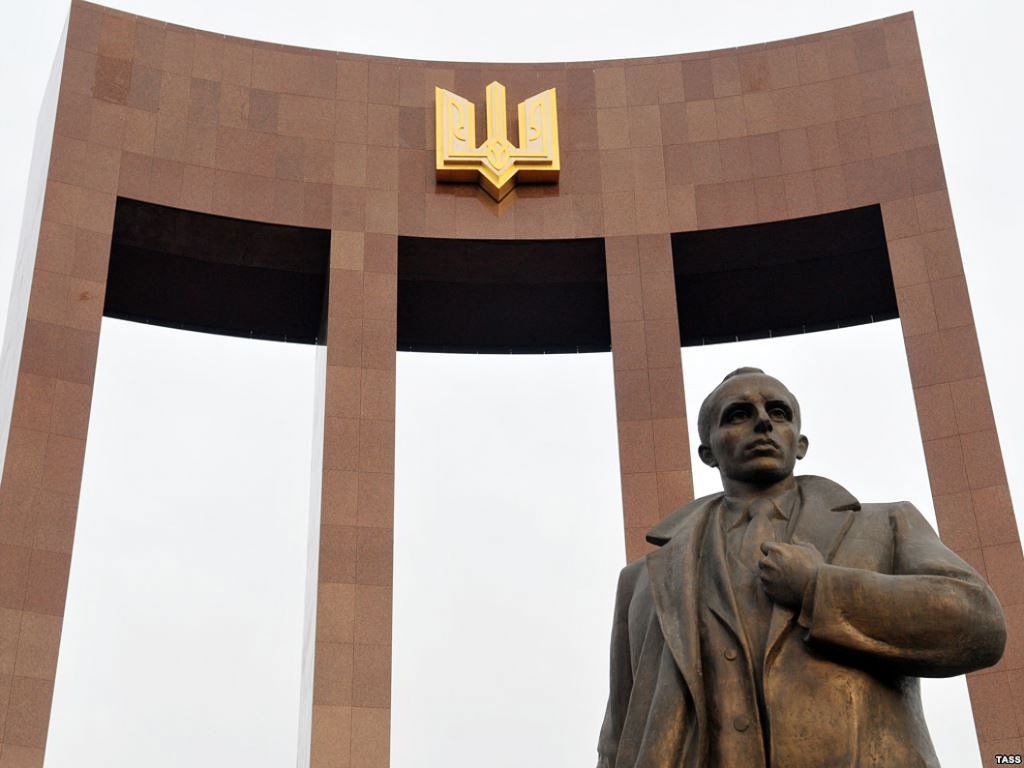
During WW2, there were two opposing camps in Ukrainian forces: Andriy Melnyk (https://en.wikipedia.org/wiki/Andriy_Atanasovych_Melnyk) who wanted to cooperate with Germans, and Stepan Bandera who opposed that (and actually spent almost all of WW2 as a concentration camp prisoner). Melnyk was much less popular back then, and today there is no glorification of him either. We honor Bandera who fought against both Nazis and Soviets. Of course, Russian propaganda can't stand the latter part, and tries to defame his memory as much as possible.
Of course this isn't true - Bandera plainly did not oppose cooperation with the Germans - he cooperated with them very enthusiastically, both before and after his arrest. And he did not spend "almost all of WW2" in concentration camps.

https://en.wikipedia.org/wiki/File:UNRA_sl.jpg