Hacker News new | ask | show | jobs
by pas 2524 days ago
Yes and no. After all, there are millions of people in deep poverty in the US. And at least a fraction of them has serious constraints on what they can do to get out of there (for example they have family, so they can't just pack up and go to a different state to start a new life).

Student loan cannot be written down in a personal bankruptcy process.

Many people have insufficient money for medication.

... and so on, so they dip their toes into crime, just selling weed at first, or laundering money, and then naturally they either get greedy, or get pressured into taking more risk, or simply get caught. (or maybe some successfully get out.)

and then there are people fleeing from very rough places (drug cartel warzones, etc.) and they usually don't have much more than their name, so they can try to do whatever makes some money.

Do circumstances make theft right? No. Of course not. But sitting idly while people are starving is also a form of wrong, which quickly turns this into a hard pragmatic question with only grey answers.

2 comments

> there are millions of people in deep poverty in the US.

Sure, but "deep poverty" today is what "middle class" life used to be for their grandparents or great-grandparents and normal student life is like for most college students. Having to cook from scratch rather than eating out every day, or maybe even only having meat a few times a week. Having to go to a laundromat rather than having your own washing machine, and riding public transit or a bike/motorbike with rudimentary knowledge on how to fix it.

These are hardships only when compared to extremely lofty standards of living - and if that makes you become a career criminal, it is hard to have sympathy.

I think this is inaccurate and you need citations to justify the idea that those in deep poverty are better off then they were 25, 50, 100 years ago.

Health outcomes, (obesity, nutrition, drug addiction ) could easily be worse.

Security outcomes, (violent crime, domestic violence, police violence) could easily be worse.

Economic outcomes (job security, lifetime earning expectations, minimum wage) could easily be worse.

Social outcomes ( close friends, community ties, connection to close family memebers) could easily be worse.

Remember that looking at averages is misleading if the distribution is changing around a constant mean.

Further, the idea that crime is an economic choice, and not a socially determined choice is highly suspect. For instance, street level drug dealers make very little money [1], the average US bank robber steals ~$4,000 [2]. Crime is rarely a "rational decision" it's made in a socially constructed context.

[1] https://www.prisonpolicy.org/scans/sp/5049.pdf [2] https://www.usnews.com/news/articles/2012/06/11/what-you-sho...

There is no way that Health and Security outcomes are worse today than maybe 50 years ago. The crime rate has fallen dramatically since the 90s, and health outcomes are dramatically improved between advancement of medical tech and generally improved care.

Do we have an obesity problem? Sure, that's kind of a self caused issue. You could blame our food being too cheap, but the alternative is starving to death which is far less in your realm of control.

Minimum wage is at its highest in direct value, luxury goods are at their cheapest. Now instead of writing a letter or traveling significant distances, you can chat with your friends all damned day.

Is life hard and imperfect? Of course it is, but to suggest that somehow life is harder now than in the past 25 or 50 or 500 years is absolutely foolish.

So it should be easy for you to find sources.

Life Expectancy in the US is going down [1]. That's happening as many people are living longer than ever. The difference comes from plummeting life expectancies at the bottom.

Real minimum wages peaked in the 1980's [2]

Calling obesity "self caused" is unreasonable. Access to food, particularly for poor people is very different today than at any time in the past, Malnutrition is totally possible alongside sufficient caloric intake.

Why is the cost of "luxury goods" relevant to anything?

[1] https://edition.cnn.com/2017/12/21/health/us-life-expectancy...

[2] https://www.visualcapitalist.com/visualizing-real-value-u-s-...

Life expectancy in the US has dropped by about 4 months in the last 3 years. In the last 40 years it has increased over 8 years. https://data.worldbank.org/indicator/SP.DYN.LE00.IN?location...

Remember that real wage is a deflection based on cost, but the cost of living is absolutely localized whereas the minimum wage is federal unless overridden by the state. Therefore as an average that might be true, but is generally incorrect for any given actual datapoint. Just because minimum wage is garbage in Mountain View doesn't mean it's not perfectly fine in Ohio. https://saylordotorg.github.io/text_microeconomics-theory-th... https://www.expatistan.com/cost-of-living/index/north-americ...

Obesity is absolutely self caused unless you're on a feeding tube. You can get 2400 cals a day for about $4 from McDonalds - don't even need to cook. Yes, your fresh organic vegetables that had to be trucked in from halfway across the US costs more than a bag of processed corn chips that can sit on a shelf for 2 years. You can still eat very healthy for very little money.

The cost of luxury goods is relevant because things like laptop computers, the internet, cellphones, cars, and so on are considered luxury goods. And hey, it turns out it's pretty hard to get a job if you can't email, and it's hard to be connected if you don't have a phone. You can get a functional phone for $20 and a plan for about $15 or less a month - something mind boggling compared to a few decades ago, not to mention more portable than a telegraph or a landline.

Again, you're looking at the average life expectancy, but we're talking about the poor, not everyone.

CoL in NYC/SF has almost no effect on the overall price index, it's much more representative of middle america.

Completely missed my point about someone being malnourished because they get all of their calories from Mickey D's.

You'd be surprised how many poor people continue to have low access to email and find jobs by physically walking into retail stores to apply.

>> Having to cook from scratch rather than eating out every day, or maybe even only having meat a few times a week. Riding public transit

In another Hacker News article, these would all be things we should be striving for

Unfortunately humans care more about their relative wealth than their absolute wealth. So telling them that objectively their life isn't all that bad is not very effective when they see their neighbors having a lot more wealth.
Scarcity means that relative wealth _is_ absolute wealth because we need to compete for resources. Falling too far behind other members of society means not being able to compete for resources successfully. Focusing on relative wealth is perfectly rational.
Exactly, when prices are set by what the market will pay then being surrounded by people who are able to pay more for a product will drive that price up and out of your relative reach.

Also, never understatement status-seeking when it comes to motivations for crime, even if your current conditions would have been considered high status 100 years ago, if you are seeking social/sexual relationships you are only going to be judged by your relative status today.

This relative status-seeking is why even rich people will still risk their positions and jail over felonies that will only make them 5% richer.

Or, you know, unable to afford rent in places where there are jobs, so being forced to live in a car near the Amazon warehouse. Lofty standards indeed.
You clearly have zero understanding or empathy for what living in deep poverty actually entails.
To be fair, the poster he replied to doesn't either. The only people living in deep poverty in the US are actively avoiding the help that is available to them. It has been argued that the poor in the US have it worse than the poor in Europe, but in neither case are they are in deep poverty.
Three million people in the US were living on less than $1.90 a day in 2013, and five million on less than $4.

https://www.nytimes.com/2018/01/24/opinion/poverty-united-st...

Extreme poverty in the US is real: https://www.al.com/news/2017/12/un_poverty_official_touring_...

I'm skeptical of the $1.90 a day number. Those people would be dead. You literally cannot buy enough food to eat with that much money. Since we generally don't see millions of people dying of starvation in the U.S., some part of the equation must be missing.
Actively avoiding? What do you mean by this?

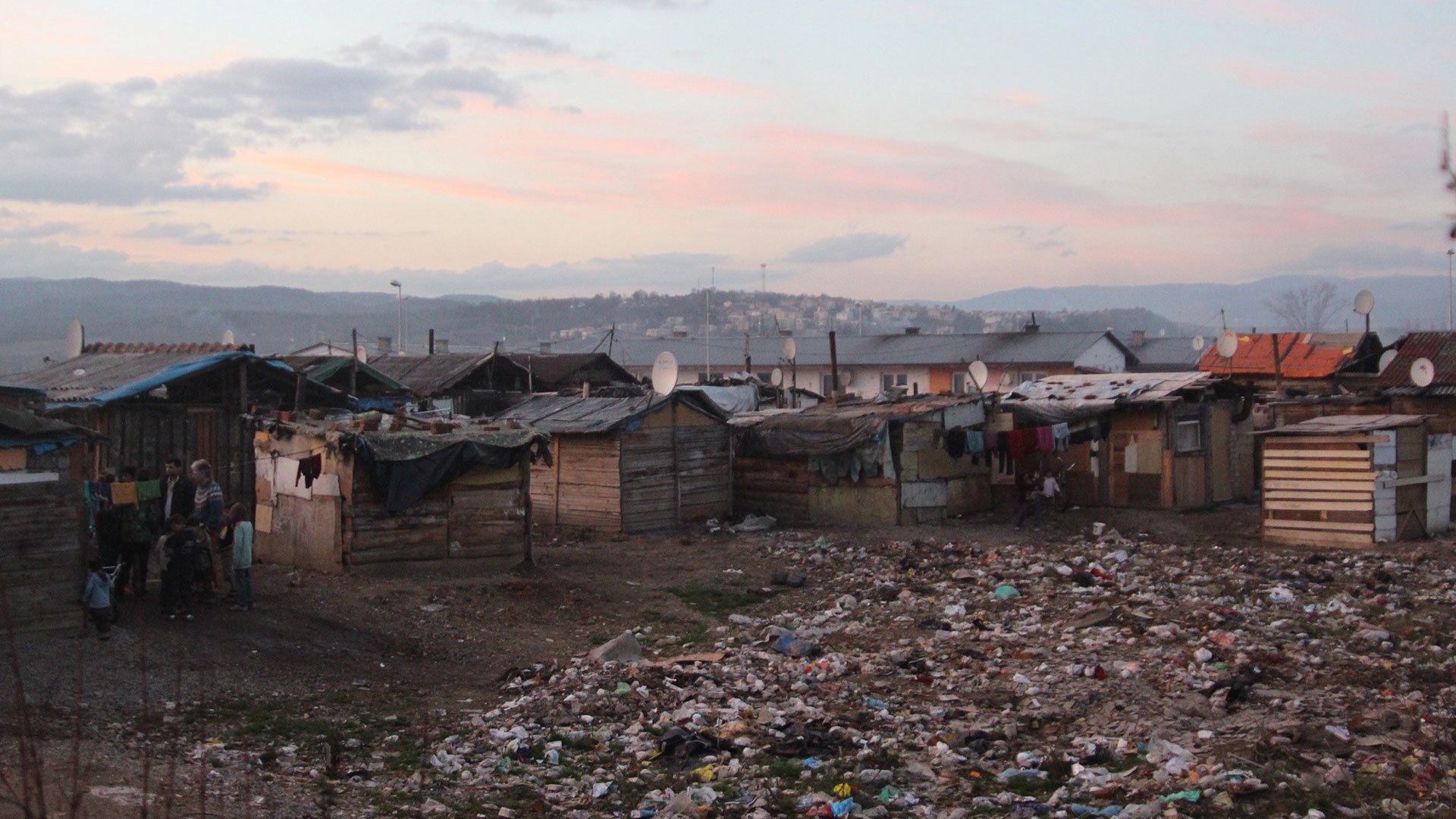
Neither are in deep poverty? I happen to live in Hungary, and well, see for yourself:

https://budapestbeacon.com/wp-content/uploads/2017/10/one-qu...

https://cronkitenews.azpbs.org/buffett/hungary/img/single/ma... (this is from Slovakia)

> Student loan cannot be written down in a personal bankruptcy process. Many people have insufficient money for medication.

Your typical street criminal isn’t sad about student loans, nor are they stealing to buy medicine. They are victims of a culture, not circumstance.

> but sitting idly while people are starving is also a form of wrong

In the United States, find me one person that has starved to death in the past year. Not only are there food stamp programs, but many churches and charities all over the country have some sort of food program. You would have to be supremely incompetent if you are literally starving to death in the United States. It’s so extremely rare as to be a news story if it happens. Poor people in the US are more likely to be obese than starving.

Culture has an enormous influence on circumstances. Naturally, a culture where people look after each other, where people are sincere and ask and receive help and make do with very little will have just few instances of those circumstances.

That's why crime is usually modelled as an infection.

> starving

I haven't said 'to death'.