Now, this doesn't directly translate to higher taxes on the wealthy (there are a lot of factors that go into effective tax rate) but it puts the handwringing around AOC's 70% top tax bracket in perspective.
Taxes never were that high in reality, so we can't draw any conclusions on what such a high tax would actually do.
People may have this fantasy about rich people that they're just hoarding money like a dragon hoards gold. In reality, rich people invest their money, which the government wants them to do, so they don't tax investments (capital gains) that highly.
It's always been fascinating to me that "things that poor people spend most of their money on" is subject to a sales tax but "things rich people spend most of their money on" isn't.
Services from beauty shops, car repair, home maintenance and repair? Taxed. Services from lawyers and accountants? Not taxed.
Buying a TV, food, gasoline? Taxed. Buying a piece of land or stocks? Not taxed.
Sure, but why does he need to wait for everyone else to support it? He should set a positive example by dumping his own money into the treasury first. After all, he really does believe in this and it's not just virtue-signaling.
What is your take on the reasoning he put in the article on why he doesn't "just" do that?
> Two decades ago I turned full-time to philanthropy and threw myself into supporting public education, scientific and medical research, and visual and performing arts, believing it was my responsibility to give back some of what had so generously been given to me. But I’ve come to realize that no amount of philanthropic commitment will compensate for the deep inequities preventing most Americans — the factory workers and farmers, entrepreneurs and electricians, teachers, nurses and small-business owners — from the basic prosperity we call the American dream.
That's not a reason why he can't do it, he's just saying that other people will need to do it too. I completely agree with him on that, he certainly can't do it alone. However, I think that he should set an example without waiting for others to join him.
It's a funny and forgotten relic. Many countries had similar schemes from around the same era.
There was a fashion to bequeath part of your estate to the government "to pay down the national debt". It was thought the patriotic thing to do. Obviously little impact was made on national debts. :)
I've thought a lot about that option, but the problem is that wealth provides a disproportionate amount of influence in politics.
If all the people who didn't want to give any of it up hoarded it and spent it lobbying to keep inequality at a maximum and the people who wanted equality gave the majority of their wealth away then we would very quickly find ourselves in a dystopian nightmare.
It has to be everyone, equally. It has to by a systemic change.
Money at that level is power, and giving it up means letting people with similar wealth have more power over you. People don't generally unilaterally disarm.
I was really glad to find the Washington Post publish this. Perhaps it will wake up some people to the questionable promises that certain Democrats are espousing currently.
(The wording of this comment was edited to cause less offense)
Can you clarify why you believe this is a "virtue signal?" You're the second person in this thread to do so.
My understanding of "virtue signal" means promoting "virtue" over "action." And yet:
> Two decades ago I turned full-time to philanthropy and threw myself into supporting public education, scientific and medical research, and visual and performing arts, believing it was my responsibility to give back some of what had so generously been given to me.
In the article he's saying this isn't enough. So, why use the term "virtue signal?" Are you arguing that he's doing nothing about the issue but writing a blog post?
Can we add virtue signaling signaling to the lexicon? A keyword (along with a host of others like SJW, etc) to say "ignore the topic and the messenger, it's too lefty to discuss".
I think you're getting downvoted for using a term like "virtue signal" to describe someone who devotes themselves full-time to philanthropy, and then diverging into a political flame-bait comment about "democrat scam."
If you were a military commander and someone proposed attacking an opposing force with a unified front, would your answer be "You're welcome to go out there and attack them yourself if you want to"?
The point is to enact tax policy that applies to everyone, so that the sum total of the changes can actually make an impact. Saying "well people can always donate to the treasury" is a ridiculous way of dismissing it.
I'd actually love to see politicians who voted for overseas wars visit the war zone (though I know it's impractical).
The point is that nobody will take you seriously until you show some concrete action. It's easy to claim that you'll give your money willingly, if you know that it's extremely unlikely to happen.
I think people are taking this question in bad faith, which I understand, because I can see it come off as you essentially saying "if he wants to pay more, maybe he should voluntarily," which isn't at all in the spirit of the article. He CAN pay more, and he does donate to charity - his entire article though is about how the ultra wealthy are getting away with far too much, and society needs to step in. Non-voluntarily.
In any case, to answer your question: No, the IRS doesn't prohibit it, and as far as I can tell it's not illegal.
> Taxpayers who overpaid their taxes can file for a refund. Taxpayers must file a claim for a credit or refund by the later of these two dates: Three years from the date they filed their original return. Two years from the date they paid the tax.
I guess if you overpaid, didn't file for a refund, and waited 3 years, the money would just vanish.
The problem is it'd vanish into a black hole - no congressional committee has budgeted for that "extra" money to suddenly appear, there's not really any accountability for it like you'd have for charity.
A higher tax rate means that economists can much more confidently say "this is how much money the US government will have for spending in 2020" than guessing how much ultra-wealthy will pay, and then not request refund on.
Yeah that's my thought. 'Why don't you personally go do that and get back to us' in response to argument for collective action is a bad faith response.
>Why don't you personally go do that and get back to us
So, he did that. He works full time as a philanthropist, then came back to us with this blog post and said "I alone can't fix this, we need collective action, in the form of higher taxes on the rich."
The typical argument made by fiscal conservatives is "the philanthropists will remove the need of the welfare state." This rich philanthropist is writing this article to say "that is incorrect, it isn't enough."
It doesn't just vanish, it reduces inflation which allows more money to be spent by congress. It would only be able to "vanish" if you were paying your taxes with a non-fiat currency.
I've read the IRS just returns the money, but you can donate to the government. But the argument is that charity does not make up for the negatives of low taxes. Also, the Broads are noted philanthropists, and they have committed to giving away 75% of their wealth.
No, don't believe so (I mean, I could probably reject my income tax refunds too). But I think what they're arguing here is that as a class they feel they should pay more.
While one billionaire paying extra for the Greater Good would be fine in isolation, how effective would that be in the big picture?
You are presenting a false dichotomy. Eli could dump his money into the US government and advocate for increased taxes for the rich. In fact, if he did that then he would be arguing from an even stronger position since it's obvious that he actually believes what he is saying and he's not just virtue-signaling.
you're assuming a dichotomy was presented. Again, what does one person putting forth extra of their funds do in the big picture?
Concerns of virtue signaling? The ramifications of what he is proposing is that if he gets his wish, he (and others like him) have their taxes go up. He's coming out in support of policies already being discussed (and attempting to persuade other politicians to also champion those policies). This isn't changing one's profile picture in support of the cause of the moment.
You can make donations to the treasury. People can always raise their own taxes. The title is supposed to be: "I'm in the 1%, please raise other people's taxes."
>In recent years, the term has been more commonly used within groups to criticize those who are seen to value the expression of virtue over action.
This man appears to be taking action, and advocating action.
> Two decades ago I turned full-time to philanthropy and threw myself into supporting public education, scientific and medical research, and visual and performing arts, believing it was my responsibility to give back some of what had so generously been given to me. But I’ve come to realize that no amount of philanthropic commitment will compensate for the deep inequities preventing most Americans — the factory workers and farmers, entrepreneurs and electricians, teachers, nurses and small-business owners — from the basic prosperity we call the American dream.
Lately, I find myself in discussions with people using the term to mock anybody that demonstrates care for liberal cause. I'm happy to acknowledge the transformation of the term "virtue signalling" to mean "supporting liberal causes," if that's what you want the term to mean in your post. Of course, I'd abandon any presumptive negative associations with the action of "virtue signalling," then.
Which man we talking about here? Anyhow, my point is that nothing prevents Citizen X to send more money to the IRS. They talk about it and will "do it only if others do it" but like I said they are only using words rather than actions.
The author, Eli Broad. He's not just using words, he devotes himself "full-time" to philanthropy.
This is my confusion - everyone's saying "why doesn't HE do anything about it?" He is, is he not? And he wrote this article because he's " come to realize that no amount of philanthropic commitment will compensate for the deep inequities preventing most Americans — the factory workers and farmers, entrepreneurs and electricians, teachers, nurses and small-business owners — from the basic prosperity we call the American dream." So what gives?
If you took the total combined wealth of the wealthiest 100 Americans, you wouldn't be able to fund the federal government for more than half a year or so.
Taxing the rich sounds nice as virtuous political rhetoric but it won't effectively address poverty, just further erodes the liberty of private citizens. If you want to fund more social programs then tax corporations, like the oil companies and the large investment firms, like ExxonMobil and Goldman Sachs. Don't punish success.
> just further erodes the liberty of private citizens
How does taxation do this? Taxation is a mechanism for funding the maintenance of an ordered society which enables extreme wealth creation. It's the wealthiest citizens who benefit the most from law enforcement, infrastructure, and national defence.
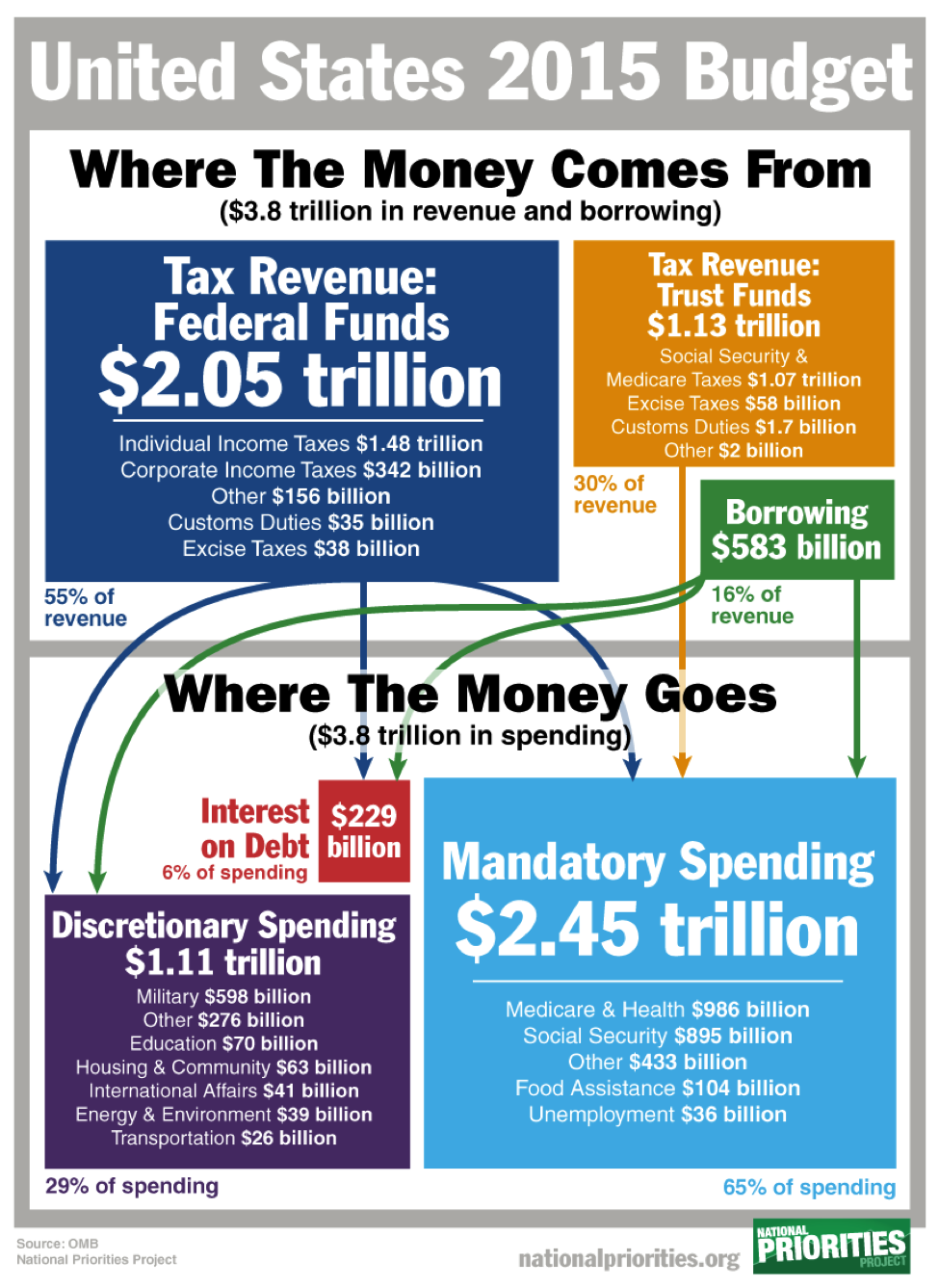
Yes, because the amount the US spends on welfare is a smaller fraction of the whole budget. For example, the US spends around ~$100 billion on food assistance [1]. Wikipedia estimates that all non-medical poverty assistance accounts for around $400 billion of the US budget [2]. Increasing expenditure by 10-20% (or even 5%) will almost certainly have a noticeable effect on poverty.
You do realize that the top 1% is more than just the wealthiest 100 Americans, right? And you do realize that nobody's saying "reduce everybody else's taxes to zero", right?
Senator Warren's plan would affect about 83,620 people[1].
I'm not saying you're point isn't valid, but your reference to the wealthiest 100 Americans is relatively meaningless to any discussion being had here.
Also, the federal budget is composed of so many things[2], saying that taxing high wealth individuals couldn't affect it is a bit disingenuous. The bottom line is that if you have more money in the pool (either by raising revenue or cutting expenses), you can pay for more new projects. Taxing these people could add millions of dollars to that pool. I'm not trying to say that's good or bad. It's a zero sum game here, either the individuals spend it on the projects of their choice, or the government gets it and spends it the way they want.
Just because it's not literally applicable doesn't mean it's meaningless, it emphasizes an important point that people overlook. The amount of wealth held by the top 80K is a drop in the bucket when compared to the total revenue of the federal government.
The greatest effect of this policy is that it will harm individual liberty. It will have nearly no effect on improving poverty or increasing social programs.
But it's not. 45% of the federal government's income comes from individual taxes.
In 2016, the US took in about 1,442,385,000,000 total of which 839,898,000,000 was from the top 5% of individual earners. That's OVER HALF of the total amount[1].
You're wrong. You're point is not valid or based in the actual data. To say that hundreds of millions or billions of dollars in extra revenue couldn't help fund social programs or improve the conditions of the impoverished is factually inaccurate.
> I never claimed the top 1% is just the top 100 wealthiest Americans.
But in a response to an article about the top 1%, you used the top 100 wealthiest Americans as a counterpoint. If you're not trying to make a connection, why bother with the analogy?
I never brought up the top 1% and the top 1% has nothing to do with the wealth tax. The wealth tax will apply to all Americans with assets over $50 million, which is roughly ~80K people, or 0.02% of the population.
You could fund the entire federal government for half a year with the wealth of only the top 100 people in the US? That's mind-blowing, and makes me way more optimistic about the practical effect of taxes on extreme wealth than I have been.
But why raise income or wealth taxes when you can raise land value taxes or carbon/pollution taxes instead? My income does not harm anyone else, nor does being wealthy. But my hoarding of land does exclude land from others. My release of carbon / pollution into the atmosphere even more obviously harms other people. I think we're doing a huge disservice taxing the wrong things, when there are things that are useful to tax (apart from the government revenue).
This is why I think we should lower (or remove) income taxes -- because we could raise the same amount in more useful ways. I think there are also economic reasons to believe income taxes make the labor market less efficient. If your goal is to tackle inequality, why insist on doing it in a sub-optimal way? It absolutely matters not just how much you tax and who you tax, but also what you're taxing (and therefore discouraging). Let's start with some revenue-neutral changes to the tax structure. We might see both a stronger economy and less pollution because of it, for free.
Given the current state of AGW and Climate Change, taxing babies beyond replacement rate (2.1) is not a bad idea.
I mean it's political suicide, but I don't see anything morally wrong with it.
After all, we already subsidize babies with our taxing scheme. So you wouldn't even need to tax babies. You would just cut off the subsidy after 2 kids.
If we incentivize those who are childless and have shrunk their carbon foot print, that would also encourage people to make thoughtful decisions about baby making. Example: If someone didn’t have any children at all, then they should get tax free status or reduced premiums etc.
A woman increases her carbon foot print 10-20 times with every child. Medical costs and food and transport and pretty much everything is borne by the rest of us. Suspend benefits. Tax excess children and give tax breaks or retirement benefits to those who didn’t have children.
I suspect that retirement benefits would be a better incentive than tax free status. Most people hope that children would take care of them when they get older. It’s not worth the true cost of over population.
Exactly, and that is why it's such an abysmal idea. Wealth is capital and how capital is allocated to a large extent how fast an economy will grow. To take private capital, which presumably was invested where it could find the greatest risk adjusted return, and move it to another enterprise (presumably a darling of some vested interest) or worse to consumption leaves the overall economy worse off.
Taxing income, which is a flow rather than a stock, has distorts incentives on the economy as well but much more gently.
My comment still applies. Most wealth is invested. Investing is a good thing; it allows long-term thinking. Taxing investment, like taxing income, has a negative effect.
Reminder that during the time generally pointed to as 'the good old days' (the 1950s) the top tax bracket was 85% (!): https://web.stanford.edu/class/polisci120a/immigration/Feder...
Now, this doesn't directly translate to higher taxes on the wealthy (there are a lot of factors that go into effective tax rate) but it puts the handwringing around AOC's 70% top tax bracket in perspective.