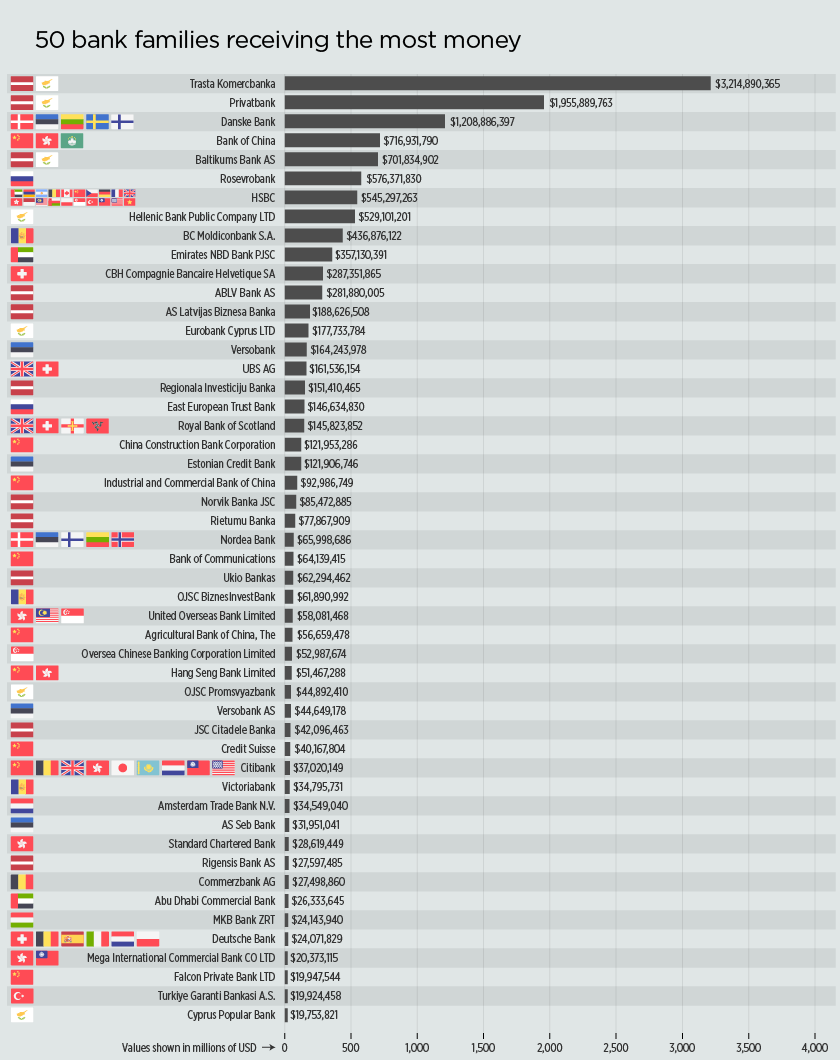
I’m not certain as to the original post’s implication, but the multi-billion-dollar Russian “Laundromat” schemes that have come to light over the past few years fed through Baltic banks, including at least one in Lithuania. I’d think, though, that since these came to light there would be added scrutiny and it wouldn’t be an ideal place for further nefarious activity.
> through Baltic banks, including at least one in Lithuania
Just to clarify: The Russian Laundromat mostly relied on the banks from Latvia and Estonia[1], the two EU countries with the largest Russian population. The only banks which participated in the scheme from Lithuania – Danske and Nordea – were actually Scandinavian, and have either left the country (Danske), or merged with others (Nordea) afterwards.
This one was really a Lithuanian bank, even though founded by a person who was born in Russia, and who escaped to Russia when the bank collapsed in 2013. There are none of such banks left in the country anymore, and people are very concerned about any possible Revolut's connections to Russia.
> Why does being regulated by Lithuania make it look it like a money-laundering scheme?
It doesn't raise issues per se. But Lithuania has a sizable Russian population [1]. It's also a small country.
The latter means it has less experience supervising novel and complex financial systems. It also makes its regulators easier to unduly influence, either through bribery or threats (e.g. Revolut failing would probably deplete Lithuania's national deposit system).
> But Lithuania has a sizable Russian population [1]. It's also a small country.
The Russian population (5%) is a tiny minority here, not represented by any political party in the parlament. It's much bigger (25%) in Latvia and Estonia, as Russians tend to live in the cities near the Russian border[1].
> The latter means it has less experience supervising novel and complex financial systems. It also makes its regulators easier to unduly influence, either through bribery or threats
In this case, there is a common view in Lithuania, that as a tiny economy we should focus on IT sector and follow Estonia's example, trying to be the most modern and innovative state in the EU.
Therefore, there is an entire goverment program for attracting and supporting fintech companies[2], hoping that they will open offices in Lithuania and employ recent graduates, preventing them from fleeing to Western Europe for better job opportunities.
Of course, it makes no financial sense to give a banking license to a foreign startup for such a small economy, but Revolut is extremely popular in Lithuania and the general population sees it as an alternative to Scandinavian banks which have occupied the local market.
As a result, those policitians who have tried to oppose giving the license to Revolut were publicly attacked from all sides as "working on behalf of Scandinavian banks".
> Those policitians who tried to oppose giving the license to Revolut were publicly attacked from all sides as "working on behalf of Scandinavian banks"
I rest my case. That such financial regulation is being politically decided gives Revolut more leeway in Lithuania than it would have in e.g. the U.K.
> That such financial regulation is being politically decided
It's not being politically decided, but multiple senior members of the parlament in the committee on Budget and Finance have publicly expressed their concerns.
I agree that there is a lot of general inexperience in the entire system, and I don't believe that Lithuania would be able to regulate Revolut properly, as it's based in the UK.
The point was, that Revolut was more than welcome in Lithuania, and they didn't need to try to influence anyone. The politicians and regulators were even proud that one of the biggest fintech startups in Europe chose to set foot here.
They also saw that N26 was successfully granted a license in Germany, Monzo in the UK, and Bunq in Netherlands. Therefore, it wasn't seen as such a big risk.
Good point. I believe there are EU directives in place which mandate that if an institution is authorised in one member state it can operate in any other state
The way I understand it, not really. Financial services seem to operate crossborder just OK, while the licenses are not cross border (I mean cross EU border).