I was not talking from a religious perspective, I thought it was funny because I found the 70 year-good-life (health-wise) to be very accurate even in modern times; to me it seems the psalmist simply recorded what he saw around him (just like the Book of Ecclesiasticus is a very sobering/"uninspired" perspective of a "simple" man, very much unlike most of the bible).
The religious explanation for the longer lives of early humans, I think it is that there were very few people and they needed the longer lifespans in order to reproduce more and somehow humanity became more degenerate down the line; also back then people could marry their sisters so I suppose there were very few recessive genes (guess that could also contribute to the longer lifespans) :) ?
So perhaps the DNA could be somehow cleaned up and people could live 900 year life-spans ?
Also, in a post messianic age, in the Old Testament it was written than people dying in their 120th year would be considered to die young (I vaguely remember reading that just because in the christian post-messianic age you wouldn't die at all)?
Of all the good and useful things that religious texts are (and there are a lot), surely it would be a hard argument to sell that exact factual depictions of life was one of them. These texts are used as stories to pump up the spirit, teach connection, oneness, useful life skills and outlooks, but do you really think it was accurate descriptions of how life was? If so, why? What data have you seen to assume that when a religious text writes about someone who lived for 800 years - it is not just a poetic device? There is nothing we have seen in biology or evolutionary science that this was possible.
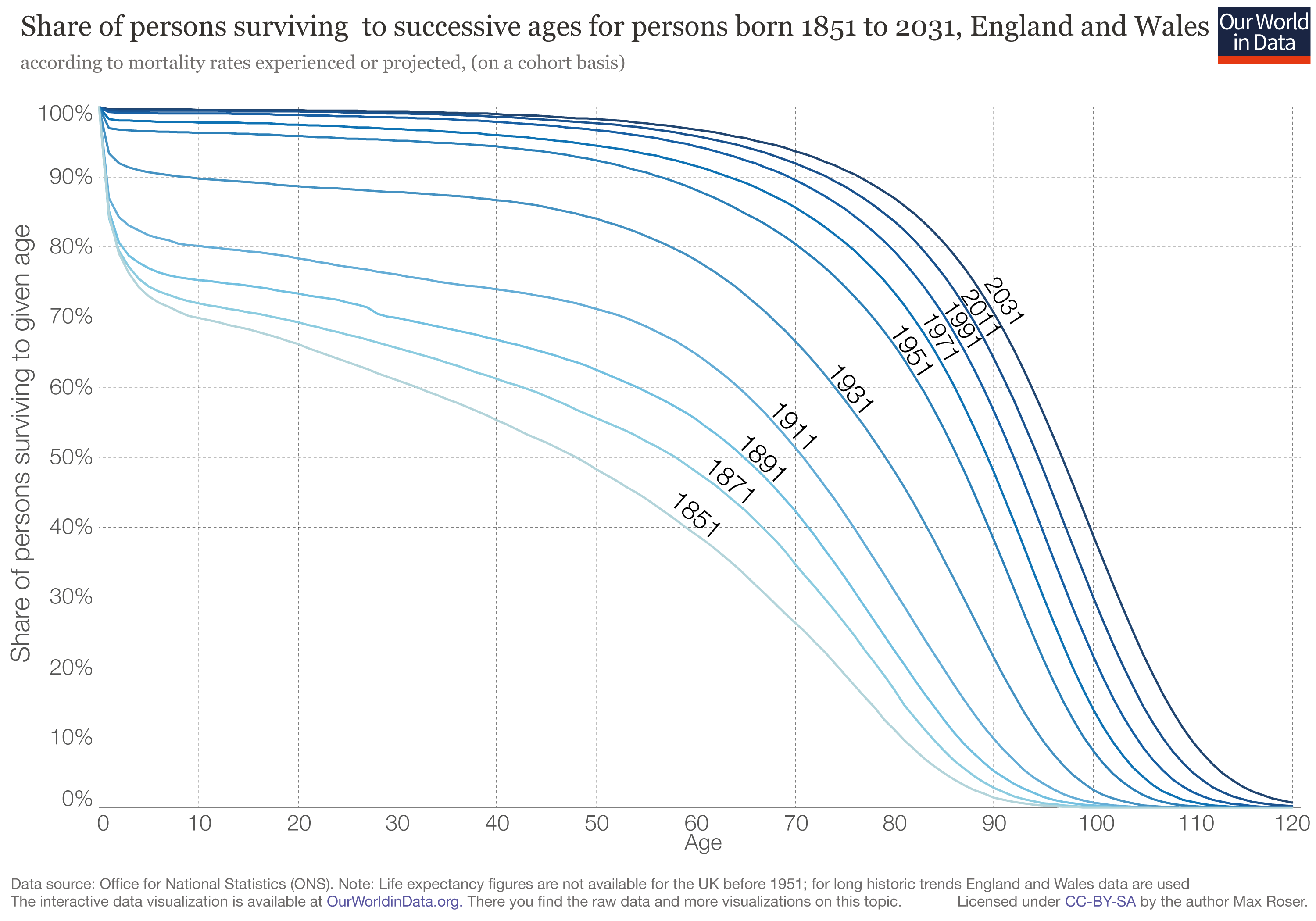
It was quite surprising for me to read (in Angus Deaton’s The Great Escape - Nobel laureate) that most of the advances on living longer that we have achieved are basically focused on not dying young (baby, infant, adolescent); but that the overall limit has been fixed in its place since hundreds of years ago.
Look at the shapes of this and to what do they converge:
Im trying to find a chart of the evolution of age-specific mortality rate that very clearly shows that we have a mortality plateau up until about 30-35 years, and then the rate increases linearly. It is quite humbling.
It is from Canada. The aforementioned book shows time series of several countries and periods, and helps driving the point home that (non-intentional) adult mortality has been more or less fixed since a long time ago.

The religious explanation for the longer lives of early humans, I think it is that there were very few people and they needed the longer lifespans in order to reproduce more and somehow humanity became more degenerate down the line; also back then people could marry their sisters so I suppose there were very few recessive genes (guess that could also contribute to the longer lifespans) :) ?
So perhaps the DNA could be somehow cleaned up and people could live 900 year life-spans ?
Also, in a post messianic age, in the Old Testament it was written than people dying in their 120th year would be considered to die young (I vaguely remember reading that just because in the christian post-messianic age you wouldn't die at all)?