Hacker News new | ask | show | jobs
by prickledpear 2552 days ago
It's great that YC provides feedback on why they don't accept (some) companies. However, it's a bit disappointing to see that not having MRR is a reason to reject a company. It seems like a lot of the successful YC companies were accepted way before they were anywhere to close to revenue -- and some were even working on a completely different product when accepted.

My hope is that MRR is sufficient, but not necessary for acceptance!

5 comments

Maybe I just don't get the Silicon Valley culture, or perhaps I'm missing something fundamental, but let me just get this straight:

1. Startup has no revenue whatsoever, but ostensibly have good product. They go pitch to investors and get rejected, likely because they have no revenue.

2. They hack around for 1 (!) weekend and get their MRR to $500. Five hundred bucks. They now go back to investors and say: hey look, we now have revenue (peanuts really), can we get funding please?

In what world would those $500 be expected to make a difference? How is that a proof of anything? I expect even really inept startups can somehow pull together $500 revenue from friends and family.

I suppose I just don't get how $500 in revenue could be seriously considered the tipping point between rejection to acceptance for investment?

To my layman reasoning, this is incredibly naive, but I'd like to be proven wrong.

It's the kind of situation that an auto mechanic in Pennsylvania would give a confused look of "kids these days" toward.

Focusing on growth is great but what has happened here feels to me like an inversion of accepted business logic. It seems like there wasn't a thought given to revenue before receiving this feedback.

The funny part about that is how this little bit of $500 MRR would have definitely helped this small team pay their grocery bills, and they could have been benefitting from that months ago if they just...thought about how businesses exist to make money.

The desperation to get into YC feels like an episode of American Idol, where the contestant may not remember what the benefits of being on American Idol are in the first place.

Looking at their site, it's got a few misspellings, a dead link, and some really strange ways of communicating that they used to have no watermarks, but now they have watermarks.

The product seems slick but incredibly limited as well. I'm not sure the idea of a video editor being web based is actually incredibly useful over an installed app.

Finally, they're charging $50 a year for a product that does less than iMovie (pre-installed on 50% of smartphones sold in the USA) or Adobe Premiere Clip (free).

If you stayed subscribed to this product for 6 years you'd have broken even by just buying Final Cut Pro, assuming they don't ever raise the price.

I'm not really surprised that YC had revenue concerns.

I sort of agree, but $500 monthly is quite a bit - it's way more than I'd expect most people who don't already have a significant public following to be able to reach on e.g. Patreon in one weekend. I could probably expect to find $500 from friends and family, but I doubt I could get a monthly commitment of $500 from them.
Except it's not $500 monthly. They claim £250 MRR but they got rejected 2.5 weeks ago so we don't actually know how many of those users will continue to pay next month. I'm not arguing this isn't still impressive for a weekend hack, but it is categorically misleading to claim £250 MRR when you haven't even had a billing cycle yet.
Having $500 in MRR proves two things:

1. The product is something that people will pay for

2. The team can sell it, at least a little bit

Both are huge validations of a startup

That's the thing. In my mind $500 proves nothing. Well, it proves that you can get $500 a month. I think it says zero about the actual ability of this business to become a success.

Put differently, if I believe in the idea behind a startup, I'm willing to overlook the fact that they have no rapid growth yet. If the idea is not enough to convince me, a miserable $500 is sure as hell not going to make a difference. It's too little in too short a time. It says zero about customer retention or satisfaction, etc. It's akin to taking two data points, zero revenue and $500 MRR and then extrapolating the growth. Nobody but a fool would believe such a metric.

If they went away, hustled hard for 2-3 months and got to say 50-100 paying customers (with that number consistently growing), good reviews or some feedback that customers actually like the product, I'd be more inclined to think of it more than just a fluke.

I'm 100% with you.

And honestly, seeing something like this would make me less confident in a startup, because as I said in another comment, the impetus for charging seems to be completely tied to getting accepted by YC, rather than trying to build revenue for the business. "Let's just hack our way to $500 then we can show we have revenue and the objection they listed will be moot and we'll get accepted."

The better move would be to have a solid plan for a pro product, start charging, be able to show growth in paying users, and then reapply for the winter YC class showing those data points.

$500 and then some churn and poof... You really need to do a stable couple of thousands for a couple of month to “know” you’re paid plans actually provide long term value. Or sell yearly plans.
>In what world would those $500 be expected to make a difference? How is that a proof of anything? I expect even really inept startups can somehow pull together $500 revenue from friends and family.

In practice, this is actually much harder than you'd expect. Also, competent VCs will probe to understand who made the purchase, and whether they're likely to do it again.

You might have missed it in the article, but their explanation is really apt.

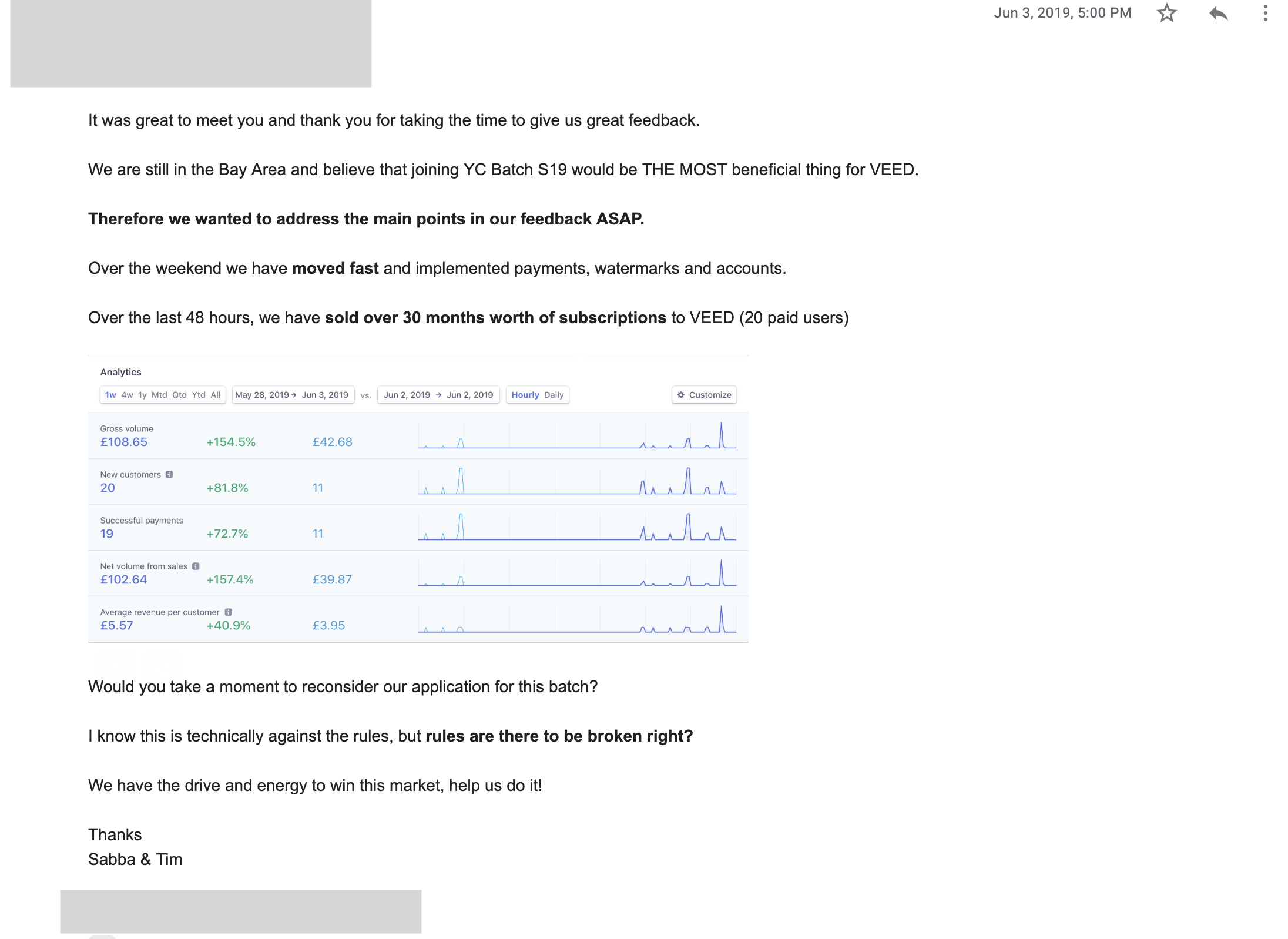
"Therefore, we thought that if we can get first paying users and MRR over the weekend and get back to YC next Monday morning, they would see that we had achieved MRR in only a few days. Additionally, we would look like a team who could move fast, listen to feedback and get stuff done."

The reason they were rejected is because they had no MRR. They were also told they need to move fast.

They proved over 1 weekend that they can get $500 in revenue and move fast.

It's the notion that they got feedback, moved fast to implement feedback, and showed that users were willing to pay on day 1 with a half-baked MRR plan.

Also their reply email hits all the points they were rejected: https://ghost-veed-blog.s3.eu-west-2.amazonaws.com/2019/06/S...

They did all this in 48 hours as 2 developers.

The $500 isn't about cutting the burn rate in a significant way. It's just the first domino to fall.

It's very hard to make the first dollar. Customers want to see other people pay you first. That's why many startups fill their websites with logos of big-brand clients, even if they're making very little from each.

It’s proof they can actually make money on the thing, which matters because it sounds it’s soemthing people like enough to pay for so as they grow the user base, they’ll grow revenue. However, keep in mind they still didn’t get in to YC after changing it, so it may not have chances things that much.
Excluding cheating - asking friends and family, or business to partner to boost your MRR -, a few hundred dollars prove a lot of things. Getting the marketing, billing system, and actual product right for this few hundreds is way harder than it seems.
I think they do continue to accept companies without MRR. I suspect they simply value it more in cases where they are unsure if the product is something that can eventually be monetized (i.e. they don't know if people are willing to pay for it).
From the feedback from YC, lack of MRR isn’t the takeaway, and I think both OP and a lot of people on this thread aren’t getting that.
I found the feedback contradictory. They said: (1) you need to charge for this, and (2) it's a market that no one owns yet so you need to grow fast to capture it.

The surest way to grow fast is to have a free product. I realize that not a lot of time can go into this feedback, but this struck me as pretty contradictory on its face.

It seems that they only added the watermark when they started charging. Pre watermark it is hard to know if the business is potentially viable at all. Free signups might fall off now that they aren’t getting everything for free.

Assuming that is the case the business model would have to change to pro features or add. Maybe VC would be more comfortable on some data on all this.