Hacker News new | ask | show | jobs
by oldjokes 2583 days ago
"Median pay for a Bachelor's degree is below 1990 levels"

This is really something. 30 years, and we're moving backwards. This is completely unacceptable, we need to rethink the foundations of our society if we're failing so many people who work hard and play by the rules.

6 comments

But it never is by the rules is it?

A ton of startup founders striking it rich were already rich.

A ton of scientists in the medieval and rennaisance era were already rich.

People who went to university back in the day had an advantage because they had knowledge no one else had.

I'm seeing a couple of patterns, they are:

1. You need to have a solid base in life and quite some free time in order to invest in a competitive advantage. This used to be knowledge, but now this is less the case.

2. People who are able to game supply/demand mechanics will win in the game of money. Some people don't play that game, they also win (by focusing on their own goals). Other people who do play that game simply lose.

3. Currently having a strong network is a competitive advantage.

I feel like these things really follow the theory of (I forgot what it was called): something that is an advantage becomes a requirement 15/30 years later.

> * something that is an advantage becomes a requirement 15/30 years later.*

We see this within the realm of college competition itself. 20 years ago, shiny new dorms, rec facilities, and food service was a competitive advantage. Now, it's a requirement that drives up costs for everyone.

NB: That is in inflation-adjusted terms, not in nominal dollar terms.

I could not find the "quote" you cited above in the article. The actual quote from the article (at least as shown by outline.com) is: "Americans with a bachelor’s degree earned less in real terms last year than in 1990, according to New York Fed data."

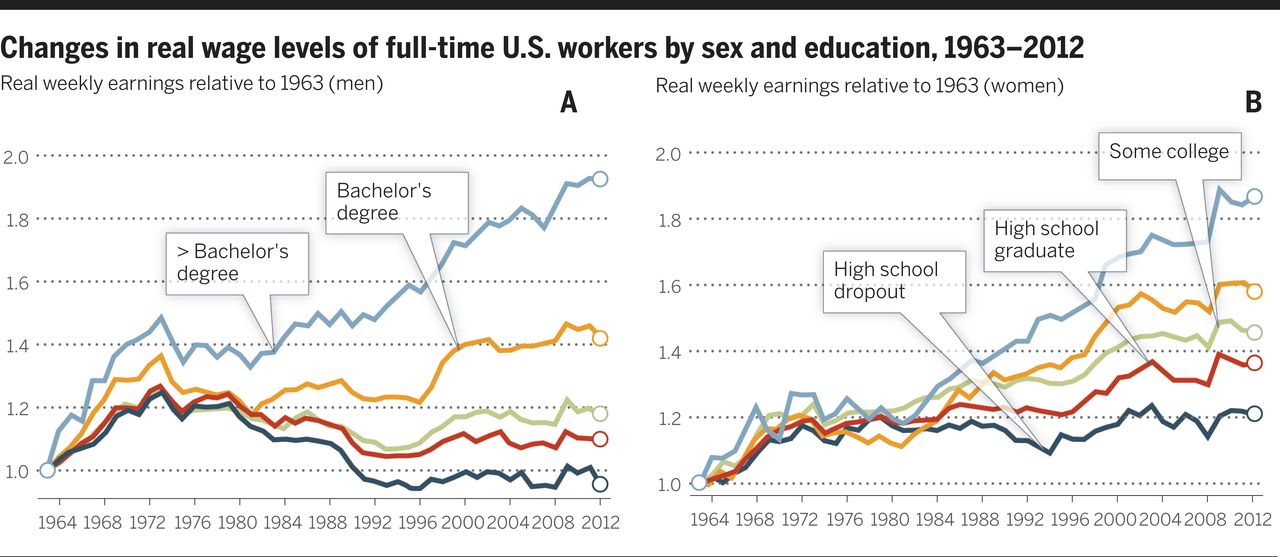
Except the income for just a HS degree has also gone down. This chart (https://en.wikipedia.org/wiki/Educational_attainment_in_the_...) shows that, at least as of 2016 and in 2016-adjusted dollars, those with just a HS degree are making less than they did at that time too.

At the same time, earning for > Bachelors degrees has continued to rise (https://ourworldindata.org/uploads/2013/07/ourworldindata_ch...) suggesting that, as others here have noted, the ubiquity of college has driven the marketplace to reward higher degrees in the way that it once rewarded a bachelors. Although that's probably a bad thing from the perspective of student debt, since it means students will need to attend school even longer at higher cost to compete.

My cousin teaches kindergarten in some of LA's worst neighborhoods. The only way for her to get a raise is through higher degrees. So now she has two Master's degrees. I'm sure that it's cost-effective for her to do that, but are two Master's really needed for someone who's not intending to climb the administrative ladder?
Other states are even worse. In New York, teachers are required to get a Masters degree within 5 years.
Yeah but the number of Americans with at least a bachelor's degree[1] and the number of 4 year degree granting institutions[2] have both increased by nearly 50% since 1990. So your median bachelor degree holder today is likely younger than in 1990 and has a degree from a less established University. If you control for age and institution (e.g what does a 40 year old with a 4 year degree from the University of Iowa earn in 1990 vs today) you'd probably see every different results.

My gut says that a lot of this debt and reduced job prospects come from those 50% of institutions founded in the last 30 years. But I admittedly don't know enough about the subject to say for sure.

[1] https://en.wikipedia.org/wiki/Educational_attainment_in_the_...

[2] https://nces.ed.gov/fastfacts/display.asp?id=84

Depends on what you think college does.

Bryan Caplan argues it's about signaling: https://jakeseliger.com/2018/03/12/the-case-against-educatio.... Bizarrely, none of these articles cite his work.

If so, then the signal is getting weaker, as more people acquire it.

Seeing buyer's remorse is consistent with Caplan's work.

You're setting yourself up for failure if you believe the rules you play by actually act in your favor...

If you don't have clout, experience or money you're also in a very disadvantaged position to change any of those rules or have anyone believe your ideas will really improve the outcome of said rules.