Hacker News new | ask | show | jobs
by PrimalDual 2580 days ago
I still don’t understand corporate income taxes. These are just pass through entities. All the money goes to actual people which are a lot easier to tax than a corporation. I think it’s such a waste of human capital having corporations incentivized to spend on armies of lawyers and accountants trying to come up with some baroque legal construction to avoid taxes. Maybe I am ignorant about tax law but people seem a lot harder to “invert” to cheaper tax jurisdictions no matter how rich they are.

I would even go as far as saying that payroll taxes are the same. Taxes hidden from the general public with weird incentives that break stuff in unexpected ways. We would be better served with more income, property or sales/vat taxes.

18 comments

"Corporations are people, my friend!"

Corporations are certainly not pass through entities. They own assets, they exert influence on society. They benefit from government institutions. They amass wealth so that they can spend it to their benefit.

Maybe, like people, it makes more sense to tax them on revenue then on profit so they cannot invert to a cheaper jurisdiction?

Or am I a pass through entity? Arguably, most actual people are more pass through entities with respect to money then corporations. Corporations are far more likely than most individuals to amass wealth.

But when corporations spend wealth to their benefit it comes out of their profit. So they end up paying less tax. I.e. corporate tax is an incentive for corporations to spend more, not less?

Profits are owned by shareholders. So why not just tax them normally when they receive these profits?

I might be in the minority but I think there should be a 0% corporate tax rate. For the amount of revenue received by corporations doesn't match how much affect they can have on the tax code. They lobby quite a bit to affect their tax status and situation because they have the means. Yet its the individuals that contribute the most taxes but have the least amount of lobbying power. The tax code should be decided by policy of the democratically elected. Reduce the corporate rate to 0% and lobbying will decline I believe.
Why would a corporation with lots of regulations they'd like changing suddenly stop lobbying for them just because they didn't pay any tax? And if lobbying for lower taxes is undesirable, surely actually giving the lowest possible tax to the lobbyists to make them go away is worse still?
That's a really interesting perspective, and yes I think you are most definitely in the minority. Your point is well taken, though

I wonder, however, if corporations stop lobbying over taxes, will they just move that budget over to other things? Like lobbying against EPA regulations, etc.? Corporations are going to spend what corporations spend on lobbying, regardless the issue at hand.

I do really like your point that John Q. Public pays more in overall tax but gets significantly less in representation. This needs to be fixed.

Or we could try to legally limit how much corporations can lobby.
> Maybe, like people, it makes more sense to tax them on revenue then on profit so they cannot invert to a cheaper jurisdiction?

Taxing on revenue as opposed to profits harms corporations that have a low margin, high turnover business (for example retailers)

Sure.

But, IMO, among the income-based taxes, gross is still the most fair. Net/value-added is too easy to manipulate and too difficult to prove manipulation of. c.f. Hollywood Accounting[1]

I also think that a progressive gross-based scheme would help prevent runaway growth in the case that r > g. At some point, the incremental cost of storing income becomes greater than the cost of passing the money through.

[1] Not a tax, but dealing with a similar problem https://en.wikipedia.org/wiki/Hollywood_accounting

It also benefits large players as a chain of companies producing a product would have a larger combined revenue than a single company with teams doing the same work.
Isn’t this just another way of saying “higher gross margin”?
If I'm understanding what you mean right, no I don't think so.

If we have two companies, one makes a widget and the other buys it and adds a clock to then sell:

Cost of making the widget $5, sale price $10

Cost of adding a clock $10, sale price $40

As two companies, the first has a gross margin of $5 and the second $20. If the companies were to combine, they'd have costs of $15 and a sale price of $40 = gross margin of $25.

I might not understand the term properly though, I based it on this https://www.investopedia.com/terms/g/grossmargin.asp

Yeah, it might be interesting to put together a list of most impacted products. Depending upon the rate, the impact of a revenue based system on car manufacturing could be huge.

And, in practice, I'm not sure that the result would actually be better than a simpler consumption tax.

And it hurts people who have high expenses. We have found ways around that.

(I have no strong opinion on this subject.)

You can deduct expenses from income, every freelancer does. So we don’t actually tax people on revenue either. We tax them on profits. (General cost of living is not an expense). Most tax systems also have progressive income tax rates, taxing lower incomes substantially less or even not at all. Certainly, a tax system that does the same for corporations would be possible. That would then benefit smaller companies.
> (General cost of living is not an expense).

General cost-of-living is an expense—just see how long you can keep earning that "profit" without paying it. This is partly accounted for by the standard deduction, which is approximately equal to the official federal poverty level.

To put them on even terms with corporations, individual employees and freelancers should be able to deduct any personal expenses which are reasonably related to allowing them to perform their jobs, including but not limited to food, shelter, child care, and basic utilities. Depending on the demands of the job and local conditions this may well exceed the official poverty level.

VAT solves that
At the cost of complexity and acting as a honey pot for criminals. I have to deal with VAT for a business I help to run and it's very complex. The bigger problem in the EU are the large amounts of carousel/VAT fraud.
> I help to run and it's very complex.

Most of the complexity comes from a backward compatibility and the fact that politicians creates exceptions for certain products to gain votes. If the tax was the same for everything it would be much simpler.

Fraud is a solved problem, especially if you can start from a blank slate like in US. Governments are trying to reduce the fraud, but they are super slow. https://en.wikipedia.org/wiki/SAF-T

If Corporations are truly "people" then they are slaves to their owners. The assets they own are actually collectively owned by their share-holders and the actions they take are carried out by their principal officers.[0]

The real difficulty is probably with foregn ownership because then you have the argument about taxing the citizens of other countries.

Taxing where business takes place is also a possibility, but turns into yet another source of obfuscation.

[0]Yes, I know about the idea of corporate "personhood". I just object to it on principle.

You are thinking about personhood the wrong way. In the law, personhood means being able to own things, sue and be sued, pay taxes, enter contracts, and a number of other things.

Do you think that immigrants don't pay taxes?

>Do you think that immigrants don't pay taxes?

This is what puzzles me about the immigration debate. Most move here to work and better themselves and effectively pay a higher tax rate than corporations.

I don't know where "immigrants" came into this. I made NO mention of immigration, just foreign (overseas) ownership of shares in Corporations. What has that got to do with immigration?
It came from the post above.
Are you really suggesting that Corporate Officers aren't able to enter contracts, sue people, etc.? And what the Hell have immigrants got to do with any of this?
Corporate officers are able to enter contracts, sue people, etc, as themselves. Not as the company, which is a separate person from themselves. When you buy a product from Apple and they refuse to respect their warranty, you don't sue Tim Cook, you sue Apple. You can only do that because Apple is incorporated.

>you have the argument about taxing the citizens of other countries

If a company poisons baby-milk, who do you arrest? The company? It's a "person" after all.

(I presume you know this, but this was an actual case in China).

You brought up immigrants, not me. What are you talking about?
The problem is that the money only goes to actual people eventually, not when it is earned. A beneficial owner can simply sit on their share of the company as it earns profits and becomes more valuable, and incur capital gains taxes if and when they sell. They can defer these taxes indefinitely - if they need cash, they can simply use the stock as collateral for a loan in lieu of realizing capital gains taxes. And when they die, the cost basis gets reset, wiping out whatever taxes have been deferred (and replacing them with estate taxes, if those haven't also been optimized away).
> A beneficial owner can simply sit on their share of the company as it earns profits and becomes more valuable, and incur capital gains taxes if and when they sell.

That's half the problem with income taxes. They provide an incentive for the rich to never sell their investments because if they sell they have to pay tax, meanwhile they give the working class less incentive to invest rather than consume because they do have to pay the tax on their earned income immediately even if they invest it rather than spending it.

So you get bigger corporations (the rich can't sell to invest in a startup without paying tax), more incentive for international tax avoidance/arbitrage to the detriment of smaller businesses who can't do that, and more wealth inequality.

> They can defer these taxes indefinitely - if they need cash, they can simply use the stock as collateral for a loan in lieu of realizing capital gains taxes.

Because we're not using consumption taxes. You can't avoid VAT by taking out a loan.

> And when they die, the cost basis gets reset, wiping out whatever taxes have been deferred (and replacing them with estate taxes, if those haven't also been optimized away).

Again solved by consumption taxes, because there is nothing to reset if the money is taxed when spent rather than earned.

But the corporation's income is taxed so they cannot just sit on their share of the company. Then they will pay capital gains taxes
But the gains made by the lender are taxed, so in a way even taking a lone out you are still being taxed. Loans are not free.
If you itemize your taxes, investment interest expenses (such as margin loans) are deductible against your net taxable investment income, with carry forward of unused amounts. So it nets out to zero.
Margin loans don't give you cash to go buy a car or house, or pay for a fancy vacation. If somebody figured out how to do this they probably are breaking the law. There are also a lot of limitations to how much can be detected in this manner.

So back to the point, at some point, you are going to want to convert your wealth into actual cash to spend. When this happens taxes are levied. Yes at different rates.

Loans backed by your assets do come at lower interest rates, because of less risk, but the interest as profit on the bank is taxed as income -- for the bank.

Also, on the title "U.S. businesses contribute the smallest share of federal taxes" while may fair, looks interesting next to "U.S. businesses pay us nearly all of their paycheck".

I think it would be more simple of businesses had 100% the tax burden, but I don't think it would translate into any of us taking home more cash. All that would happen is wages would lower and businesses would pay the tax.

unless you have income (which is taxed as such) how do you pay back the loan without eventually selling assets and paying capital gains?
If the rate of growth of your assets exceeds your rate of spending by enough to handle volatility, then later on you have significantly more assets to borrow against. As long as the net value of the position grows fast enough, you can kick this can down the road indefinitely. The loan gets paid back after you die, when you no longer owe capital gains taxes on the proceeds.
I also forgot to mention the insane amount of resources wasted lobbying to complicate the tax code so every company and sector gets their loophole. This doesn’t just have the same human capital cost but it also gnaws at the trust people have in the democratic system. It’s a lot harder for Bezos or Cook to lobby for an individual tax cut than it is for Amazon and Apple.
If you really want to start from first principles, corporations may seem to be financial pass-through entities but serve as legal shields. Shareholders are not personally liable for externalities like environmental catastrophes or labor law violations. Elon Musk isn't subject to incarceration when someone is killed in an autopilot failure.

If you believe that corporations should also pass through legal liabilities, then sure it makes no sense to pay corporate taxes. But that's not the world we live in.

LLCs are pass through entities but are limited liability
You are ignoring a secondary reasons for taxes. The primary reason is obviously to raise funds for public use. The secondary reason is to give the government more control over the economy. You are right, there are ways to drastically simplify tax law if we wanted to tax ever dollar at the exact same rate or had very clear marginal tax rate buckets. We don't do that because we want to incentivize certain actions. On a personal level, you get a tax break if you pay for your education, you get a tax break if you invest in your career, you get a tax break if you have children, you get a tax break if you earn your money through investments rather than through employment, etc. We don't necessarily do those things to be nice. We do those things because we believe they are good for the overall economy and it is beneficial for them to be incentivized.
You can still do all of that with no corporate taxes. As every incentives you cited are on the individual taxes.
Sorry, I thought it would be clear that I wasn't trying to cite a complete list. There are also countless corporate tax incentives too. Clean energy is one example. How do you incentivize companies to use clean energy by taxing individuals?
There are problems with every type of tax.

Property taxes are tough because many assets are hard to value/assess and often don’t pay enough cash flow to cover their taxes, which could lead to forcing a sale (at fire sale prices for illiquid assets).

Sales taxes tend to hit lower income people the hardest since they’re spending most of their income while the wealthy are not. You could adjust for this, but then it becomes complicated and administratively burdensome.

Tariffs distort trade and slow economic growth (though there are many people that find that trade-off worth it for other reasons).

I think a lot our system in the US is designed for ease for collection, rather than what is most efficient.

The good thing about corporate taxes is that corporations tend to be more meticulous about tracking their income and expenses, and probably also about paying their legal taxes on time than individuals. Tax revenue collected would probably plummet if we did away with the W-4 withholding system on individual income taxes and people had to file them once a quarter/year like corporations do.

maybe this is overly cynical, but I suspect it goes further than "ease of collection". the average person is unlikely to strongly oppose corporate income taxes because they believe it doesn't take any money out of their pocket. if they understood tax incidence, and how little consensus there is among economists regarding corporate tax incidence, they might feel differently.

the US tax system seems to be designed more towards political expedience than any other goal. sales tax, which voters feel every day, is relatively low compared to VAT implementations in Europe. the income tax hits high earners pretty hard, but there are innumerable loopholes and exceptions for very wealthy holders of capital to avoid paying significant capital gains.

it seems like the whole system is setup to look like it's fleecing rich people while it subtly sabotages itself in thousands of pages of tax law.

edit: also you are probably right that we would have trouble collecting tax if we eliminated withholding, but what does that have to do with corporate income tax?

Indeed, if we eliminated withholding, a large swath of people would simply have no money to pay their taxes.
> You could adjust for this, but then it becomes complicated and administratively burdensome.

Minimum income is fairly simple. As are earned income tax credits.

It's no more complicated than free need-based bus passes to offset flat bus fares.

> All the money goes to actual people which are a lot easier to tax than a corporation.

Are you sure about that? Businesses are highly visible, tracked entities that have to file accounts.

It's also not unusual for the very rich to route all their activities through a business, especially political donations.

It's much more difficult for a person to shard their lives such that they live over here for this purpose but over there for that purpose, whereas for a company of any significant size, that's fairly easy.
It requires more wealth, and it's a lot harder to do if you're a US national with their unique global income tax rule, but people absolutely do split their lives for tax purposes. It usually requires dividing your time among at least three different countries, but one of them is usually a nice warm island. e.g. http://expatandoffshore.com/blog/top-ten-tax-exiles

> In a highly interesting manoeuvre, Sir Philip [Green] manages his various businesses through a holding company - Taveta Investments. This is registered in the name of his wife Christina, a South African who resides in Monaco. The family and company thus manage to avoid tens of millions in tax.

Taxing people has the same problem; trust founds, tax heavens...

Sales / VAT tax is not progressive and is unfair to poor people.

Governments love sales tax! Its just so damn easy and simple. When I was a kid it was at 17.5%- now its at 21%. I don't mind because the government here actually tries to provide for its citizens. Keeping the nation orderly and tidy takes a vast amount of money.
Taxing poor people will always be easy. That's why the most significant progress in economic history has come with the ideology that fights against doing that.
When you combine consumption taxes with basic income you get a net progressive system. You also get the benefit of discouraging consumption rather than discouraging earning income.
This is actually the ideal solution. It has the additional benefit of being the most privacy-preserving system, since individuals are no longer required to file tax returns or be means-tested for benefits. Everyone receives the same benefits, and the taxes are collected indirectly via the corporations whose goods and services are bought by (potentially anonymous) individuals. Meanwhile, the accounts of corporations are subject to greater scrutiny, as governments focus their efforts on auditing them.
True, however inflation works the same way, and is a much bigger and persistent threat to the poor than sales tax or VAT; inflation compounds over time whereas sales taxes do not.

Inflation is basically an unvoted regressive tax on the poor that increases every year.

Inflation is no threat to the poor at all. The poor have zero or worse net worth. Inflation benefits them by reducing the impact of their debts over time.

When all your money (and more) goes on just living, inflation is a complete irrelevance (so long as your wages keep up, of course).

> When all your money (and more) goes on just living, inflation is a complete irrelevance (so long as your wages keep up, of course).

Yes, but dismissing this caveats is waving away the entire point. High inflation of course includes wage growth (and when it doesn't, you've got a wage growth problem,not an inflation problem). But it does so _on average_: every worker doesn't get an automatic raise every time a price goes up. The poor are the least able to sustain situations that are good on average, because they have the smallest savings buffers to weather the downswings of an average trend.

If a poor person falls prey to the various life catastrophes that might make you miss some income, not get a raise, etc, a high inflation provides a much less forgiving environment, since the real value of whatever modest amount was in your bank account is rapidly eroded (and as pointed out above, this type of buffer is rarely if ever kept in inflation-correlated assets)

Getting knocked off of an unstable cycle is practically the central challenge of the working poor, and high inflation gives you a lot less wiggle room to avoid this.

Poor people try to save money too, and are more likely to have their savings in cash and bonds and therefore wiped out by unexpected inflation.
35% of the UK have a negative net worth. Inflation helps there, assuming your salary increaese with inflation. Interest rates of course then have the opposite effect,

Year 1: debt of £100k and salary of £20k and 2% interest and 4% inflation. £18k left over, £100k owed (5x wage).

Year 2: debt of £100k, salary of £20,800. £18,800 left over, £100k owed (4.8* salary)

Year 10: debt of £100k, salary of £29600, £27,600 left over, £100k owed (3.4* salary)

In Year 1 pounds, salary stays at £20k, but debt drops to £67,566, and interest payments drop to £1351 a year.

It’s not a judgement against poor people. No one has their savings “wiped out” by inflation.

It is simply an annual cost for having assets, and an annual benefit for having debt. Since poor people necessarily have more debt on average than rich people, poor people on average benefit from higher inflation whereas to rich people it acts like a tax.

For people who want a weath tax, I say, why not just target a slightly higher inflation rate?

I would argue that rich people have on average far, far more debt than poor people. Rich people also have far more ability to protect their assets from inflation than poor people.

With regards to "no one has their savings wiped out by inflation", tell that to, say, Russians in the early 90s. Very real and very significant savings in Sberbank turned to virtually nothing, i.e. wiped out, by inflation.

I would still argue that a higher unexpected inflation rate would hurt the poor the most, but may benefit middle class holding mortgages (although the more likely effect is that the negative effect on the overall economy would end up hurting everyone, with the poor being hurt the most).

Inflation can hurts pretty badly pensions though, so it's not only a rich vs poor thing.

And also inflation is not uniform and depending on its composition can hurt poor people much worse than rich ones.

Historically I haven't found any clue that a higher inflation would help against inequalities. Actually the only literature I have found on the topic seems to indicate a positive correlation between inequalities and inflation but the relation between both seem very complex and not really understood/modeled correctly right now.

> It [inflation] is simply an annual cost for having assets

Not all assets, just cash or claims denominated in cash (like loans). Most investments don't lose purchasing power just because you devalue the dollar. The poor are most likely to have the majority of their savings in the form of cash, for various reasons; minimum investment limits, for one, and also investing in general is more efficient when you have more money to invest. Below a certain point, the brokerage fees alone would outweigh any likely annual return. Moreover, in an inflationary economy consumer prices tend to rise faster than wages, so the purchasing power of labor declines. Deflation is just the opposite: Sure, wages are falling as the dollar becomes more valuable, but prices tend to fall even faster, so purchasing power increases.

If you're looking to tax wealth then inflation is not the answer.

Recent decades of history show your last condition is not true, wages do not keep up.
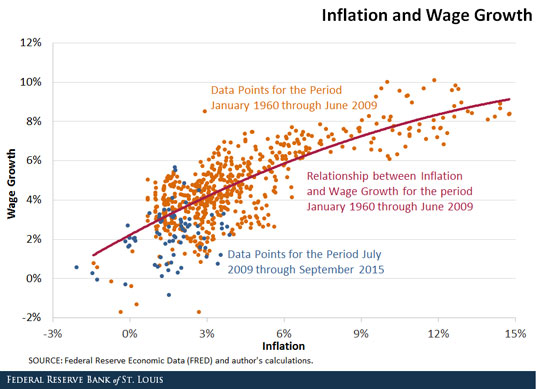
That looks true when inflation goes above about 6%

https://www.stlouisfed.org/~/media/blog/2015/november/graph_...

Wages are not set by inflation, they are set by supply/demand for labor. In the face of lower historical inflation, wages would just be lower today as a result.
Only the delta between wage and price inflation matters there. And that can really blow up an economy: the main problem with 20% inflation is that people need a raise every month, and are far more likely to go on strike over it.
But the money doesn't always go to people. In the UK at least, Corporation tax is specifically calculated on what's left after you've paid the people, and after you've taken into account reinvestment.

I agree that the baroque structures, and the crazy accountancy games companies play, need to be addressed somehow.

Taxes aren't just a means of revenue for the government, they're a means of incentivizing for various goals.

- Want a higher population? Give a deduction for children. - Want citizens to switch to alternative energies? Give a deduction for solar panel roofs and electric cars. - Want to reduce dependency on foreign oil? Give a deduction for new drilling operations. - Want to create more jobs? Give a deduction for each employee. - Want to create more housing? Give a deduction for real estate depreciation. - Want to encourage new technologies? Give a deduction for R&D expenses.

You could just hand out money instead of deducting it from taxes. E.g. it's common in many countries to get a child raising stipend which is basically cash in hand (well, in bank account)
Financially, these are the same, but politically they're not.
Taxes are also a way to disincentivize "behaviors", like taxing alcohol and tobacco, taxing pollution emitters.
You are making an excellent case for a revolt.
You want to revolt against how society has worked pretty much since the dawn of civilisation?
There's been plenty of revolutions since the dawn of civilization. But also taxing as a way to ('subtly') modify behavior is a very new concept, it didn't exist centuries ago.
Yup. Corporate/business taxes to begin with are not so smart because because businesses can basically incorporate in any jurisdiction for reduced or 0% tax rates. Many countries have "free trade zones" with 0% business taxes. Those countries still benefit though because their citizens get jobs they might not otherwise have access to. With free trade agreements, it is easier than ever to have your headquarters in a tax haven and then manufacture and sell your products worldwide.
The problem is that corporations have value, assets, and money. And more importantly they can leverage it.

If we moved to a 0% Corporate tax and relied entirely on income tax then we'd start to see all manner of schemes for Executives to avoid taxes. They'd do things like taking little salary but instead being issued Corporate spending accounts with limits comparable to what they'd otherwise earn in salary.

Maybe I am ignorant about tax law but people seem a lot harder to “invert” to cheaper tax jurisdictions no matter how rich they are.

this is only because we allow corporations deductions for intellectual property, remove ip deductions and remaining corp income deductions will revolve around paying wages and investing capital (e.g. building a factory), things that cannot be "inverted" or made to pass through ireland.

the corp income tax is actually less harmful than personal income or sales taxes precisely because it only falls on corp profits and the aforementioned deductions (with exception of ip) are good ones - you want companies doing those things. arguably double taxation on dividends is a somewhat questionable feature of the corp income tax though (and if anything the last type of company you would want to exempt from this double taxation is REIT like ones)

Wait, I thought corporations were people. When people earn money, they owe income tax on it.
All of the rights of people, but none of the obligations.
I sort of agree, but in jurisdictions with low corporate taxes and high personal ones you’ll find a lot of small contracting companies that hold a lot of personal assets.
The IRS already takes a dim view of this in the US.
While I agree in principle, in practice you would have no guarantee that the money companies would save on taxes would directly go to increasing employees' wages, which would have to balance the increased individual taxes that you mention.

Market forces would compensate to an extent, but not for jobs with a low demand/supply ratio, I think.

Well your friends from downunder figured out how to solve this long ago. You allow the company to pass through a tax credit (franking) to the shareholders on any dividends paid. It is amazing how keen companies are to pay tax when this is in place.
Why would it be the case? Not all the money ends up with humans. Google and Apple has the largest cash stock in recorded human history.
Ideally, taxes should be used to discourage undesirable things, like emitting pollution. Taxes should not be used to discourage productive activity.

We should be taxing pollution, consumption of raw materials, plastics, use of undeveloped land, etc.

> Taxes should not be used to discourage productive activity. We should be taxing...use of undeveloped land.

Aren't many (most?) uses of undeveloped land productive? About 100 years ago, someone built the house I'm sitting in. That was a productive activity to transform the use of that land for housing, IMO.

If it's productive enough, it's worthwhile paying the tax. There's only so much undeveloped land, developing it all means destroying our environment.