Hacker News new | ask | show | jobs
by devinmcafee 2602 days ago
I think many young people in tech learn this lesson the hard way. They get excited with all the free food, laundry services, and events that tech jobs offer. They end up spending all of their waking hours at work and work becomes an identity. Then one day something changes and they realize they spent the last N years of their life at work, not building real lasting relationships, pursuing hobbies, dating, etc. It truly is a cautionary tale and startups and big companies alike want their employees to drink the Kool Aid.

Personally, I love all the perks tech jobs offer but work-life balance always comes first.

9 comments

Shortchanging non-work life for several years is not specific to "tech". The ~30yo dating pool in Boston was a wealth of people who'd been focused on grad school, med school/residency, and making partner in a law firm. Many people consider career focus a good investment, in those fields. (Though many manage to do both, and some others try but fail to do both.)
The difference is that in tech you have a choice and in medicine you don't.
Medicine also tends to have more clear career tracks. Tech will run you into the ground and discard you if you are not careful and creative about where you go and how you go about it.
I think a lot of people learn this the hard way, yes. But I kinda don't see what is wrong with this. Having work life balance is somewhat of a luxury, and it's a luxury to be able to say "money doesn't make me happy". It's a luxury to come to that conclusion.

How do you arrive at that conclusion without going through the ringer first?

> Having work life balance is somewhat of a luxury, and it's a luxury to be able to say "money doesn't make me happy". It's a luxury to come to that conclusion.

Exactly. Any time anyone says "money doesn't make me happy" what they really mean is "I already have enough money that it's no longer the limiting factor in my happiness."

The vast majority of peoples' lives and happiness could be markedly improved by giving them more money.

I think this is unnecessarily cynical. I’ve been through multiple periods of both success and extreme hardship in my life. I can confidently say that money doesn’t make me happy, because I’ve managed to be happy at my lowest points of financial stability. If losing financial stability robs somebody of all their happiness, then I’d say they should question whether they were really happy to begin with, or just comfortable. But to say that anybody who has financial stability can’t say ‘money doesn’t make me happy’ denies the possibility that they’ve lived experiences that genuinely brought them to that conclusion.
I've gone long stretches unemployed because of chronic health issues.

Money helps reduce anxiety. Health insurance even more so.

Once you have responsibilities, mouths to feed, it's no longer just about you. Now that I'm an empty nester, I care about money a lot less. I'm practically happy-go-lucky.

> I can confidently say that money doesn’t make me happy, because I’ve managed to be happy at my lowest points of financial stability.

I'm not saying that being poor makes it impossible to be happy. I'm saying that money can remove many stresses which make it harder to be happy.

Also, there's 'low income' and then there's 'financial instability'. If you get paid $100/week, spend $50/week on rent, and $25/week on enough food to keep you well fed, and have $25/week spare, and you have a reasonably reliable job (or can easily find another one) then you're financially stable.

If you're on $2000/wk but you have $1500/wk in rent/loans/whatever and $450/wk in food and transport costs, your boss is constantly threatening to fire you, and you know you can't get another job if you do get fired, you're going to have a very hard time being happy.

> If losing financial stability robs somebody of all their happiness, then I’d say they should question whether they were really happy to begin with, or just comfortable.

I'd flip that around and say if your happiness levels aren't affected by 'losing financial stability' then you've lost income but not financial stability.

That's totally fair, and I think many people can identify with what you're saying, with a caveat. I think you're talking about a different kind of happiness... I'm not you, so I can't say for sure, but it sounds like you have what I would call "joy" no matter what. Where "joy" is a sense of purpose, of maybe self worth and other things that stay with you even when you may not actually be enjoying yourself at any given time, you can even be sad, and still have an overarching sense of "joy".

I think the other posters mean happiness as the more run of the mill enjoying the moment, enjoying life, am happy about X kind of happiness.

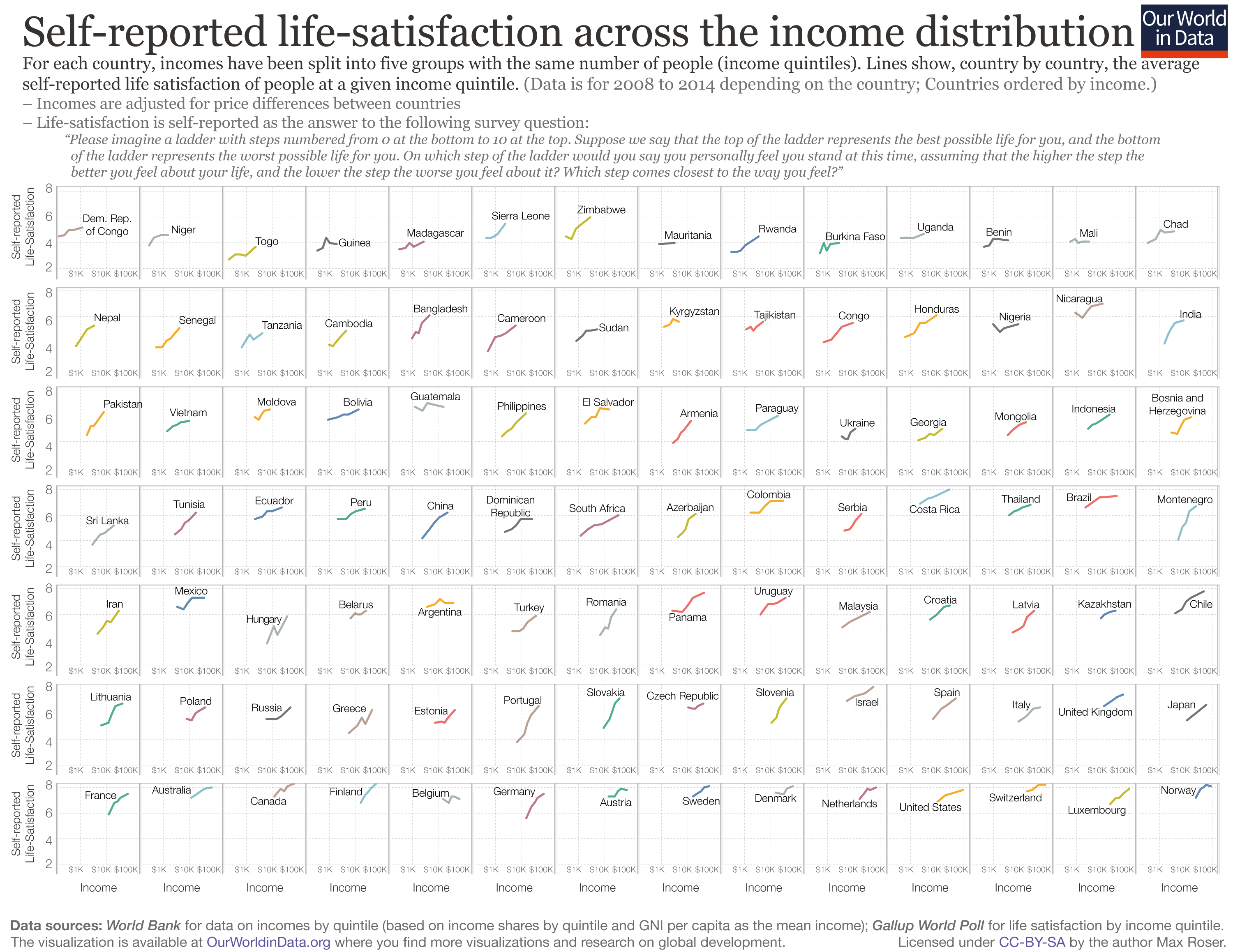
Also, when we talk about happiness vs income, we should actually look at what many people actually say about it themselves, in data (pardon the pun :):

1. https://ourworldindata.org/grapher/gdp-vs-happiness

2. https://ourworldindata.org/uploads/2017/04/Happiness-by-Inco...

3. https://ourworldindata.org/uploads/2017/04/Happiness-across-...

I mean, it seems like there is a connection between happiness and income up to a certain level.

This isn’t at all what people by money not buying happiness. Even if your life objectively improves, it’s just a matter of time until your brain adjusts to the new normal and you’re back to the same levels of happiness you were at before the money. It’s pretty much the crowning “feature” of our biological wiring - because if an animal like us in ancient times was blissfully content the moment their lot in life improved, they would stop trying and not end up spreading their genes. So we’re pretty much doomed to never be truly happy/content because of how natural selection works.
If you're hungry, or cold, or have no safe place to sleep, money will fix that. If you're just managing to make ends meet and in constant fear of losing your job, money will fix that. If you're overworked and stressed from your high pressure job, money will fix that. In fact, until you're rich enough to be way off the pointy end of Maslowe's hierarchy, money will fix pretty much anything that ails you.
From what I've seen, there's a clear line of demarcation below what you're implying. If I remember correctly, the research says it's around $60k-$75k in the U.S. where the happiness levels out in response to money. I'd have to look it up again to make sure I'm not misremembering
Yep, that lines up with what I've read and what I've personally experienced. Beyond $75k (or your local currency equivalent), more money is more of a theoretical "can do more nice things", "drives a nicer car", "can go skiing for holidays instead of rent a beach shack." It's nice, but it's a change in degree, not a change in kind.

Below $75k combined income is where those "do I want X or Y because I can't have both" situations come about increasingly frequently. Below $45k it becomes "do I want to pay the electricity bill or the rent?"

This is commonly misreported. A 2010 study found that answers to questions like "Did you experience a lot of stress yesterday?" leveled out between $60,000 and $90,000. How satisfied people said they were with their lives continued to increase.[1]

[1] https://www.pnas.org/content/107/38/16489

According to what? There are plenty of fairly trivial counterexamples to this. If what you say here is correct, what is mental illness? What is a solid marriage vs a terrible one? What is a good job vs a bad job?

For instance, lots of peoples' mental states improve when they are able to not live with their parents, for various reasons. That requires money.

> Having work life balance is somewhat of a luxury,

Tell that to the history of labor unions

Talented and ambitious people would hate being in a labor union. It's a place where doing more than what is expected is actively shunned, and knowing how little work you can do is the optimization.
> Talented and ambitious people would hate being in a labor union

Doubt it. Mentorship and apprenticeship opportunities are abound. Unions provide a floor for negotiations from which you can up-negotiate.

If your categorization was true, actors would never have breakout opportunities despite their union representation. Reality disagrees with your assertion and any movie star ever acts as evidence contrary to your claim.

Movie stars are in a guild, not a union. Much like doctors.

Unions have personally screwed me out of hundreds of dollars of month in payment for pensions I'll never see because they've forced me into inappropriate position titles to the benefit of legacy members.

Are you talking about Sag-AFTRA? It's a labor union.
The Actor's Guild is a labor union and part of the AFL-CIO.
It's a tough thing being pro labor, anti union.

Good governance, fairness, accountability, responsibility, transparency remain challenges for all organizations, not just unions. Happily, we've been getting better at finding and learning from other experiments.

Reform is thankless exhausting work. It takes a special kind of crazy for a person to do that kind of policy work.

Phd Graduate students seem to like labor unions - they have been organizing and striking for them a lot recently. And classical musicians (The Chicago Symphony Orchestra recently went on strike). Are they all stupid and listless?
It's simple. When the supply vastly outpaces demand, it opens up many doors for exploiting those lower on the ladder. Both grad school and classical music are 2 such areas.

Software Engineering still hasn't reached that point. The profits earned by having top percentile employees, far outpace the compensation packages they demand.

A decent software developer might be worth three to five mediocre ones, without being particularly valuable. The idea of the 10x developer is so overwrought, but there are just so damned many people who are not capable of producing anything at all.

It's really a profession that does not scale well.

Here in (socialist/democratic) Sweden unions are prevalent for all categories of labour and have been for ages.

Even if you’re not actually an active member of one of the about 60 organizations, the work they do benefit you through collective agreements.

Look at the companies and innovations sprung from this setting through the years. It’s IMHO actually quite impressive considering the population size.

At least I believe it’s safe to say it doesn’t stifle innovation or hard working individuals in general — high performers gonna’ perform.

You aren’t typically a member of a union if you work in tech in Sweden. Some unions are also very passive, basically just an insurance.

Crediting unions with the inventions and companies seems quite optimistic. Imho, they were at best a method for avoiding a working class/socialist revolution in the early 1900s and for supporting blue collar workers in general.

Also, Sweden isn’t socialist, and socialism isn’t equal to democracy.

First off, I'm not "crediting" anything, I'm refuting the idea that unions would hurt ambition.

Second, you have quite a narrow and arguably wrong idea about what socialism is:

https://en.wikipedia.org/wiki/Types_of_socialism

Sweden is for example governed like a social democracy:

https://en.wikipedia.org/wiki/Types_of_socialism#Social_demo...

Being scared of the S word is kind of silly and assuming socialism equals totalitarian Stalinism or Communism is just plain wrong.

Third -- if you work in tech you might very well be a member of for example "Unionen" (660.000 members, myself included) or "Sveriges Ingenjorer" if you're an actual engineer.

Take a look at SACO with it's 22 unions: https://www.saco.se/en/

Just some other thoughts:

The opposite of socialism is not capitalism, as is usually portrayed.

For me, the opposite is what happens when accountability towards the people and greater good is nowhere to be found. Be it through unregulated free market corporations, organisation and politics or a totalitarian dictatorship.

Both corrupt and destroy and one thing is common: lack of accountability.

Also, I like talking about ”socialist Sweden” whenever an American talks about the horrors of unions, regulations and government.

I learned this a few years into my career and made major changes to adjust it. I've never felt happier and more fulfilled than this last year where my job is a sideshow and my focus and best hours of the day are spent with my family.
That’s great to hear! What changes did you make?
Found a job where I can work from home.

Developed a healthy but firm relationship with my employer that I shall not be available outside office hours.

Hacked away at slack to permanently disable notifications and never show the blue distraction dot. Developed an expectation among the team about my responsiveness via slack or email.

Unlearned from my previous job: installing any work related software on my phone.

Adopted a financial lifestyle that prevents me from being a wage slave. This is the most important part, I think. It means all of the above can never be eroded because I'm not afraid to quit/be fired. This means I can stand by my philosophy.

I'm 53yo and worked in tech (as corporate wage slave, consultant, 1099, and self-employed remote) for 30 years now, and I do believe you have found the true path to how to handle working in tech.

I consider myself lucky that during my formative years in tech in the 90's, I was also playing guitar in a semi-professional band touring Florida during the year. I feel that due to these experiences, I was always able to see what many of my colleagues couldn't.

That tying your emotional, social, and financial happiness to your tech job is a dangerous place to be.

Glad to hear I'm not the only one who hacks out the blue distraction dot. Every time slack upgrades itself it comes back and I remove it posthaste.
Please feel free to publish it as a Firefox extension. I’ll pledge to donate $10 (via SEPA or cryptocurrency) if it’s not out yet, in honour of putting your money where your mouth is
How do you cope with spending the majority of your time being a "sideshow"?
Majority of my time?
I can't blame them.

It is the first big real world thing many of them do, their first real career job, and possibility the most important thing to them they've done to date... it's so easy to get wrapped up in that when a company steps in to fill in all the possible gaps in life.

If you don't know what else you'd fill your life with, it's easy to fill it completely with the first big deal that comes along.

It's a cult and they deliberately want to make it a cult.

This is one of the reasons they provide free food, corporate vacations, team building exercises, etc.

They want you completely dedicated.

As someone who’s worked at multiple big tech companies, I don’t think this was true, at least not on the teams I worked on.

I probably averaged 50 hour weeks. I also earned enough to max out retirement accounts and make substantial investments in my post-tax accounts. I had enough to where I could start taking bigger risks. I had two vacations per year while building wealth. I also got married during this time.

I read comments like this and I wonder if someone had a bad experience or if it’s just resentment.

To be clear, I think there’s massive room to improve gender pay gaps, diversity, etc. That being said, I don’t think these companies are as nefarious as you make it sound. It depends on your situation. I never had to travel, unlike the author of the medium post. I didn’t face sexual harassment, although I’m also a female. I do know these things do happen, just as they would at many non tech companies.

>> if it’s just resentment.

Ah, there it comes.

Having been around lots of employees of one of the tech giants, I think the cult mentality is actually very strong.

You can observe this in two specific ways:

1 Adding in a gratuitous note at every possible chance about those who are resentful because they didn't "make the cut". Now, you could have made your point without the gratuitous note, and the fact that you still had to add it does make you part of the cult, de-facto. Interestingly, you observe this attitude in a lot of ways when you interact with them in real life too, and especially when you say something critical but factual about their software (e.g. that it is bug ridden despite an entire army of folks working on it)

2 The general idea that unlike the schmucks who need to comply with laws, a tech giant is not only above the law, but rather deservingly so (Facebook being the very obvious example with its friendly fraud case, but every tech giant has a pretty shady history in this regard). If someone disagrees, "it's just resentment". Even more tellingly, almost none of these folks actually take a stand on clearly unethical practices well after "earning enough to max out retirement accounts".

Instead of bristling at such comments, you should probably introspect a little more.

You’re resorting to personal attacks with accusations of cult mentality. I’ve generally worked with people who were good to me or people I came to trust. Obviously I must be part of a cult for not hating the teams I worked with. Are you miserable at your current job? If not, does that make you part of a cult? And if you are miserable, with all the rage you’re holding up, maybe you need to take a break and worry less about us?

>Adding in a gratuitous note at every possible chance about those who are resentful because they didn't "make the cut".

I never made any statement about someone being resentful because they didn’t make the cut. You’re arguing a straw man with these things you’ve conjured up, and after making this statement, it’s probably likely you didn’t make the cut. On the other hand, making the “cut” isn’t so black and white. Great candidates sometimes fall through and don’t get an offer. The system isn’t perfect at any company.

>Interestingly, you observe this attitude in a lot of ways when you interact with them in real life too, and especially when you say something critical but factual about their software (e.g. that it is bug ridden despite an entire army of folks working on it)

There’s buggy software everywhere. Hopefully you can find bugs and address them before your users do but be transparent if something is serious. I haven’t seen anyone state that engineers at big tech companies write flawless code, so you’re arguing another straw man.

>If someone disagrees, "it's just resentment". Even more tellingly, almost none of these folks actually take a stand on clearly unethical practices well after "earning enough to max out retirement accounts".

People take stands on issues they disagree with all the time. You read about it when folks at Google, Microsoft, or Amazon speak out against selling tech to the defense department. It’s even on there news.

>Instead of bristling at such comments, you should probably introspect a little more

Your angry rant is misinformed, with personal insults and generally in bad faith. Do you have an employer and are they perfect? Even if you’re self employed, are the folks you work with or work for completely 100% objectively ethical, and if yes, how do you measure that and who/what defines that bar?

I never stated tech companies are above the law, that engineers at these companies write bug free software, or that everyone else is only upset they didn’t make the cut. If I had to guess, it sounds like maybe you didn’t make the cut, which is why this idea even came to your mind.

My experiences have been good. It seems like you came here hoping I would have insulted my previous teams.

One piece of unsolicited advice -

You won’t be successful and people generally won’t respect you or want to work with you if you’re the person who tries to pull the most negatively possible interpretation from others so you can use it to put others down. It doesn’t matter how smart you are or think you are.

Good luck!

> I probably averaged 50 hour weeks. I also earned enough to max out retirement accounts and make substantial investments in my post-tax accounts. I had enough to where I could start taking bigger risks.

I'm in a similar situation, and feel sad that a "bigger risk" for me - and probably a lot of employees in tech - is putting my foot down and working only 40 hours a week. Without having money saved, I'd have a much weaker hand in sticking up for myself.

Do you really need to? Or do you think you need to?

I left my first company after college only after 3 years, despite the pay being great. I moved to a tech company, which longer term ended up being absolutely the right decision. At the time, I only left because I felt burned out. In retrospect, I worked nights and weekend, pulling in closer to 60 hours, but it was never expected of me. If anything, I set that expectation, and it wasn’t fair to my colleagues who couldn’t work more than 40 hours a week because they had a spouse, kids, or other responsibilities that I didn’t have outside of work.

If you do feel like you have no other way, my suggestion would be to find a different team or different org at your company if possible. Otherwise, time to move on elsewhere.

Keep your skills sharp - changing jobs is stressful and can suck, but never end up in a position where you absolutely rely on the job you have now. Build your nest egg early.

This is especially true if you’re young. I only wish I had someone give me this advice but my parents both worked their entire lives, and I saw them both work sometimes two jobs at a time. I didn’t know better having grown up in a home where that was the norm (they didn’t have a choice because they were trying to support 3 children, pay rent, car payment, etc).

I really think that just spreading more awareness of this goes a long way. I worked crazy hours my first few years too but it wasn’t company pressure, it was me wanting to prove myself.

I didn’t change til I literally worked myself into a hospital. I do wonder if knowing more about how often this stuff happens would have made me more aware of the pattern I was falling into.

Perhaps overly impersonal, but I think of it as an investment profile: you need diversity.

Invest in your education, invest in your career, invest in your family, invest in your friends, invest in your hobbies, invest in your health.

Not all of those are sure to succeed, but if one fails or you realize is overvalued, you've still got a lot left.

I have two comments.

You want you career path to follow; what you can learn, what you can do, what you know, who you know.

Every job should pay you in, experience, money and connections. If a employer is short changing you or blocking you on any of those, LEAVE.

This sad story is common but usually happens to people who weren't going to build a life anyway, who'd be home on the computer in their free time instead of getting paid to do something profitable with it.
And its these people who stick around too. Saves the company plenty of money giving them 3-5% yearly raises.
I don’t think that’s necessarily bad though. Learn all these things when you are 23~ish