Hacker News new | ask | show | jobs
by setr 2642 days ago
>The proposal would give each member state a choice from 2021: either to keep the current summer time system or scrap the twice-yearly clock changes

So if you travelled vertically within a timezone, you could end up going back and forth by an hour repeatedly, depending on the state’s decision made here?

Truly, a design made by committee.

11 comments

Arizona doesn't observe DST, but it contains the Navajo Nation which does[0], and in turn contains the Hopi Reservation which doesn't.

So you can go back and forth by an hour within a single US state.

[0]The Navajo Nation extends into Utah and New Mexico, which observe DST, so this lets the Navajo Nation maintain a single time throughout.

There is actually a Navajo exclave inside the Hopi reservation, and a Hopi exclave inside the Navajo reservation, so if you travel into Arizona via route 264 in the summer, you have to change your clock seven times.
I like this, in a crazy way, despite having argued elsewhere for consistency... Makes me wonder, if Italy and Austria ended up choosing different time zones, would the ethnic Austrians living in Süd-Tirol get their own time zone too?
Note that the article is incorrect. I just went thought the proposal and what member states can choose is between keeping summer ot winter time!

quote:

"Consequently, the Commission proposes to discontinue the seasonal time changes in the Union, while ensuring that Member States retain the competence to decide on their standard time, in particular whether they will move to the standard time corresponding to their summer-time on a permanent basis or whether they will apply their current standard time permanently. "

https://eur-lex.europa.eu/legal-content/EN/TXT/PDF/?uri=CELE...

Edited: clarified "This is actually incorrect" to "Note that the article is incorrect."

The comment you replied to is correct based on what you said - if you start in a state in permanent summer time, travel south to a state in permanent winter time, keep travelling south to a state in permanent summer time, and so on, you will be going back and forth by an hour repeatedly.

Hypothetically, if you start just north of Sittard and east of the German/Netherlands border (in Germany), and travel in a straight line, almost due south to Geneva in Switzerland, you could, depending on what time member states choose to permanently adopt, potentially go from German summertime, to Dutch wintertime, to Belgian summertime, to Luxembourgish wintertime, to French summertime, to Swiss wintertime, all in under 350 miles and with not much deviation in longitude.

Ah! you are correct. I thought the author was referring to the possibility of a country south of another being 1h ahead/behind depending if they do the yearly switch or not.

But in this case we go to the general problem of choosing of timezones. You have plenty of cases of south borders with different timezones (ie. without moving in longitude you still switch zones).

It's a matter of country size, not to mention that it is a matter of economic interest to keep the same timezone as neighbouring countries. I would assume the scenario you mentioned to be quite unlikely.

If Belgium and the Netherlands don't agree on a timezone, you could probably do that in the space of half a mile at https://en.wikipedia.org/wiki/Baarle-Nassau
That's already what happens if you go from France to the UK or Spain to Portugal, so it's not really something new.
UK/France isn't such an issue, there's a big stretch of water in between that takes a minimum of an hour to get across by any mode of transport (once you factor in waiting/boarding time).

Not sure how many people make daily border crossings between Spain/Portugal like those I described in my other comment, but even then it is something new if the time difference between states varies with the time of year.

In short, if your country opts out of summer time but your close neighbours don't, all those living in densely populated border areas are still affected by the summer time changes, only with the added complexity that your neighbours in the next suburb don't always keep the same time that you do...

That's so very common.

In North America, for example, there are (admittedly not very populous) mountain time regions that are north of areas that observe both Alaska time, which is 2 hours behind, and Eastern time, which is 2 hours ahead.

If you want to complain about bouncing back-and-forth across a single time zone boundary by going north and south, as someone who's lived almost their entire life in various places along the Central/Eastern time border, all I can really offer is ¯\_(ツ)_/¯. Committee or not, it's gonna happen. Because there are so many reasons beyond simple longitude to pick a time zone.

I once found a latitude with 4 different time zones. I think it goes through Pakistan. Time zones are always going to be weird.
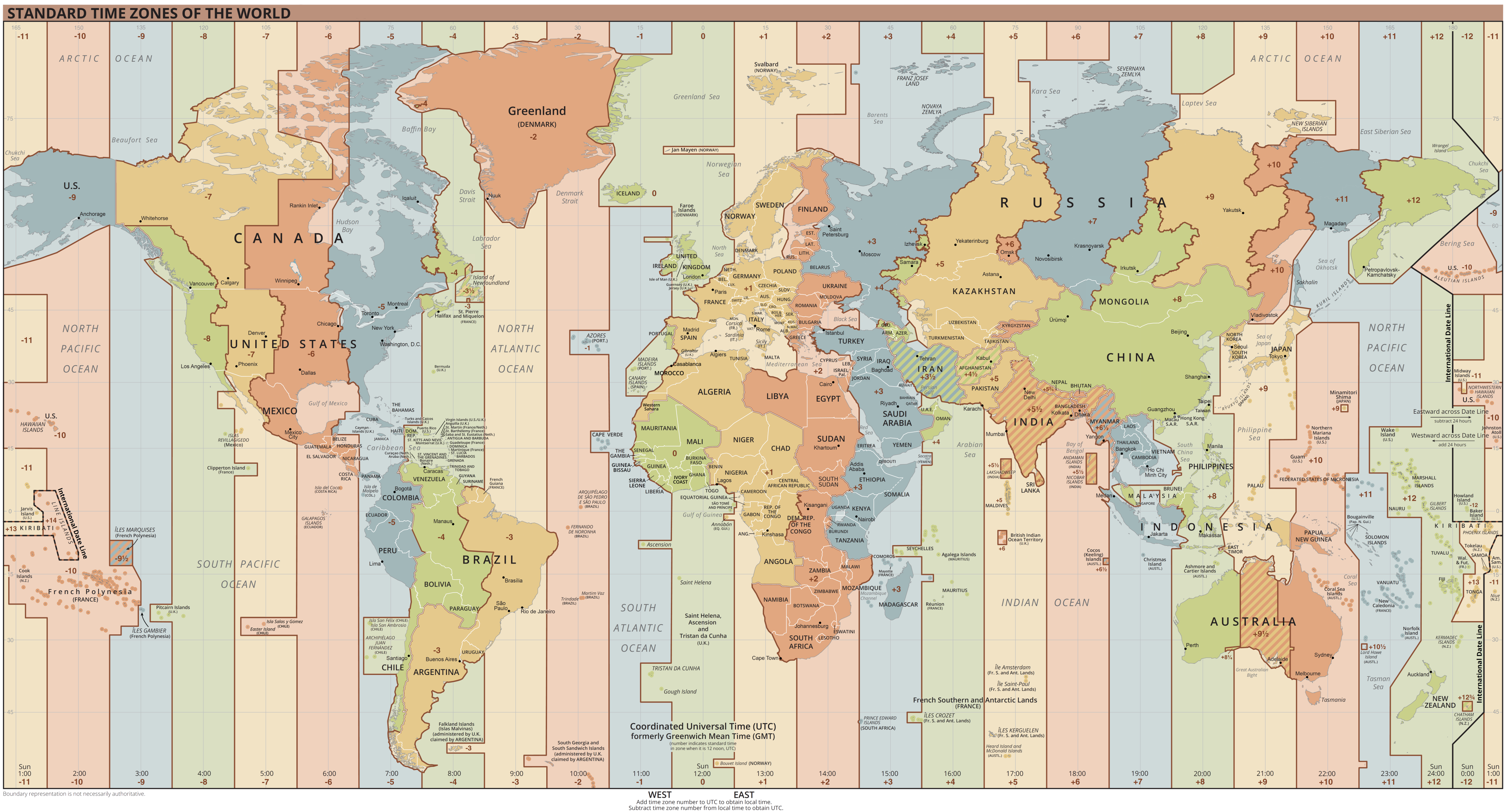
If the Wikipedia map (https://upload.wikimedia.org/wikipedia/commons/8/88/World_Ti...) is accurate: - at the longitude of Kabul you have Afghanistan (+4.5), Pakistan (+5), India (+5.5), and Kazakhstan (+6). - at the longitude of Rangoon you have India (+5.5), Burma (+6.5), Indonesia (+7), China (+8) (and the open ocean at this longitude is theoretically +6)
There is actually also +3 at that latitude. In russia, the moscow timezone reaches far enough in the North.

That means you get 6 timezones for that latitude if you include the ocean.

That's what I get for figuring this out by eye.
I believe India and Pakistan shared a time zone until partition (there were Bombay and Calcutta Times), and Pakistan adopted some standards asymptotically closer to Bombay Time (see the Wikipedia article for Karachi time)
Outside the EU that's already true, even between countries that all observe DST (since start and end times of DST vary). But having most of the EU in the same time zone with the same DST rules was very convinient.
That's the case currently in the US year-round as the timezone borders aren't nice, straight lines and no one seems to have a problem with it. For example, traveling North through Western Indiana.
There is already no single timezone, with the possible exception of a timezone in the deep pacific, that would allow you to go from south to north without adjusting your clock once.
See eg. https://www.timeanddate.com/time/map/

There are a few more longitudes for which it works but not that much...

>So if you travelled vertically within a timezone, you could end up going back and forth by an hour repeatedly, depending on the state’s decision made here?

See: Arizona

You already have that in EU -- Spain is observing CET (and its summer equivalent CEST) even though it is pretty much completely in the same time zone as Great Britain.
And Portugal is on GMT, so you have a bit of Spain (GMT+1) that's due north of Portugal (GMT) and borders it by land.

(and most of Portugal is west of 7.5 degrees west so "should" be GMT-1... but really in any sane time zone scheme Portugal and Spain would have the same time.)

PS: GMT is defined by UTC, and not the other way around.
Arizona is a hack. This is where the EU is starting from.
This is already the case. Travelling across Europe, you would go back and forth between the current date and VG Day 1945.
Getting date and time correct is already a challenge in some cases, adding multi-dimension time zones does not make it easier.

This is why people don't trust politicians - they don't understand the effects of their decisions (it _might_ be slightly more complicated than that.. but it's still).