Hacker News new | ask | show | jobs
by pmoriarty 2679 days ago
The movie War Games inspired me to get a 300 baud modem, and one of my first memories of using one was to play Adventure (one of the first text adventure games) on a BBS. I war dialed like there was no tomorrow, and racked up huge phone bills downloading wares from across the country.

300 baud modems were super slow. You could literally watch a line of text be typed across the screen in front of you, one letter at a time. I upgraded to 2400 baud after that, and 9600 after that. Even at 9600 baud, I seem to recall that downloading one single mp3 (once those fancy high tech music files were invented) would take something like half an hour. 56k modems came after that, and finally ISDN and cable modems.

In the late 80's I discovered the Internet and UNIX at the local university's computer lab, and there was no going back to BBS's after that. I remember trying to convince a Fidonet sysop to try the Internet, and he adamantly refused, saying that Fidonet is all he'd ever need. I wonder if he's still on Fidonet now, keeping to his vow never to set foot on the Internet.

5 comments

Relive the memory by piping everything through Brendan Gregg's wonderful "baud.pl" script [0]. Truly nostalgic!

(Using "baud.pl" is much smoother than trying to recreate the effect by piping through `pv`)

[0]: http://www.brendangregg.com/Specials/baud

baud.pl works nicely for command line output, but it can't help with running a GUI through a 2400-bps terminal, unfortunately. So I still have to use my minicomp emulator via a real terminal to get the experience.
> Even at 9600 baud, I seem to recall that downloading one single mp3 (once those fancy high tech music files were invented) would take something like half an hour.

I downloaded the original Command & Conquer demo over a 2400 baud connection. I had a 33.6 kbps modem, but the modem pool for the VM/CMS system I could connect to only allowed for 2400 baud connections. IIRC, it took most of a weekend to download that 10 MB file.

I remember downloading the complete Dune 2 from a BBS. We were visiting a friend of my dad, and his son showed it for me (he had quicker access to the sources from his uni). By the time it was downloaded it was long in the evening, and I was tired (being about 10 years old or so), but it was super cool seeing the game. Or maybe it was just the demo because the download took too long, I can't remember.
When downloading files via command line my hands still type 'wget -c', even though it's been many years since my last interrupted download.
mp3s from a BBS at 9600? Surely you jest. MOD and STM, with an outside chance of WAV, were more like it.
There was overlap, for a short time even advanced, cross technology overlap.

Amigas, which never were really 100% netizen computers had their heyday in the BBS years.

But in that twilight, there was a network stack which on the Amiga side said to AmigaOS "yes, I'm a BSD network socket stack, trust me. You want a socket? Here's a socket!"

While in reality, it took that "socket" and piped it (with some simple multiplexing) over a modem, to a Unix program on the other side and this Unix program opened the real socket on the Unix side. So, while there were actual real network stacks for Amigas, this one was faster and smaller due to it not actually running on the Amiga, but on some Unix host.

Back to my point, was that my little brother downloaded mp3s through one of these contraptions to his Amiga. A brutally specced out Amiga (68060 third party CPU) could just barely play a 128kpbs mp3 in mono.

Whilst I can't recall downloading an mp3, I remember them existing and I was still at 9600bps in late 1995 when I was on Zipcon.

MP3 was introduced in 1993, which was around the time 14400bps modems were introduced. These things cost something like $350+ in 1990s-dollars, and I at least had more time than money at that point in my life.

Bit of a stale thread, but I was thinking of 9600 as having a somewhat short window of use by personal / noncommercial users. I spent a great proportion of my teenaged lawn-mowing income on a USR HST 14.4 in perhaps 1991, but it wasn't too long before 28.8 came along. With regard to mp3, the format seems to have been very obscure up until 1996 or so--perhaps some folks from Fraunhofer would consider this late to the party, though.
I downloaded my first mp3 (White Zombie of some sort) from a FSERVE on IRC, at 14440bps of course
I played MUDs on a 1200 baud modem, and I was at a distinct disadvantage. Going to 9600 was incredible.
MUDs are actually still around, and the more popular ones are still going strong.

I went on a MUD binge recently, and got a good dose of nostalgia. Check out The MUD Connector, if you're interested.

https://www.mudconnect.com/

I think basically all art forms will for now on live on forever. Someone will always be programming an Atari 2600, play a MUD, or paint in oil on a canvas.
I lived out several years of my youth at 1200 baud. The word "U.S. Robotics" was like porn to me.
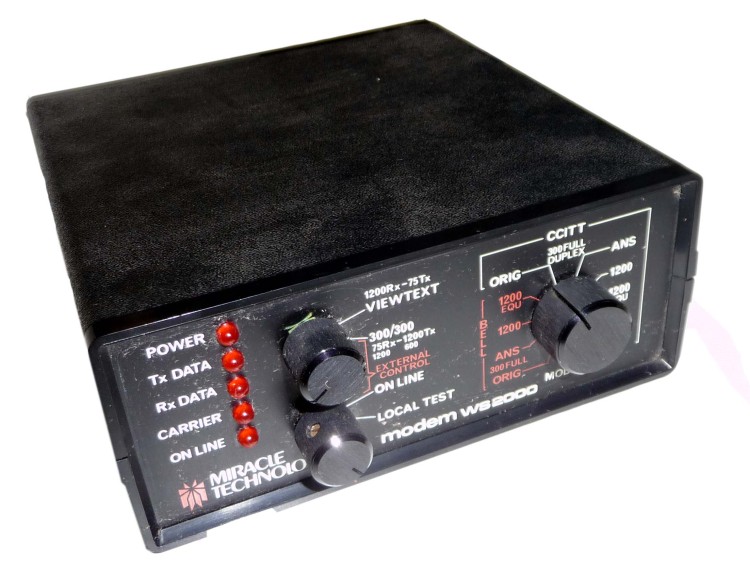
In the early days, I had a Miracle Technology WS2000 with manual, rotary knobs to select speeds (all the way from 300 to 1200bps), plus a manual connect/disconnect knob, so making a connection consisted of dialing the BBS number, listening for the tones and putting the modem online.

Unfortunately, my modem had a sticky phone line relay and so to disconnect the call the procedure was: turn knob, listen for click, thump modem a couple of times just in case, lift phone and check for dial tone.

Pic here, although mine was an even earlier model with a brown case:

http://www.computinghistory.org.uk/userdata/images/large/86/...

Manual, rotary knobs remind me of phones with manual, rotary dials. They were everywhere through the entire 20th Century, but now there are plenty of people who've never seen them in their entire life, and of course youtube videos of kids being laughed at by their parents when they're forced to try to figure out how to use them. That's something else we didn't have back then: humiliating videos of ourselves -- recorded by our family, no less -- broadcast to the whole world. I don't blame the kids for failing, though. The dialing mechanism of such phones is clearly not very intuitive.
I recall getting a Beta or Alpha version of the new 2400+ modems from a colleague (Cthulu who rank Arkham Asylum) who worked with me in Tymnet - they had sent a batch as possible upgrades for Shades.

I actually used it for work for a few years for dialling in from home.

Fidonet was pretty cool - truly peer to peer with its own routing system.