Hacker News new | ask | show | jobs
by lkrubner 2686 days ago
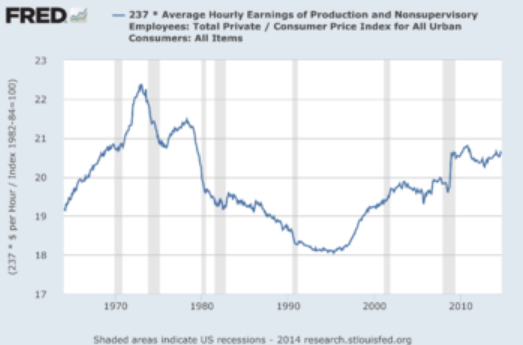
Exactly. Male real wages have been stagnant since 1973, and that's without considering the situation around health care, where costs have risen much faster than general inflation. Counting health care, male real wages have declined noticeably since 1973. Meanwhile, returns to capital have grown dramatically. This is precisely what you would expect in a weak economy, where the workers necessarily lack bargaining power. In a strong economy, the percentage of national income going to workers would increase, as it did from 1935 to 1973.
5 comments

Additionally, in 1973, there was a good chance you had a partner who could stay at home to watch the kid(s). Now you have both people working whether you like it or not, because you're competing with two-income households for housing.

Of course, not trapping women in domestic servitude is a good thing, but making it (on average) necessary for two people to work to afford a home when before it took one is a bad thing.

>Of course, not trapping women in domestic servitude is a good thing

Alternative is 'trapping them' (horrible choice of words btw) into corporate servitude. Which of the two is better? Which of the two is better for children?

Which of the two is better?

trapping in corporate. Trapping in corporate grants economic independence.

Which means, depending on the family situation, it may be better for the children... it means the woman has the ability to run away if she needs to.

Not saying its a perfect system, or that it should be a binary choice (it shouldn't be), but of the binary choice, one is blatantly better.

"Domestic servitude" is a poor way to present homemaking, but calling its historical pull a trap for women isn't far off. Obviously anyone who's struggled in the business world understands joining the game is only liberating along a couple of dimensions (economic, mainly).

The choice should be there for men and women to work or rear. Applying that freedom appropriately is the individual's responsibility.

> "Domestic servitude" is a poor way to present homemaking

It is when you are absolutely economically dependent on the outside of the home work, from which you are functionally excluded, of a partner for survival, when even searching for an alternative in the same line is grounds for termination without support, and where the one on whom you are dependent has a legal right to use you sexually without consent (criminalization of marital rape in the US began in the mid-1970s after the mass entry of women into the workforce)? I think “domestic servitude” is an overly positive euphemistic description of the condition women were generally trapped in before their out-of-the-home work became normalized.

I'm absolutely not making a case that women weren't effectively forced into domestic servitude in the past (and, depending on a a range of factors, in the present). I'm also not making a recommendation that anyone be a full-time homemaker. Given the state of the world, that's a very risky path.

But.

There are women (and men) who would prefer to work in the home and they should be free to do so. It's demeaning to equate a person's effort in homemaking with servitude. There is not something inherently inferior about maintaining a home and it's only a perverse economic system rooted in traditional misogyny that tells us otherwise.

As I said initially, the choice should be there. The social and institutional compulsion obviously should not.

> It's demeaning to equate a person's effort in homemaking with servitude.

No one did that upthread. Someone compared the condition women were trapped in prior to the normalization of their choice to work in the general market as being trapped in domestic servitude. This is not equivalent to equating freely-chosen homemaking with domestic servitude.

> Of course, not trapping women in domestic servitude is a good thing

Any reason you used the term servitude which implies a negative connotation, when many women were happy with that arrangement? It also implies none of the women received positive utility from staying at home with the kids and it was always a chore, which seems a little ridiculous.

We should be embracing every opportunity for more personal involvement with our children and family, not calling it servitude. It does all families, past, present and future, a huge disservice.

If it's something either parent does because it's what they want, then it is indeed not servitude.

But in 1973, it fell almost exclusively to the female parent, whether it was what she wanted or not. Many women may well have been happy with that arrangement, but practically no men would have "received positive utility". And either there's something unique about the Y chromosome that makes it impossible for them to enjoy that, or a lot of women weren't so much "happy" as "accepting".

We should indeed embrace opportunities for more personal involvement in families -- for both parents. Generous leave is a big start on that. But "100% leave, as long as you're female" is not.

the term presumably is used because at that point it was not a choice. Many women may have been happy with it, but there was scant alternative for those who were not.
It depends on a lot on where you were, but there are places that literally fired women when they got married. https://www.irishcentral.com/news/how-things-have-changed-te...

This has changed, but it reveals a lot. It also might relate to why it's so hard to find teachers for the price government is accustomed to paying - if you were a well-educated woman in the 1950's you had far fewer options (aka bargaining power) than you do today, and teaching was likely to be one of the few options with a bit of prestige and mental stimulation available to you.

It's true that women weren't FORCED to not work, but to suggest that they didn't face a strong disadvantage is disingenuous. Hell, it's still a rampant problem - how many tech bros get off an interview and then say "ah but she's 32, she'll want to take maternity soon". This is a good reason for making maternity and paternity leave equal, incidentally...

https://www.nytimes.com/2018/06/26/podcasts/the-daily/pregna...

Though for all that, my wife stays home with our kid by choice. She went back to work when our daughter was 6 months old, and after six months of barely seeing her outside of the weekends she just couldn't bear it (I didn't much like it either). The only reason we can do that is because I have a good paying job in tech making something over the 90th percentile of incomes in my country. I wish other people had that choice. Hell, I wish I had that choice. But few do.

I think we would all be happy to be financially independant with our families but reality is different. Every society is severely broken by patriarchal norms which is hurting everyone. Most of all women. Enabling domestic servitude (which is both negative and the appropriate term) by catering to utopian fantasies only is only enforcing these norms and directly crippling women.
I've always wondered how much of the lack of wage growth can be explained by financial institutions investing in other countries. If the actual growth happens somewhere else, and some of the profits make it back to the US economy, also growing it, overall wages wouldn't really be affected, would they?
The US is the world's largest recipient of foreign direct investment and maintains a substantial capital account surplus. Capital inflows finance our current account deficits.

https://www.cfr.org/blog/mapping-capital-flows-us-over-last-...

This is one of the most brilliant and succinct put statements I have read in a while. However, do you have any pointers to underpin your statement?
This is a weak economy if you're a laborer and not a capitalist. Overall, it's still been a VERY strong economy since '73. The US has been either first or second in GDP growth EVERY YEAR FOR 40 years! China has been killing it recently, but over the given time period, the US is still by far the best: https://en.wikipedia.org/wiki/List_of_countries_by_GDP_growt...

A real weak economy would look like Japan, Ukraine, Russia, Zimbabwe, etc.

Life for the laborer has been under systemic attack since Reagan, but the US economy as a whole has been doing swimmingly.

> This is a weak economy if you're a laborer and not a capitalist.

Replace capitalist with monopolist and I'd agree.

How many capitalists make losses for 20 years and not only stay in their job, but actually become the world's richest person? Where would Uber be if they couldn't use VC money to undercut taxi companies, and subsidize hundreds of millions in losses. And let's not even get started on the issue of offshore tax avoidance, something your local hardware store will never have access to.

GDP is a very bad target to aim for.
Total compensation has almost doubled since 1970, adjusting for inflation.

Looking at wages alone is only half the picture.

You are thinking of average compensation. Most reasonable people avoid talking about average compensation, since income has concentrated into the hands of the top workers. The top 1% of Hollywood actors, sports athletes and Wall Street hedge fund traders make several million dollars a year, and therefore they grossly distort the average. Their income hides the reality. If we focus on median income, of all forms, total real compensation for men has declined since 1973.