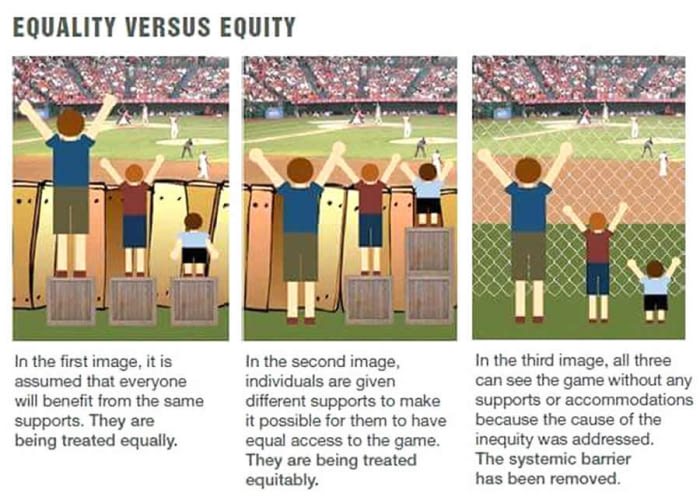
It just dawned on me that the left and right absolutely do not think of “racist” exactly the same. The left looks at outcome and the right looks at intent.
Those words are "systemic" or "implicit" or "institutional", etc. All you really need is a proof or example that racist/sexist outcomes are possible even when there is no overt intent. And there are plenty of examples like that out there. Failure to accept that those examples exist, however, is something beyond just looking at intent instead of outcome.
I don't see how those adjectives add any clarity to the situation, since you can swap them out interchangeably and you're still describing the same vague, handwavy sense of racism somewhere being a cause for an unequal outcome.
This isn't about unequal outcomes, it's about racist/sexist outcomes. It's very possible to have unequal outcomes without them being racist/sexist. And despite what seems to be commonly believed, liberals/left/progressives/democrats/etc don't tend to have a problem with that.
It's also not vague and handwavy. If you'd like to explore an example of institutional racism, check out the Parable of the Polygons. It's a clear, simple model with repeatable results.
I'd also like to bring up the International Obfuscated C Code Contest.
Just because a policy seems reasonable and has straightforward justifications for all of its pieces doesn't mean it wasn't maliciously designed to another purpose. The stated intent is not always the only intent and if the results...
That's true too, yes. I just think it's interesting that malicious intent isn't required. I think it helps to talk about it too - if you can approach the participants and assume good faith, allow them to believe that you believe the output is completely unintentional, then maybe it will be easier for them to agree to change their system.
There's plenty of "systemic" racism/sexism/etc. coming from the left, though. Social engineering in general is a recipe for every kind of unintended consequences at the "systemic/institutional" level, and the left is huge on social engineering.
"Systemic" doesn't even have to be left/right though, that's the point. It can simply be well-meaning people that keep ignorantly doing things they way they did before, unaware that their system has racist/sexist impact.
I don't know what you mean by social engineering, by the way. I've only heard it in the context of hacking, like calling customer support and pretending to be someone else to try to get their mother's maiden name or whatever.
Not the person you're responding to but I took their meaning to be social engineering in the sense of someone's purposeful planning and intercession in areas where there is a social output, fiddling with whatever knobs are available to shape the desired output.
For example, Harvard admitting less Asians because they are over-represented compared to other races. If you take your view that racism is an emergent phenomenon that you can spot based purely on the outcome, then Harvard was exactly correct to deny more Asians admission than other races, yes? If Harvard didn't do that, then the outcome of their admission process would've been "racist."
Many would disagree with that interpretation of racism.
The right[2] looks at intent because that's what matters in a hierarchical view of society. This division is from a fundamental difference in what societies are. This can be observed din how they use language; from one of the most enlightening articles[1] I've ever read:
> One of the biggest problems of the entire Culture Wars is that people like us [the left[2]] use language impart information. We usually are not aware that a nice big chunk of population does not use language in that way at all. Their use of language is that of Phatic Language [...] In a hierarchical society [the right[2]], language is [often] not used for exchange of information [...] It is used to establish social hierarchy.
For a good explanation of how this works, George Lakoff's lecture[3] "Moral Politics".
Haidt's book The Righteous Mind does touch on this - he'll likely have references to the studies in his book. What he says the studies show:
Conservative ideology: Fairness is about guaranteeing everyone equal rights. If different people have different outcomes, the question is: Did one person have more rights than the other? If so, let's correct for it. If not, it is because the person did not fully utilize his/her resources. However, this step is often omitted and people jump to "Person did not put in effort."
Liberal ideology: Fairness is about guaranteeing equal outcomes. This often (but not always) ends up being a metric regardless of the effort the person put in - so if the outcomes differ, it's a sign of something unfair at play.
There is overlap between the two, and they are not fundamentally at odds with each other. However, as a lot of pop psychology has taught us: People are fundamentally lazy in applying analytical thought, and will look for simple proxies. So instead of thinking through as their ideologies dictate, they will jump to the conclusion.
That's not a third option - it is the conservative option. If you build a fence that is tall such that some person is disadvantaged, then he doesn't really have the same rights.
The short person still has the right to look over the fence. They just have practical difficulties on exercising it.
Similar cases: Voter ID laws with disproportionate impact on minorities, gay people having "equal" right to marry someone of the opposite gender, people in impoverished school districts having "equal" rights to an education, etc.
Your last two examples are ones where a conservative ideologue would look and say "No, they aren't being granted equal rights". In the former, you have judges refusing to follow the law. In the latter, you have children who are not getting access to the same public education their peers in wealthier districts are.
>The short person still has the right to look over the fence. They just have practical difficulties on exercising it.
It all depends on what the fence is achieving. I can't take the cartoon literally, because conservatives wouldn't argue that people should have equal rights to view a ball game - whether you can view one or not has little bearing on, say, your financial success. Nor does it impinge on your right to speech, religion, etc. If the fence represented something that was a barrier to achieving what is viewed as a right, and it's a barrier for one group and not for another, then the approach in the cartoon is not inconsistent with conservative ideology.
With regards to voter ID laws: I'm not even going to go there, as in my past experience, it's an issue that both sides refuse to understand the counterpart's.
> Your last two examples are ones where a conservative ideologue would look and say "No, they aren't being granted equal rights".
Unless we're "no true Scotsman"ing things here, conservative ideologues in the US (and a variety of other countries) have strongly and consistently opposed gay marriage, often arguing they had the "same rights" as others and that allowing same-sex marriage would be "special treatment".
Before that, the same was true for conservatives and interracial marriage.
The point of the cartoon is not to advocate for the right to watch a baseball game. It's an analogy showing how the binary "you either have to have an unfair situation or give someone preferential treatment" isn't always the only two options.
>If his studies basically equated liberal ideology with communism (equal outcomes)
It's an easy mistake to make, but Communism (at least as Marx and his contemporaries and Lenin envisaged it) does not have anything to do with the principle of equal outcomes except in a very narrow sense - this sense being equality of privileges to some portion of society.
I think the bigger issue is that I've never anyone other than conservatives characterize liberals as believing in "equal outcomes". That's a slanted frame from the getgo.
Among democrats and liberals, it's usually "equal opportunity" or "equal starting lines", language like that. That's very different than "equal outcomes" because it still believes in self-reliance, merit, diversity in outcomes, etc - it's just that it requires a level of fairness that applies to everyone.