Hacker News new | ask | show | jobs
by Thriptic 2727 days ago
This EHR data problem is something I've pondered for a bit.

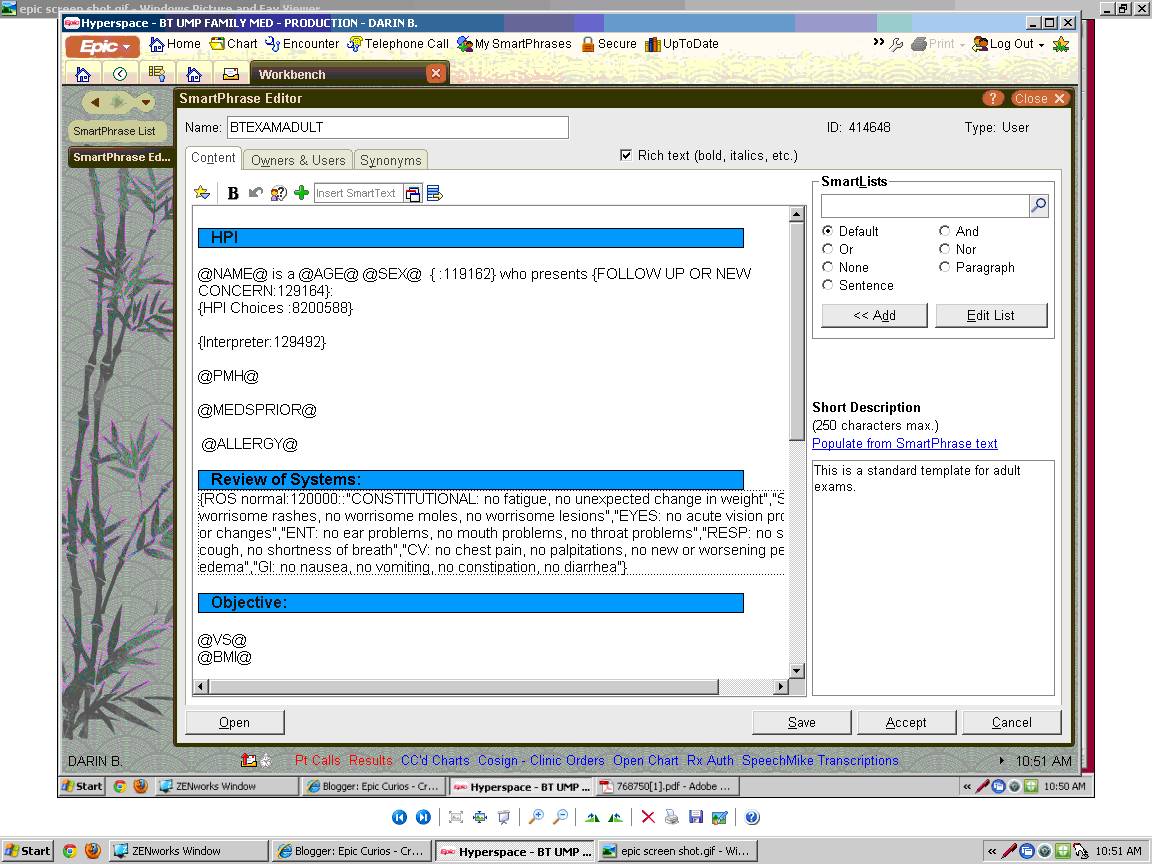
One "simple" solution is to have departmental standardization of note format with thoughtful inclusion of what fields are typically pertinent. This doesn't solve the problem of care transitions but it might help standardize review in a hospital context.

The other thing that I've been pondering is something resembling a formalized data structure and language for note taking. For example, diagnosis X based on Y Z. Other probabilistic diagnosis A ruled out because not B not C yes D. Reduce free form notes to be as sparse as possible. Also there should be a reference system to point back to other notes / lab values / imaging which when clicked will bring up that data. Finally, a timeline which charts pertinent diagnoses, lab values, and changes over encounters. I'm not sure how viable it would be given the complexity of notes that my physician colleagues have showed me / what I've seen in research, but I'm curious.

3 comments

Many departments do standardize their note formats. The problem is that the note is directly connected to billing, and the billing requirements are absurd. I'm a medical student, and I recently visited my PCP for a medication refill. I have no significant medical history whatsoever, and the visit took no more than 15 minutes as expected. A month later, I was given a bill for $330 stating my hospital visit was level 4 acuity (there are 5 levels, with level 5 being ICU-like care). I looked into how the billing level is determined, and I found this article explaining how components of the notes are tied to billing levels [1]. Basically, by including 6 elements to the physical exam rather than 5, you can bill at a higher tier. There are several other areas that are tied to billing like this, including the family history, social history, etc. My PCP had completely filled out her standardized note to include every little detail I had mentioned—many of which were totally irrelevant to my current issue.

I talked to some other physicians about this, and I learned that hospital departments use their standardized notes to include as much detail (i.e. bloat) as possible so that physicians can bill at higher tiers since billing is tied to the number of details included in the note.

[1] https://www.aafp.org/fpm/2003/0100/p29.html#fpm20030100p29-b...

The reason healthcare costs so much is that the feedback loop between the service recipients, providers, and payees (the largest of which is the Government which multiplies the mismanagement) is so perverse.
FWIW, my psychiatrist calls in my medication Rx (3 drugs taken PO daily) every December, with 11 refills. I've been on exactly the same Rx for 18 years, so it's not as if he's going out on a limb. Sure cuts down on appointments to see him.
Why did a visit to your PCP get billed as a hospital visit?

And which acuity scale was this? Usually the higher the number, the less acute you are.

I meant outpatient visit. My PCP is in the main campus of the hospital, and I wasn’t being rigorous with the terminology.

I’m using the CPT codes within the site I linked to. 99211–99215 are the codes that correlate to acuity, with 99215 being the most acute. I am aware of other systems like level 1 vs level 2 trauma centers. In that case, yes the level 1 is higher acuity. Maybe that’s what you were thinking of?

Got it. I perused the link but didn’t see any 1s,2s,3s,etc. I was just worried that the US started implementing a triage scale opposite from the rest of the world.

I’m more familiar with the (pre-)hospital triage scales in non-US countries: https://en.m.wikipedia.org/wiki/Triage#Canada

This is pretty unsavory, most visits are billed at 3.
All large hospitals and clinics already have standardized note formats.

For care transitions the HL7 C-CDA 2.1 Continuity of Care Document (CCD) format works pretty well. Modern EHRs can export a summary of a patient's chart in that format. Some data may be lost in translation but usually it works fine. But there are often still technical obstacles to transporting a CCD from one provider to another.

There are existing formal code systems for notes: CPT, ICD-10-CM, RxNorm, CVX, SNOMED-CT, etc. Those are helpful for billing and analysis purposes, but they can't replace free form narrative text for most clinical use cases.