The meaning of the word "stabilize" isn't clear from the article, despite being used 12 times in the body and once in the title.
It would have been easy to make the article more clear. Simply explain what aspect of Bitcoin is supposed to stabilize.
Given the unending fascination with the USD/BTC exchange rate, it can be assumed that the author is referring to this metric. The inclusion of the heading "Does the price of Bitcoin have a Nash equilibrium?" also supports this idea.
However, if this is the case, why does the author include the following quote the middle of the article:
Why has Amazon stabilized, and will bitcoin do the same? When Amazon shares debuted back in 1997, earnings were non-existent. […]
As you can see, it's a concave-upward curve, punctuated by various declines, all the way back to 2003.
This may sound like hair-splitting, but I think there's a real possibility the author is actually talking about USD/BTC exchange rate volatility. This is an animal of a completely different stripe.
I would say that stability refers to purchasing power, and doesn't need to be a flat line. It can also be a simple math function (liner, logarithmic, exponential) which means that it is somewhat predictable. (Edit: I think a better word than "stable" may be "dependable", which is probably what the article meant).
For example, the US Dollar loses purchasing power over time, but that is OK, since it is mostly at a predictable rate. But when something has wild swings up and down, and random times, then it is less suitable to either use as a currency (the stock person with the price gun will be working overtime correcting prices on everything several times a day), and it isn't that good of a store of value if there isn't any reason for it to not lose all of its value over a given period of time.
The Amazon graph you linked to does look fairly stable, a nice exponential function that has very good reasons to remain so for a good period of time (not saying this or anything else is guaranteed, but at least there is something tangible behind that price).
So the article concludes that Bitcoin can gain stability by being anchored to the price of gold. However isn't gold a "Keynesian Beauty Contest"? That is, gold is valuable because other people believe other people believe it is a store of value.
I think there's something to be said about gold's utility as money. It's remarkably good at being money compared to other materials. It's easy to store, identify, divide, it's fungible, and it's scarce enough. If civilization were to collapse, I think that there's a fair chance that we'd be using gold and other precious metals as money again, whether or not it was used in the past.
I'm not sure I believe that. If civilization were to collapse, you'd want food, medicine, potentially gas. Potentially solar cells, and some other things.
I think you'd see more traditional bartering than money being introduced again in its earliest stages.
The problem with bartering is that useful but rare products are a poor store of value because peot need to use those things. Useless but rare things are better as money, as long a users are confident that there is economic growth to spend money on (decoupling consumption from production)
If gold was no longer wanted for investment, its value would go very close to 0, despite utility to industry. Why? Because there's 190,000 tons of it, most of which is being held as an investment. If it wasn't needed for investment any more, then all that becomes available for industry, and now supply absolutely swamps demand.
Jewelry demand wouldn't help, either. If the price of gold went to 0, how much would be used in jewelry? Sure, it's pretty, but being expensive is part of the point.
I think the tensile strength/density might make gold transmission lines a bit crap. Maybe steel core with a gold outer where the AC current flows, but not sure if it would actually be any better than aluminum.
Gold has a 3000+ year track record of being a store of value. Yes, people worldwide could decide that gold was just a fad that we've moved past. But I'd regard it as a pretty safe bet that they won't, at least not in my lifetime. Gold may be a Keynesian Beauty Contest, but it's been winning for long enough that it's almost in a different category by now.
Bitcoin, on the other hand, is still firmly in KBC territory.
It will eventually come down to the fact whether people feel it is or will end up becoming digital gold. It's very much a binary situation; true or false.
That outcome will likely also result in a further 50x return from here, or a further decline.
Bitcoin doesn't need to stabilize to be successful. In the same way that the exchange rate of the hyperinflating German Mark and gold didn't need to stabilize. All bitcoin needs to do is continue to operate with it's programmed monetary policy such that its value can't be inflated away through coercion.
Money is a commodity whose goal is to transport value through space and time. We are living through -- in human-species scale -- a brief 90-year experiment in the artificial elimination of a free market of monies by violence of the state (until bitcoin was invented).
Artificially increasing and decreasing the supply of money in an economy has about just as much utility as artificially increasing and decreasing the supply of any other good -- which is none.
Bitcoin's success narrative doesn't depend on the amount of non-scarce dollars the market is willing to trade for it ceasing to change ('stabilize'). The success narrative is: an increasing set of people understanding that the hardest money always wins. Bitcoin is one halvening away from being harder than gold and is _the_ hardest money ever in existance. Those who have taken exposure to bitcoin will have more wealth preserved than those who denominate their value in inflatable dollars. As more people see bitcoin improving the quality of life of individuals they also take exposure to bitcoin. This process doesn't need a planner nor intelligent agents, it just needs bricolage.
Thank you for posting this. Not surprising to see you getting downvoted to oblivion here, but this is something that people really need to keep an open mind about.
It's downvotes because it's using false facts as a basis for opinion, and using weak logic to connect them. Fiat money is over 90years old, Bitcoin is deflationat by design, and neither of these facts matter. The open market is subject to manipulation (counterfeiting and cornering) as much as government fiat.
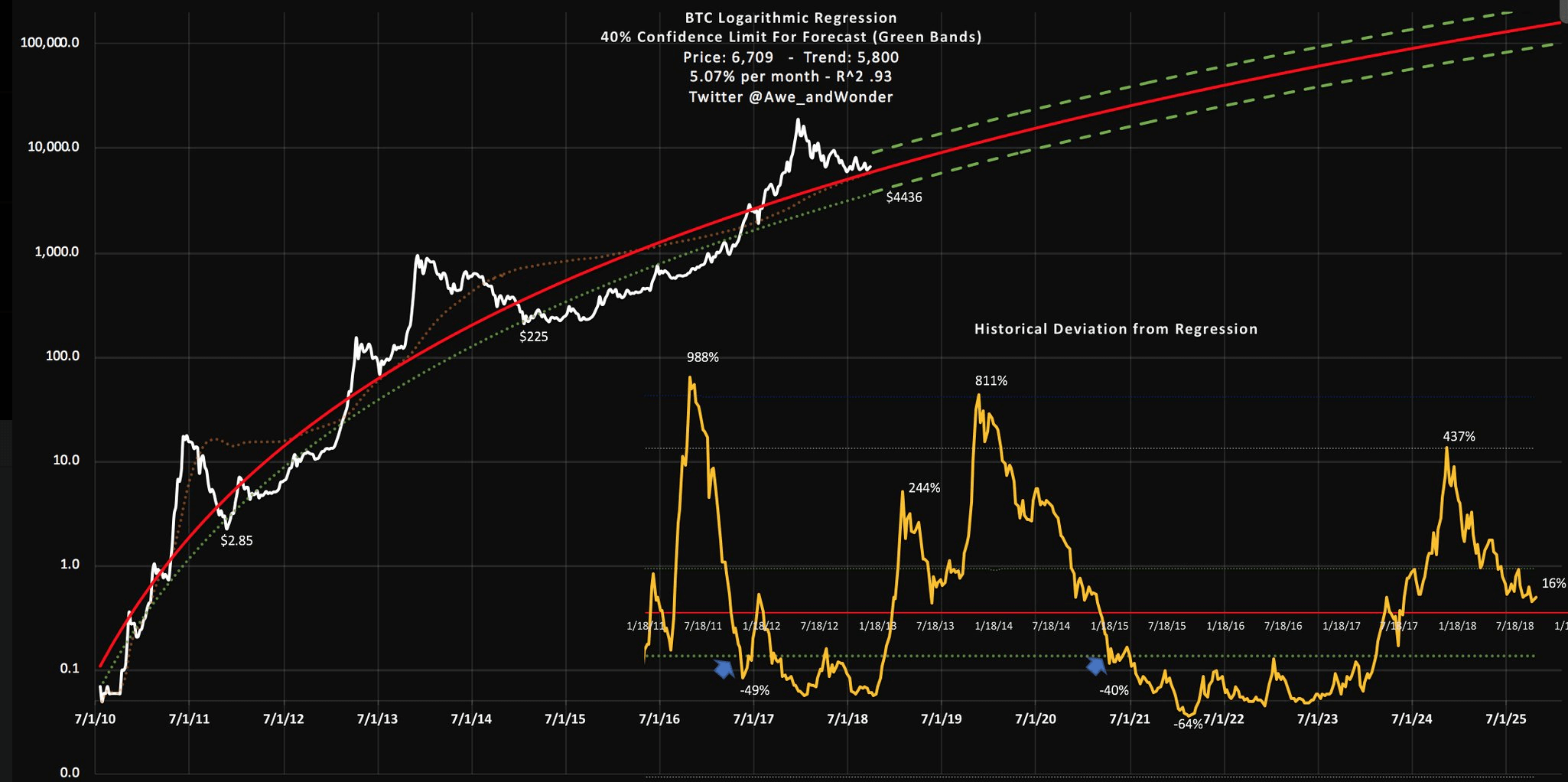
The data in that "model" appears to stop before the end of 2014. The last year of Bitcoin price breaks that "model". I'm also using scare quotes because those kind of "models" should be scary because they're misleading at best.
I have ZERO evidence to believe that the trend will continue. This chart is pretty popular amongst cryptocurrency followers. I'd actually love to know what experienced trading analysts think about these type of predictions and whether similar non-crypto models exist.
Interesting that it called $10K/Bitcoin only a month early, though, and did so 3 years in advance. The actual Bitcoin price underperformed the model by about an order of magnitude throughout 2015 as well as a long stretch in 2012; Bitcoin seems to have a "big bubble, then it bursts and plateaus for years" pattern.
Your first chart stated that BTC would be over $10,000 by the beginning of 2018, and be somewhere in the ballpark of $20,000+ by now. Your second chart drastically reduces that forecast. You do know you are just overfitting a curve to data here, right?
Well to be fair it is just refitting not overfitting. If it was overfitting it would have heaps of free parameters and match the data really closely. The criticism should be what is the mechanistic explanation for why you would expect this logarithmic trend (for the log price, is that just linear or am I just confused?)
The red curve is an average price. The first chart states that BTC would be $10,000 on 22-11-2017. On that day, the price was $8310. The prediction was made in 2014, so this is pretty accurate I must say. There is also a belief that the reason for inaccuracy of the first chart is because of a hardfork (Bitcoin Cash), that "ate" part of the Bitcoin's market. Afaik, the second chart was made by the same author a few days ago. It's obviously different, because it takes recent prices into consideration.
Right, and how is that going for them? The average home cost around $3,400 in 1913 (when the FED was created), and today is around $200,000. And $1 is still worth $1.
It's actually going very well for the US. Inflation has been been low and stable. The real economy is larger than it's ever been. Unemployment is very low. Out of all the countries and currencies on Earth over the past 100 years, the US and its dollar have had a better track record than almost any other.
A few corrections to some possible misconceptions:
(1) Fed is short for Federal Reserve. It's not an acronym.
(2) The goal of the Fed is not 0% inflation. Because downside risks are worse than upside risks, the Fed's explicit long-term target is 2%
(3) House prices aren't great to use as a metric of inflation. A house built today is far, far better than house built in 1913. According to the consumer price index, $3,400 in 1913 has the rough buying power of $88,000 today.
In my opinion, if you want to make a serious argument against the Fed, you should (a) do more work than rhetorically asking how the past century has gone for us, and (b) at least be familiar enough with the thing to spell its name correctly.
Thanks. I am well aware of all the things you pointed out. I think we just have a different opinion of what stable is or should be.
I think a currency that has $1.00 worth of purchasing power when I am given it should not lose 99% of its value over the next 100 years if I do not spend it. I am aware that that is impossible due to inflation, and that is why things like gold are much better stores of value than the dollar.
Are you planning to hold on to that dollar for a hundred years?
Do you think you'll be alive then?
Do you not think that perhaps if you want it to maintain or grow its value you should put it to work, rather than just sitting on it?
Why should society value whatever it is you did to earn a buck today the same in 100 years?
The prices fluctuate not due to mere speculation (on the beauty of currencies) but the need to convert currencies to run a company or live your life (e.g. you have dollars and you need to pay your supplier in yuan).
> Would you consider USD also subject to a Keynesian Beauty Contest?
No. The Fed puts its thumb on the scales. We've known since about the 19th century that growing economies and fixed-supply currencies don't play well together.
The late 1800s had some rather severe panics that were caused by deflation - specifically, the Panics of 1873 and 1893.
The problem with fixed-supply currencies is that if the economy is growing, and the supply of currency stays constant, currency is worth more.
If your debt is measured in that currency, your debt just increased, and you might no longer be able to pay it. Large numbers of foreclosures are bad.
Incidentally, one of the biggest political movements in response to these panics was a push to put the US onto the silver standard. Silver is more common, so it's easier for the supply of currency to increase (read: inflation) as the economy increases. A guy named William Jennings Bryan made a rather famous speech[1] about it.
Today, we eschew a metallic standard entirely and just focus on achieving a constant rate of inflation. Zero inflation would be fine, but it's hard to achieve, and any missteps might lead to deflation. So, the Fed aims for 2% inflation - low enough for the value of the dollar to be pretty stable, but high enough that if the economy does something weird, we don't enter a deflationary state.
Along with most stocks. I think the key isn't whether something is/isn't a KBC, but how much other stuff exists that helps anchor it to some kind of objective reality.
Bitcoin has been pretty stable around $6500 for the past month. And for six months has been way more stable than The Shitcoins (BTC has gone from 30% to 50+% of total market cap in that time).
This comparision is empty because anything exchange into the same results with the same. in other words: nobody exachange dollar into dollar unless they are not sound-minded.
Fiat currency is at its best second degree KBC because other countries decide on accepting or rejecting US economical indicators by temporarily betting on their short term future and set currency exchange point for the next 24 hours or so. Nobody buys US dollar because american flag is pretty or english is second broadest language in the world or some other “pretty face” indicator, as currency exhange dollar versus everything for the last 25 years clearly shows USD strenghtening +500% and weakening even 50% all the time.
No, Feds do not decide on this beauty contest. May be suprise to you but only 20% of printed dollar remains in usa. 80% is being shipped out for all sorts of purposes such as balancing countries oil wallets (aka petrodolar) to aiding other countries ending on fact that many countries prefer intra-use of greenbacks to its own currency. So Feds at its best control pretty face of dollar on its local playground aka USA, but in reality they dont because again dollar strength comes from evonomical indicators, not from how much feds prints.


It would have been easy to make the article more clear. Simply explain what aspect of Bitcoin is supposed to stabilize.
Given the unending fascination with the USD/BTC exchange rate, it can be assumed that the author is referring to this metric. The inclusion of the heading "Does the price of Bitcoin have a Nash equilibrium?" also supports this idea.
However, if this is the case, why does the author include the following quote the middle of the article:
Why has Amazon stabilized, and will bitcoin do the same? When Amazon shares debuted back in 1997, earnings were non-existent. […]
The USD price of AMZN has in no way stabilized:
http://bigcharts.marketwatch.com/quickchart/quickchart.asp?s...
As you can see, it's a concave-upward curve, punctuated by various declines, all the way back to 2003.
This may sound like hair-splitting, but I think there's a real possibility the author is actually talking about USD/BTC exchange rate volatility. This is an animal of a completely different stripe.