Hacker News new | ask | show | jobs
by KerrickStaley 2800 days ago
When you have more money or capital assets, more of your income comes from capital gains and less comes from the labor you do. So decreasing taxes on capital gains disproportionately benefits people who are already wealthy.
2 comments

Any tax decrease "disproportionately" benefits the wealthy because they have more.

A 1% decrease on $50,000 income is going to be less than the same percentage decrease on $500,000.

Of course, you could argue that "progressive" tax take care of that, but it only serves to drive away a portion of high meet with individuals to the point where tax revenue generally doesn't change much anyway while it can actually increase the overall burden on lower income earners.

Better solution: goodbye income tax.

Much like open source software where individual usage is free, only consumption/sales and corporate taxation has any legitimacy now.

Businesses need a commerce-positive, safe environment for such activity. In order to attract that, no income tax is an excellent incentive. Businesses, which are fictitious entities, support the services needed to entice localized growth; as population grows, so does business activity and revenue, thus tax revenue for services as well.

Of course, any system is prone to corruption filling the power vacuum so eventually it would fail. However, so long as individuals are as unencumbered as possible, people can opt out rather than continue to be abused.

Additionally, taxes serve as a psychological leash and intellectual substitute. Financial/investment education is virtually non-existent in the US and it's generally misguided or even wrong in some instances. If individuals are coddled and promised to be taken care of, they become unprepared for difficult situations.

Let a dog be a dog and let a person be a person, not a slave.

> Any tax decrease "disproportionately" benefits the wealthy because they have more.

Untrue; consider, e.g., the adoption of EITC if it didn't already exist. It's a pre tax decrease, but wouldn't benefit the wealthy (in first order effects) at all.

Or abolishing payroll tax and transferring equivalent amounts into the various trust funds out of general revenue, a pre tax decrease that would slightly benefit the wealthy (because Medicare tax), but disproportionately benefit those whose income was primarily from labor, which isn't the wealthy.

Or more simply, a reduction in the amount paid in the first few tax brackets. That is a tax decrease that would benefit everyone but proportionally benefit more those to whom the upper tax margins are irrelevant.
So complicate the tax issue which increases costs elsewhere and contribute to government managed funds that prove inept? Taking funds from a farmer growing crops successfully and giving them to the one nextdoor who still hasn't been able to get a seed to sprout is a textbook definition of idiocy, not to mention theft.

None of that changes the fact that tax breaks will be greater in absolute numbers for wealthier individuals than for those earning less. Play games to fudge numbers so all is not equal as much as you want - those with resources avoid participating in socialistic wealth redistribution.

No income tax is far simpler. Do you know what the cost for enforcement of individual income tax is? Hint: think astronomical.

Go after about 140 million individuals vs working with approximately 28 million businesses? Do you think business or individuals are more professional? Who had the bright idea to create such a logistical nightmare?

You can keep working with an insane system if you want but people with resources do what people without resources would eventually do in the face of direct taxation, whether financially or physically - leave.

> No income tax is far simpler. Do you know what the cost for enforcement of individual income tax is? Hint: think astronomical.

I do know what the cost of enforcement of individual income tax is, at least in a sane system with effective witholding and most people not submitting stupid tax returns every year: about 1.25% of money raised (https://publications.parliament.uk/pa/cm201012/cmselect/cmtr..., table 7).

And the simpler you make the system the cheaper it is (this is NOT flat rates - calculating graduated taxes on income is basically free) - you can see this from the "National Insurance Contributions" line on the same table, which is an effectively zero-complexity additional income tax which costs a third of a percentage point of money raised.

So not astronomical. Really quite efficient.

They're actually getting even better at it - 1.12% in 2009-10!

I like how you've pointed out the amount relative how much theft^H^H^H^H^H "tax" revenue is brought in rather than the absolute amount of:

£3,673,797,000

That's pretty astronomical to me. I'm sure you'll find other ways to break it down and try to refute but it still doesn't change the waste of time taxation incurs.

My stance will not change from the perspective that income tax is more destructive to low-income earners than it is to the wealthy, and that it drives away wealth.

Let's just settle this as "we won't agree" since I have more productive things to spend my time on than arguing over what shouldn't exist in the first place. Pray for Brexit or go down with socialist Europe.

But it also discourages investment if you taxed as income you just buy safer t bills etc instead of the next Microsoft or google
That's ridiculous. If you buy T-bills today your don't even keep up with inflation. Rich people need to make long term investments to stay rich, they can't take money out of the system or inflation eats it.

Further, paying capital gains at say 50% on 10% returns for 20 years is better than paying 0% capital gains on 6% returns for 20 years.

Ok maybe instead of etc I should have said t bills, bonds, bond proxies ie safer investments that are taxed as income.

When capital gains are taxed as income the whole chunks of the monetary system go away.

Let's ignore the fact that If people rush into these other assets like you claim, it would impact their price and return profile. The key question is which chunks of the monetary system "go away." Are those chunks a net benefit for society in the first place or simply a tax deferment/avoidance vehicle for the rich?

Take the recent corporate tax cut, which made companies flush with cash. Companies could invest that in 4 main buckets: pay down debt, invest in growth (r&d or acquisitions), pay out bonuses to workers or buy back stock/declare dividends.

Let's say the company has 1,000 employees and gets $1 million in new cash flow from the tax cut. They have little debt and no direct acquisition targets so they are now deciding between giving all employees a $1,000 bonus or buying back $1 million worth of stock.

Since bonuses are taxes at regular income rate and dividends/capital gains are taxed at 15%, the tax efficient way to put that money to use is through buybacks or dividends. The people making the decision are likely executives with high salaries (income tax rates) and large stock portfolios. They will only pay 15% tax on those dividends compared to the bonus option where they would likely pay at the highest income bracket.

Who gets the short end of this dynamic? Workers who helped create that revenue, but can't afford to buy enough stock to get $1,000 of benefits. The tax code has disincentived the company from rewarding its employees in favor of rewarding its investors. Again, people who are already wealthy tend to be the investors rather than those who typically labor for their income.

If there is no tax incentive the investing in new start up companies eg (fever tree in the UK)

Then rational investors will avoid risker share investments in new companies it will reinforce the position of incumbents who will be forced to pay out more in dividends and become bond proxies.

Where you are making a mistake is riskier investment have a risk premium. Further, you can offset capital gains with losses, and with a highly diversified portfolio the expected returns will be positive over time.

So, it's going to be rational with a 0 or 50% capital gains rate with some portion of your portfolio. Further, increasing capital gains makes it harder to keep up with inflation thus pushing people to make riskier investments.

PS: Try modeling a portfolio of bonds with different yields and risk premiums vs different tax rates including inflation.

==Then rational investors will avoid risker share investments in new companies it will reinforce the position of incumbents who will be forced to pay out more in dividends and become bond proxies.==

Investors will seek alpha wherever they can get it. If there is a flight into "safer" investments, the market would adjust and the returns of those "safer" investments would fall. If investors want alpha returns, they will take risks. This is a fundamental truth of investing.

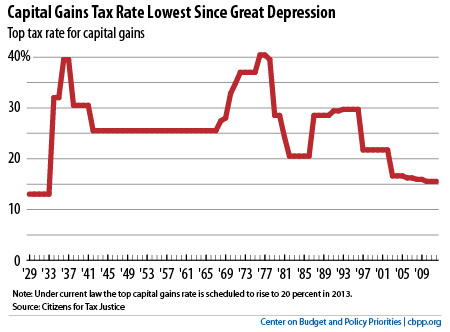
Are the incumbent's positions not reinforced in today's environment? There are 3,618 publicly traded companies today compared to 6,407 in 1987 [1]. Is that a sign of positive competition? Today's capital gains rate is the lowest since the Depression [2]. Yet, entrepreneurial activity is at generational lows [3].

[1] https://www.bloomberg.com/view/articles/2018-04-09/where-hav...

[2] https://www.cbpp.org/sites/default/files/thumbnails/image/ca...

[3] https://money.cnn.com/2016/09/08/news/economy/us-startups-ne...