Hacker News new | ask | show | jobs
by trhway 2810 days ago
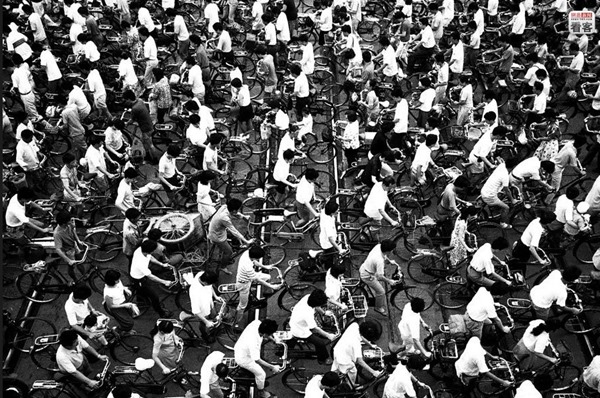
cycling isn't space efficient and doesn't really scales that good. It is a luxury ttransportation mode for low/mid density US cities not capable/not willing to build true mass transit modes. Look at the packed subway in say Moscow (https://www.youtube.com/watch?v=GCZKXHsZo68) and compare to the best possible bicycle situation - mid-80s China http://www.theurbancountry.com/wp-content/uploads/2013/02/83... - around 10 times density difference :) Take that photo, cut 1/5th in height (2-3 abreast) and put large distance between very enthusiastic riders (incl. speeding electrics) - such modern bike lane shows very low efficiency of space utilization/bandwidth and very insufficient capacity to move any significant number of commuting bodies.
3 comments

Cycling is at least four times the space efficiency of cars, unless all the cars are Smart Fourtwo or equivalent. And that’s when parked, the multiplier goes up with speed.

Additionally, low density US cities are one of the worst places I’ve seen for cycling, because not only is everything spread out, but also the multi-lane roads everywhere make it much more dangerous than equivalently populated towns and cities in Europe. Despite having cycled through central London (UK) and just over 1,000 km along the Rhine, there’s no way you’d see me cycling around Salt Lake City or Sacramento. I’ve cycled around Davis (CA), but Davis has better than US average cycling infrastructure — almost as good as the average level in the UK.

wow, I was using London as an example of how NOT to do cycle infrastructure.
London is getting there, slowly! There are some excellent examples of well-designed, well-used cycle infrastructure such as the new(ish) Cycle Superhighway along the Thames Embankment. This will hopefully serve as a model for future infrastructure.

In general, traffic speeds are low in London and there are lots of quiet side routes that are well suited to cycling. We’re no Amsterdam, but cycling is certainly much more popular and visible than it was 5-10 years ago.

London is unpleasant and stressful, but as Reason077 says, traffic is slow. Compared to the American cities I’ve seen, though, it’s second only to Davis.
A subway is a high latency, high bandwidth carrier. A bike track is a low latency, high bandwidth carrier. That is in a subway all "packets" (people) need to wait for the next opportunity to depart, whereas in a bike system all packets move more slowly, but at a more continuous pace (set by the maximum speed of the transport).

A lot more people can pass any point in a biketrack per hour than they can per subwaytrack, and they can often take a more direct path to their destination using bikes than they can by subway. That also means that a bike system is better suited to a city where both the departure and the destination are diverse among all "packets".

That's not even starting to talk about how biketracks scale much better economically since they are much cheaper to build.

>A subway is a high latency, high bandwidth carrier.

Trains coming in each couple minutes - show me lower latency than that :)

>A lot more people can pass any point in a biketrack per hour than they can per subwaytrack

several hundreds (up to a thousand in rush hour packing) people per train each couple of minutes - beat that.

Anyway, the rest of what you're saying about biking is just a theory that doesn't come even close to the reality of any big dense city in Europe/Asia. This is why those cities has highly developed subway system - the low latency high bandwidth and high speed mode of transportation. You put all these people on bikes and they would choke the city.

I guess you have never visited Copenhagen or Amsterdam? Those two are pretty strong counterpoints to what you are saying.
I stated from the start that lower density smaller cities (which Copenhagen or Amsterdam are - having density 1/3rd and 1/4th of San Francisco for example) may allow for luxury of letting people to enjoy their commute on bikes.
High density usually isn't the problem for American cities (though it might be for SF, I don't know that one specifically), but rather low density suburban sprawl is. Higher density usually makes it easier to walk or use personal transport like bikes.

For it to be too dense for biking to be a viable transport they would have to be much denser than European cities which would by definition not allow for parking in the places where business takes place (in which case nobody would drive).

Most American cities were clearly designed with cars in mind, while most European where not (having grown organically rather than being designed), and while the American decision might have seemed better for the better part of the last 100 years, that might not be the case for the next couple of decades.

Bike lanes are incredibly efficient compared to automobile lanes.

https://www.cycling-embassy.org.uk/dictionary/capacity