Hacker News new | ask | show | jobs
by user3359 2817 days ago
This is more of a problem with time frames. Wooden houses last 100-200 years if very well built. I've seen teardowns after 50, sometimes less. What's the environmental cost of building 4 wood buildings to last as long as 1 concrete building?

Concrete construction lasts centuries. And if torn down, can be crushed and after separated from rebar, re-used as aggregate in another project.

8 comments

The main problem is the environmental damage. The concrete industry is the third largest producer of carbon dioxide emissions in the world. It also represents a third of all landfill waste.

Reinforced concrete is incredibly expensive to repair and maintain. Because of the dozen different ways it can rust and spall, you need to inspect it frequently. The longer you wait to repair it, the more costly it is. A great deal of our reinforced concrete bridges are now structurally unsound. And recycling it is expensive, difficult, and reduces its strength.

Roman concrete lasted centuries, even millennia. But it's very difficult for us to produce concrete of a sufficient quality to last a very long time, as there are many ways to introduce defects. Many of our modern concrete structures wouldn't last a century without significant expensive maintenance.

On the other hand, wood buildings can actually be deconstructed easier, recycled easier, composted easier, don't have a gigantic burden on the environment, and can be made quite strong, as well as lasting for centuries. They're also much easier and cheaper to repair and replace.

I live in the northeast, where 100+ year old wooden homes litter the landscape. The biggest problem with old homes isn't the wood - it's their dated construction methods. My girlfriend lives in what was essentially a wooden barn converted into a house. It wasn't designed or maintained properly, so it's slowly shifting and falling into disrepair. But a well-designed, modern wooden home can last a century or more with maintenance without falling apart.

Concrete with rebar actually has a shorter lifespan than concrete without rebar, or wood even. Unless the rebar is coated or made from something other than iron/steel, it will eventually rust from absorbed water. Once it does so it expands and cracks the surrounding concrete.

https://theconversation.com/the-problem-with-reinforced-conc...

Directly trapping carbon for over 50 years is pretty good, and the main CO2 release in concrete is the cement - both in heating it and the actual reaction necessary to create it. Aggregate availability isn't the issue there.

On top of that, large scale structural concrete is a fairly new technology, and while improvements to longevity have been made, many buildings will be lucky to make it to 100 years.

Most buildings for which you'd consider wood will probably be torn down before they become structurally unsound simply because a different building will be desired (bigger / different purpose).

Also, is concrete actually reused like this at scale? Sounds unfeasible economically.

50 year homes being torn down? Whoa.

I haven't seen anything like that in my experience at all. House I grew up in is still going strong at 65, really quite a baby compared to most around me in my suburb.

Only know of one house which burned down completely, was torn down and rebuilt in the heart of the city.

Most significant damage caused to wood-frame homes tends to allow partial rebuilding and renovation without the need for tearing it all down completely.

There's a lot of ~50 year teardowns where I live, but it's people that want to build something big and ostentatious on the lot in desirable neighborhoods. The homes they are destroying are often all brick construction.
You see it mostly with smaller homes in areas that are desirable. The smaller homes, usually built 50-60 years, tend to have low ceilings, small kitchens, no master bedroom, etc. Some have structural issues due to neglect but most are fine structurally just not desired by buyers.

When the owners decide to sell they usually get snapped up basically for the land cost - demolition cost and are torn down for "teardown" houses. In Chicago it's pretty common. Our street is about a 50% mix of 50s homes and < 10 year old teardown homes.

If you want to see what full neighborhood teardowns look like, plan a visit to Vancouver, BC. The number of McMansions popping up all over the place is shocking.
Does concrete last centuries when reinforced with steel?

I know next to nothing about building construction, but I saw this article recently, which suggests it doesn't:

https://theconversation.com/the-problem-with-reinforced-conc...

found via http://www.notechmagazine.com/2018/09/no-tech-reader-21.html

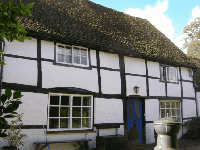
My gran's cottage was timber framed and I think over 500 years old. She had more problems with the 1970s extension than the old bit http://www.tree-ring.co.uk/images/2010/Dean_Leys.gif
Japan builds houses to last approx 30 years, and it wouldn't suprise me if other first world countries copy that: https://www.theguardian.com/cities/2017/nov/16/japan-reusabl...

I suspect most 80's houses anywhere in the world (concrete or wooden) are rather undesirable.

"What's the environmental cost" is not as relevant to most people as having a modern house, and what's the long term environmental cost of old homes with poor insulation?

My house was built in the 50s. It's perfectly livable, and the wood used for framing is better quality than what is used for construction now.

Compared to cost of new construction, adding proper insulation is nothing, even if you rip out all the drywall.

That said, in my area, old houses aren't torn down because they aren't viable. It's because tearing it down and rebuilding a mcmansion nets you so much more profit/worth.

Yup, we've got a house from 1957, 1800 sq.ft. single storey slab. The whole thing is made of Douglas Fir, super sturdy although a pain in the ass to drive nails into. We're in the process of an interior re-design, and purchase price+slab levelling+reno is going to put us quite a bit lower than new builds around here. Down the street there was a 60s bungalow that was torn down and replaced by two new builds, currently selling for $499k each. That's about $180k more than our total, with less floor area. (Plus, if we ever decide to move... there's the backup plan of "tear it down and build two shitty new builds and sell them for $499k each")
I have a wooden house from the 30’s: because I like the feel and I like the trees.

I should have been clearer: there are houses from the 80's that I love. However there are also many houses from the 80's that are built poorly or are just fugly.

I’m in an 80s house right now. It’s pretty desirable. Doubly so because the neighborhood trees have matured nicely. The 60s bungalows nearby are getting torn down though - but mostly due to their small size.
My entire neighborhood is home from the 70s-80s and their value continues to rise every year.