Pardon my language yet that is so fucking cool. Do you know how the app interfaced with the microscope and optical tweezers? I just love the idea of a simple api that controls this crazy complicated lab equipment.
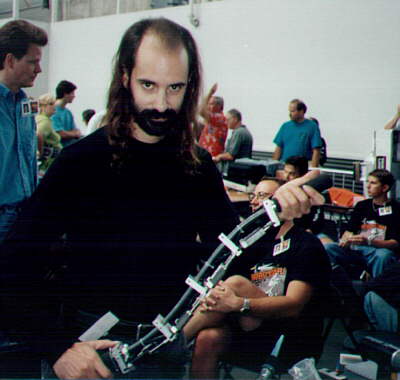
I remember as a child watching an episode of some version of battlebots, where a competitor had an articulated grabbing arm on top of his robot. The arm had, I believe, two articulating joints and then an articulating grabber/jaw at the end. To control the arm he had made a small 2d model of it and could simply move that around on a clipboard like backing, and it would map those movements to the servos in the arm. I was blown away by how intuitive and simple of an interface he had made for this contraption that I imagined would work with a complicated series of levers similar to those used by backhoe operators. I credit this in no small way with inspiring my ever-persistent need to automate as much as possible in my adult life.
EDIT: If anyone has any idea which episode of what show this was, I would be very excited to watch it again
Perhaps you're thinking of Snake, built by Mark Setrakian? One of the most iconic battlebots ever. I could only find one video of him using the skeuomorphic controller [1], and a picture of him holding it [2]
The paper I linked describes it a bit more, but it's unfortunately behind a paywall. I'll summarise it here.
They used a camera connected to a LabVIEW interface to view the trapped particles, but they control it using a laser and a spatial light modulator (SLM), which is able to imprint a spatial pattern onto the laser beam, which is ultimately what creates the optical traps. The paper says "The trap coordinates [on the iPad] are synchronized over the wireless network with a desktop computer, which controls the SLM using our freely available LabVIEW software" (square brackets mine), i.e. they control the traps using a separate computer interfaced using LabVIEW to the SLM. The iPad is used to show the video stream and allow the user to set and manipulate the position of the traps. The camera is also connected via LabVIEW: "Using the JPEG compression available in the National Instruments Vision library, we can stream around ten frames per second from the control PC to the iPad over a wireless network (limited by available CPU power on the iPad). Up to 11 optical traps can be simultaneously dragged around, and they can be created and removed with a double tap on the screen. Double tapping with multiple fingers creates multiple optical traps simultaneously, which is very useful when trapping non-spherical objects."
I guess a more up-to-date iPad would manage more traps. The one they used (circa 2011) was probably 1st generation.
EDIT: If anyone has any idea which episode of what show this was, I would be very excited to watch it again