Hacker News new | ask | show | jobs
by mishoo 2874 days ago
It's not always 10:1, but it seems to be a good average. This happened to me numerous times — I sometimes start with a quick and dirty solution for my problem, then refine and refine until I'm happy with the result, the performance, the code looks beautiful and then I'm like “heck, it's only 100 lines and it took me a week”. In more pathologic cases, I've spent a week just thinking about it, and then I started writing code.

I'm programming for 20 years and I still can't provide good ETA-s for non-trivial problems.

2 comments

> I still can't provide good ETA-s for non-trivial problems.

Well, that's why they are non-trivial problems. Don't be too hard on yourself ;)

Exactly; you can only provide a more accurate estimation if you know all the details and the exact implementation and how fast you can type, and even there you have to take at least a 30% margin either way.

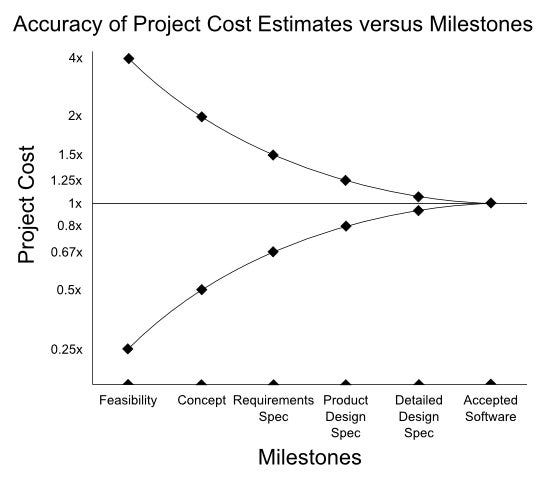
You can only be 100% accurate when it's done. Here's a chart: https://cdn-images-1.medium.com/max/1600/1*hS2GObQarMYhamPeV.... Basically, the closer you are to done, the more accurate your estimation will be.

To go even further on that point - the chart itself seems overly optimistic. +-40% of estimate after product design? +-10% of estimate after design spec?! Countless number of times I have seen detailed design specs completely thrown out of whack by new engineering, process or business revelations/insights. Human thought is iterative - most people can imagine at most 80% of the future/product/design possibilities.
Yeah this sucked to read... 10 years into programming and I thought pretty soon I'd be able to figure this stuff out on the 1st or second go...