Hacker News new | ask | show | jobs
by cstross 2881 days ago
Startup time is a non-issue for both Vim and GNU Emacs on modern hardware. (It was not ever so: I remember first meeting Emacs under DOS on a 20MHz 386. It was not speedy.)

Perhaps another underrated issue affecting relative uptake is keyboard layout.

As the OP explained, Berkeley vi was originally developed on an ADM-3A tty, with no arrow keys and the "Esc" key where a modern keyboard would position the "Tab" key.

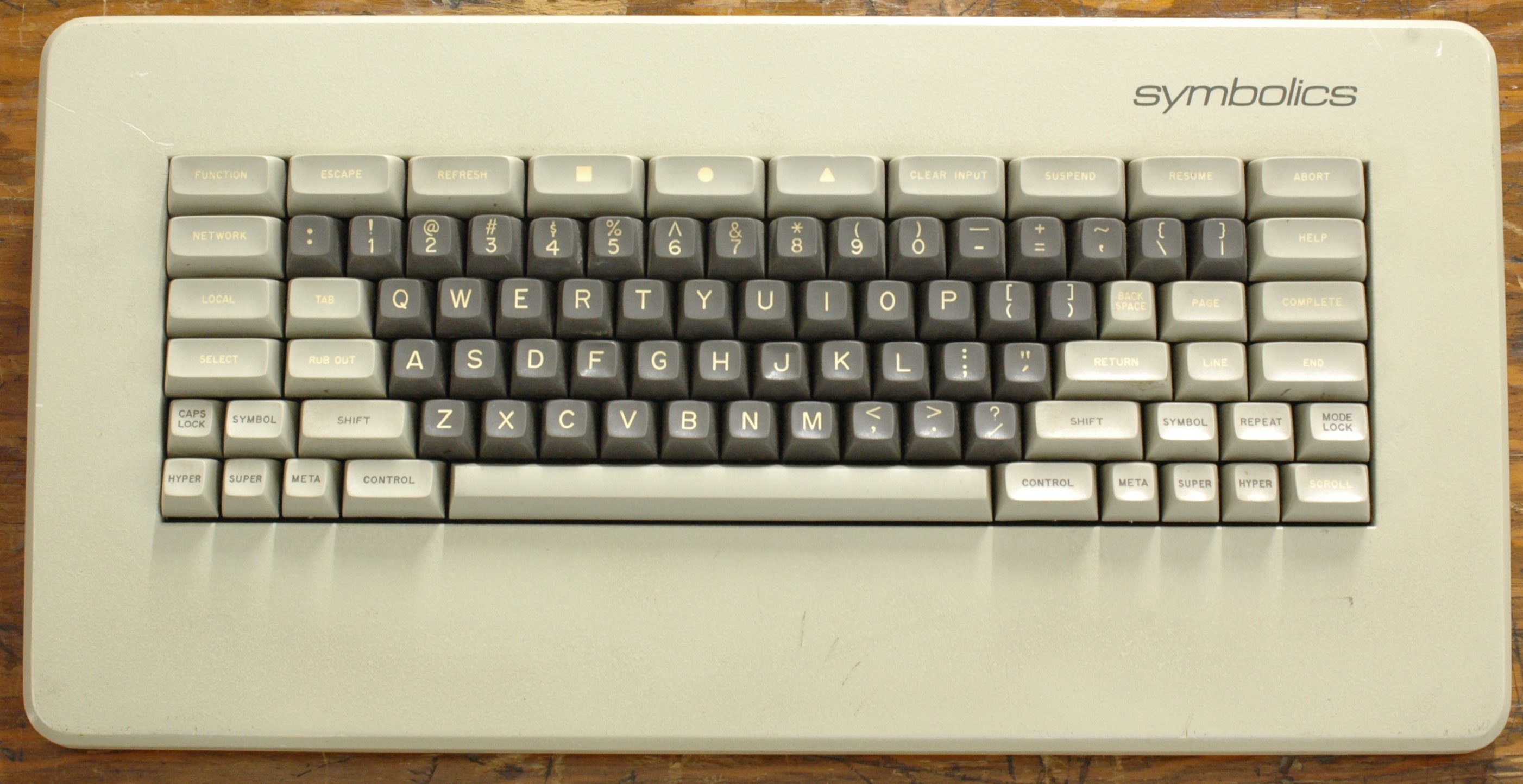
In contrast, Emacs first appeared in anything like its modern form on LISP machines, which had a radically different keyboard layout from a modern PC or Mac — much less austere, lots of modifier keys (not just Ctrl and Alt, but Meta, Super, and Hyper as well!), and an Esc key tucked out of the way at the top left, as is standard today. Here's s photo: https://upload.wikimedia.org/wikipedia/commons/9/9a/Symbolic...

If you consider the ergonomics of typing lots of Ctrl- and Meta- keystrokes on the Symbolics keyboard above, it's fairly clear that it requires a lot less hand stretching to play those chords in the key of Emacs. So it was a cheap design choice for the original Emacs folks to take that route — but every time I've tried to spend serious time in Emacs over the past 30 years on a PC or Mac keyboard, I've ended up with stabbing pains in my wrists within a week (and I will note that back in the 1990s FSF programmers were notorious for always wearing wrist splints).

The basic vi commands can all be executed from the main QWERTY keyboard area, plus the Enter, Ctrl, and Esc keys. If the position of Esc really bugs you, you can rebind it to the Caps Lock key on your keyboard (depending on hardware support, of course). The point is, there's far less chording involved.

So my working hypothesis is that vim is gaining leverage due to selection bias for an editor that hurts the hands less when you use it intensively on an IBM PC-descended keyboard layout rather than a Symbolics keyboard. But "less pain in wrists" is not something we spot easily, so a whole load of post-hoc justifications get invoked to explain the preference.

3 comments

> every time I've tried to spend serious time in Emacs over the past 30 years on a PC or Mac keyboard, I've ended up with stabbing pains in my wrists within a week

I used to think "emacs pinky" was a joke, but it is real. Eventually I learned how to re-map Caps Lock to be a Ctrl-key (I never used Caps Lock anyway), and Caps Lock is far more comfortable to reach with my pinky than either of the regular Ctrl-keys.

Yup. Remapping Caps Lock is kind of a shibboleth for Vim/Emacs users. Emacs users remap to CTRL; I hear Vim users remap to ESC.
Vim users do indeed. I still get a bit of ESC pinky, but not nearly as bad as the default layout would cause.
Wouldn't you hit ESC with your ring finger or middle finger instead? (When I used vim, I preferred Ctrl-C so I would not have to move my fingers so far.)
That would require lifting my hand off the home row, which would be uncomfortable on my wrists. Playing around with it now, the motion seems to be more of a sideswipe, with a bit of muscle tone to keep the finger from just bending out of the way.

Side note - I've noticed a big improvement in general hand pain since I got into climbing regularly, and specifically starting working with a hand exerciser.

I sometimes wonder who came up with the idea for Caps Lock anyway. I cannot remember ever using that key except by accident.
Because you got me curious enough to look this up:

It apparently originates from typewriters, when holding shift was quite physically taxing (since it literally shifted all the typeheads over to put alternate characters over the ribbon); so caps lock saved a lot of finger strain when typing acronyms or writing symbol-heavy text.

Thank you! It is kind of fascinating how much legacy from the typewriter era modern keyboard carry with them.
I like mapping jk to ESC for vim/evil-mode, then swapping caps lock and CTRL for the comfy tmux and readline ergonomics. (I've tried readline's vi mode, but I didn't like it.)
Emacs is sufficiently powerful that I think it’s worthwhile to use a keyboard with a proper set of modifiers. Moreover, the emacs approach is sufficiently powerful that I think it's worthwhile to use a keyboard with a proper set of modifiers in any program. Use easily-hit keychords for common functions and more-difficultly-hit chords for uncommon ones; maybe even reserve a prefix for certain uses (e.g. Super for the OS & Hyper for the user).

It's 2018; our keyboards could stand to keep up.

Nit: "not ever" and "never" are synonymous. I think you meant "it was ever so" or "it was always so" or "it was not ever an issue".

Interesting hypothesis. Ergonomics is certainly one of the reasons I chose vim over emacs.

Your equation of "not ever" and "never" is off - "ever" means "always", and "never" means "always not" ("ever not"). In logic terms:

"Ever so" = for all, so

"Never so" = for all, not so

"Not ever so" = not (for all, so) = there exists, where not so.

The last is fairly clearly the intent of GP. Startup is short either way now, but there exists a time when it was not short - insert references to old slow hardware that would take 10-20 seconds to boot emacs.