Hacker News new | ask | show | jobs
by peterwwillis 2890 days ago
Have you ever tried to go from New York to San Francisco? It's the same distance as driving from Porto, Portugal to Abisko, Sweden. You go through 8 countries. Or Porto to Mariupol, Ukraine, in only 7 countries. It's faster in the US, through 10 states as big as European countries.

We have more people stretched out over more land with more varying regions with more varying needs and costs with more conservative social, political and economic values. Nearly all of our trade involves trucking and cargo ships, with freight making up the raw material shipping that isn't time sensitive.

It makes no financial sense whatsoever to fund railroads. We have extensive interstate highways and most of our people have cars. Why pay for a railroad the size of Europe when you don't have to go all over Europe, and all your needs are met via the existing shipping mechanisms? What would be the point?

If you took our cars away, maybe it would make sense, maybe. But before we pay for railroads we might need to pay for our health care or education.

3 comments

Freight railroads do a lot more than bulk cargo. For example, they're how shipping containers get from west coast ports to the east coast. Rail freight is a fraction of the cost of the cost of trucking and has mostly replaced true long-haul trucking.

I agree that long distance passenger rail mostly doesn't make a lot of financial sense.

Sure it makes sense to fund long-distance railroads!

Even today, most passengers on Amtrak are NOT riding end-to-end. They are riding between Utah and Nebraska; Or between South Carolina and Vermont; Or Boston to Connecticut.

On the California Zephyr - a coach seat is sold 2-3x times for different segments of the same journey.

I’m a huge fan of passenger rail, and I have a soft spot in my heart for the cross country Amtrak trains, having ridden them frequently in my twenties. But I don’t think you offered evidence that it makes sense to fund Amtrak.

Cross country trains in the US are a perennial loss maker, subsidized by under-investing in the profitable dense population corridors, where we could conceivably invest in high speed rail if there was political will to do so (there’s not, but that’s a separate issue).

Replacing cross country Amtrak with comfortable buses would be faster, more reliable, cheaper, and more acccessible to the population that uses trains. Buses are just lower status in the USA, which I think is a pretty silly reason to keep subsidizing Amtrak’s cross country routes.

> Cross country trains in the US are a perennial loss maker, subsidized by under-investing in the profitable dense population corridors, where we could conceivably invest in high speed rail if there was political will to do so (there’s not, but that’s a separate issue).

How much money does the interstate highway system make? Yet we keep funding that for some reason. How much money does you local streets make ?

And before you pull out the "completely different card" remember that both rail and highways serve the exact same societal need: Moving goods and humans from one place to another. We stick humans/goods in a box with wheels and roll them to their destination.

Explain why the box rolling on asphalt should be subsidized but the box rolling on steel should not?

> Replacing cross country Amtrak with comfortable buses would be faster, more reliable, cheaper, and more acccessible to the population that uses trains

I don't believe you have ever taken a bus long distances. I have. Its like being stuck in an airplane. The long distance busses in Thailand are o.k. However you are still glued to your seat in a way that is not true for trains.

I specifically said comfortable buses. I most certainly have taken long distance buses that were not comfortable.

Train focused people need to get over themselves on the highway system. That is what path dependency is. Of course, as a train loving person, I wish the automobile industry hadn’t played so many dirty tricks to get us to an investment posture that makes passenger rail irrelevant, but pretending it’s not so doesn’t help.

Pretending that Americans aren’t happy to pay (whether through gas taxes or the occasional new-construction-over-maintenance boondoggle) for highways and local roads is a fantasy.

Americans, on average, don’t like trains. My wife, specifically, refuses to let us travel by train anymore, she hates them. It’s very sad for me, but my wife’s perspective is shared by the vast majority of Americans. They like cars. They like airplanes. They don’t like trains.

And there are lots of Americans who DO prefer trains over cars.

Please don't be so broad brush in your statements.

WRT your wife - go to Europe and ride the trains there. Recently I went to Spain. In Spain even the ratty commuter train traveled at 90+ mph.

Ride the TGV or AVE train. Those are quick and comfortable.

If at that point she still feels the way she does fine. But "Americans don't like trains" is a statement that is not correct. On the east coast, Americans use the trains a lot

A much better statement is "Americans don't like an uncomfortable experience"

BTW: http://www.cahighspeedrail.ca.gov/

And in San Francisco Area, Caltrain is electrifying precisely because people love the train so much. Caltrain needs extra capacity and the only way to get that capacity is with electrification. Plenty of Americans seem to like Caltrain. Plenty of Californians are ready to use the HSR project when segments open up.

My wife’s interurban train experiences consist exclusively of trains between German and Japanese cities. She doesn’t like them. It’s not a great look to spend your time telling people that they’re insufficiently cosmopolitan because their preferences differ from yours.

The vast majority of Americans, when polled, don’t like the idea of taking a train between two cities. I say this as a card carrying member of NARP (they seem to have rebranded themselves RPA, but whatever)!

I just don’t think rail partisans are practicing effective politics by pretending that current US voters support tax expenditure’s on rail.

The average California voter might, just barely, be in favor of interurban rail. I think the jury’s still out on that one, because the actual money that’s been approved by voter’s in Prop 1A is so vastly insufficient to the task, but I agree that at least in California, there’s enough popular support to at least try to make a go of a decent modern train system.

Indeed, I've travelled from NY to SF in both directions by road, rail, and air. The only experience that was much worse than my travels in Europe and Japan was by rail (namely Amtrak).

There are more people in Europe, there is more land in Europe, etc. Stop with the fake excuses.

Europeans enjoy all of it: cars, trains, and airplanes. The simple fact is that North America is lame and deficient in passenger rail transportation compared to Europe and East Asia, and the comparison keeps getting worse.

We have states as big as European countries with nothing but corn. The only people paying to cross that are people going across the coasts, which still takes three days by train compared to a day and a half or two days by car.

Why would we pay for that?

Amtrak long distance trains UNLIKE airplanes are used to connect cities in the middle to other cities in the middle.

Amtraks trains from the west coast to Chicago sell the same seat 2x - 3x over the course of one journey. Most people are NOT going end to end. I have ridden the California Zephyr from California to Denver.

I have see others get on (there are seat tickets) :

* in Utah going to Iowa.

* Nevada going further east in Nevada

* etc.

>There are more people in Europe

Well duh. The key to making trains useful is having people focused in heavily populated areas. If the US were like Europe, some heavily built rail in the Midwest would cover the vast majority of the population.

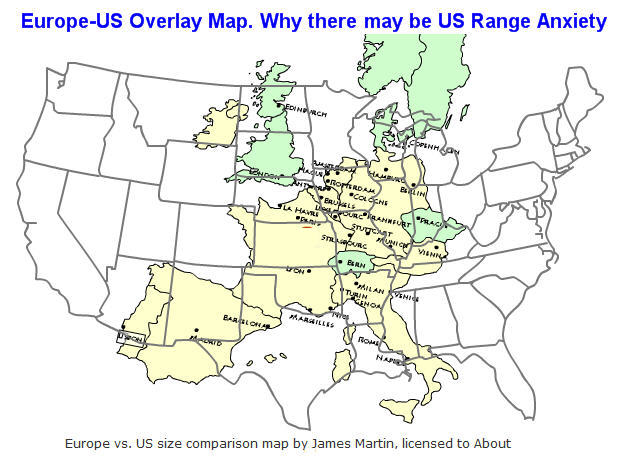
Look at this map to put in perspective how much more rail would be required to connect together the major population centers of the US. https://becovegan.files.wordpress.com/2014/09/europe-us-over...

The flagged comment by mkempe has a point. Europe doesn't stop at Berlin and Vienna.

Here's a better map of the European railway network: https://upload.wikimedia.org/wikipedia/en/1/1b/European_rail...

Russia isn't Europe and that map is pointless because it's just showing some railways without ridership details. The US also has a massive rail network, it's just almost exclusively used for freight.
Your map didn't show ridership either; the purpose of mine was just to show that the European railway is larger than what your map showed. And it certainly is used by passengers all across its length, from Faro to Moscow and beyond.
This is a pretty inflammatory way of saying, “Americans like cars and airplanes. They don’t like trains.”

You’re only making the argument harder for Americans (like me!) who like trains by being dismissive of excellent path-dependent and population-dependent reasons why the US passenger train networks died out.

Nope. I'm saying that Americans are unfortunately missing out on what is elsewhere a great, modern transportation system. If the federal government hadn't used massive war-driven budgets to replace rail with highways, and continued to massively subsidize highways, you'd be there, too.
Yes, if we had not invested heavily in both highways and airports, we may have invested more in trains (there were other problems with the railroads at the time). But that was over 70 years ago. It's not an "excuse" to explain that things are the way they are, and that it makes no sense today to fund renewed railroad investment.

There's a reason we're flush with self-driving car companies and not railroad companies.

US government subsidies to airports and highways haven't stopped. They dwarf public subsidies to railroads.