Hacker News new | ask | show | jobs
by ekun 2903 days ago
Which similar to images we see of space where they have altered detectors' responses from different wavelengths of light to be images in the visible spectrum. So we produce beautiful images, but they aren't accurate to what space would look like to the naked eye.
3 comments

Probably more useful than the naked eye in many cases. The colors our eyes can see mostly evolved to detect ripe fruit, not diseased tissue.
Why did fruit evolve to change colors when ripe?
In many cases so animals would eat them, digest the seeds, and poop them out somewhere else.
Why did animals evolve an attraction to ripe-colored fruit?
On the contrary, finding edible food is certainly important, but avoiding poisonous/diseased food is even more important.
If we can detect ripe, surely we can infer not ripe.
There's probably an app for that.
Yep. All those fantastic color pictures of the Orion nebula are just that. (Personally I think there should be a requirement to post, alongside them, true color photos.)
Why? Many times the true colour images aren't even available. How would you represent an infrared or x-ray picture properly, in your view?

False colour images aren't meant to mislead. They're meant to be more useful to understand what you're looking at. "True colour" has no meaning, really.

I'd say because without a modicum of knowledge you'd take it for granted. Compare to "images" of dinosaurs where you'll often read "this is what it should look like" vs "we know squat about the color of their skin". And for space pictures, which are 99% touted as "pictures" and not reproductive works, it's even worse. Hell, as I'm writing this I'm tempted to double check what I know about color-correctness of any space photo, and my point was already that I'm in the second stage of not knowing - that there could be something I don't know [0]

[0] https://en.wikipedia.org/wiki/Four_stages_of_competence

Why aren't space photos real? For deep space photos, where we have to wait for individual photons, maybe they're false color, but many photos are taken by putting colored filters in front of the lens and then combining the exposures, so they are actually true color.
I'm not saying they're fake - I am just saying people believe what they see. So a specific or general disclaimer of "the colors might not be accurate" would be cool, if it's the case for a specific photo.
Tell that to the color-blind.
That's what I understood at first, but what seems to be the case is that light from deep space undergoes "red shift", and by the time it reaches us, visible spectrum has been shifted into x-ray spectrum. The "false color" is just a correction back to almost the original visible spectrum. The degree of red shift is how we determine distance.
Red shift only comes into play for distant galaxies. Nothing in our galaxy, or nearby galaxies, is going to be red shifted in any significant way.

> visible spectrum has been shifted into x-ray spectrum.

No, x-rays are way more energetic than visible light (MUCH shorter wavelenths..). Red shift, as the name implies, refers to shifting of wavelengths to the red/infrared side of the spectrum, not towards the blue/ultraviolet/x-ray/gamma ray side. The most distant, oldest thing we can see is in the microwave wavelengths, and that's the remnants of the big bang.

The real issue is with dust, and the inverse square law (that the intensity of radiation follows).

Some objects are obscured by dust, and so the only way to see them is by looking at wavelengths that are able to penetrate the dust.

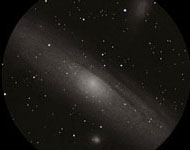
The further an object is, the less intense the radiation is reaching us, so we have to stare at it for a very long time in order to collect enough photons to form good images. This is why views of Andromeda through a telescope with your eyeballs do not look like this visible light image of Andromeda: https://apod.nasa.gov/apod/ap991114.html

Instead it looks more like this under the absolute best viewing conditions on Earth with a quality telescope (nominal is a blurred version of this): http://www.deepskywatch.com/images/articles/see-in-telescope...

hey thanks for clearing that up.