|
|
|
|
|
|
by dragontamer
2977 days ago
|
|
|
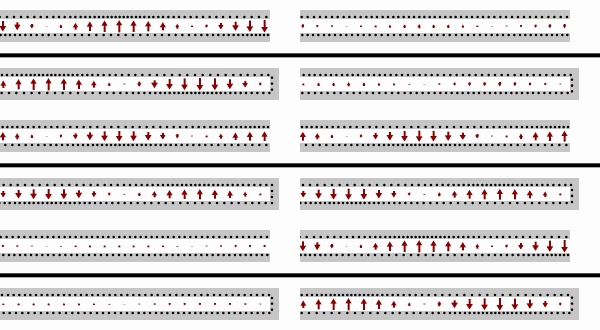
Two things: 1. Clocks don't use a lot of power. Think of a pendulum: there's a lot of movement but the energy constantly swings between gravitational potential energy and kinetic energy. Although there's lots of movement, the device uses very little energy. Similarly, a clock circuit (called an oscillator) barely uses any electricity: it mostly "Swings" energy back and forth between an inverter and a capacitor. 2. Distributing a clock over a long distance similarly uses very little power (!!) due to transmission line theory. You can effectively use the parasitic capacitance in wires themselves to effectively do this pendulum effect for efficient long-distance transmission of clocks. See: https://en.wikipedia.org/wiki/Transmission_line This gif shows an animation of the pendulum effect in a longer-transmission line: https://upload.wikimedia.org/wikipedia/commons/8/89/Transmis... ---------------- I guess things could be de-sync'd for more efficiency. But your question is kind of like "Well, can't we get rid of V-Tables in C++ to make branch-prediction more efficient??" I mean, we can. But V-Tables / Polymorphism really doesn't take a lot of time. We only do that if the performance gain really matters. |
|
|
I do have one follow-up question though: I was under the impression that clock trees contain repeaters in the form of CMOS inverters. Wouldn't those have dynamic leakage which the transmission line stuff doesn't account for?