Hacker News new | ask | show | jobs
by panarky 2986 days ago
Before you read this 2000-word treatise, know that the author, Preston Byrne, has a history of misunderstanding fundamental concepts about money and markets.

Example 1: He believes Bitcoin is a fractional reserve system.

https://news.ycombinator.com/item?id=15792314

Example 2: He doesn't understand that market participants bring liquidity to exchanges, so he thinks exchanges themselves go bankrupt if market prices decline.

https://news.ycombinator.com/item?id=15792065

I don't have a horse in the Basis Protocol race, but I have little confidence that this author understands the basics.

5 comments

It's called an analogy. I analogized the Bitcoin markets to a fractional reserve system, as the dollar value of Bitcoins in the Bitcoin market far exceeds the amount of dollars that have been spent chasing after them. The system is accordingly very vulnerable to liquidity shocks.

Re: liquidity facilities, I know for a fact certain exchanges have liquidity facilities from banks that they draw down in times of increased withdrawal demand. If market conditions deteriorate quickly enough those facilities will be withdrawn, which could result in the exchange getting caught with its pants down with a large, dollar-denominated obligation to its banks and no means to get the dollars to repay it. That is the stuff of which insolvency is made.

Repeating your misunderstandings doesn't make them less wrong.

But thanks for summarizing your thinking for those who didn't click through to the source.

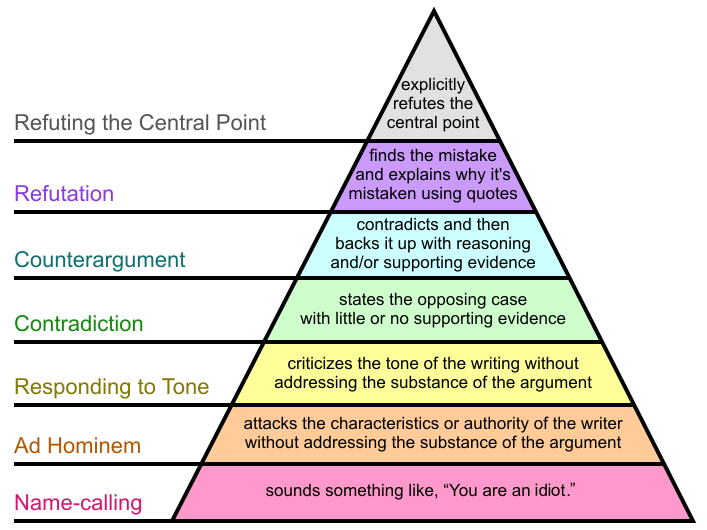
Attacks on the author aren't the best thing in general (https://upload.wikimedia.org/wikipedia/commons/a/a3/Graham%2...)
I agree that ad hominem attacks are generally counterproductive when your goal is to evaluate an argument.

However, when deciding whether to invest hours reading and discussing his latest arguments, the author's credibility is a factor.

Preston has some beliefs that don't make a lot of sense, I agree. But his ability to reason about technical facts is not impeded.

There is no fundamental argument he makes that can be refuted soundly, besides just disagreements in opinion.

Generally agree, but those are pretty damning comments showing a weak understanding of money mechanics, and this project is fundamentally about money mechanics.

The second comment is especially relevant as it deals with pricing, which is the thing this project is about: https://news.ycombinator.com/item?id=15792065

Author doesn't understand that prices are only determined by what people are willing to trade for, rather than them being some external thing that exchanges have to guarantee.

Thanks for pointing this out. Example 2 clearly demonstrates that he doesn't understand how a currency exchange works, which is strange for someone of his professed experience.

This article is also rather obnoxiously written and there's only one substantive point in the whole thing. However, I think he probably isn't wrong in this case. "BASE bonds" are more like futures or options than bonds, and when the price falls the incentive of being paid in the falling currency probably isn't enough to attract the investment needed to maintain the peg.

Thanks for the links, he really doesn't understand how exchanges work. I am not sure how someone who wants to be an authority on a subject does so little research.
Pointing this out is a DH1 in Paul Graham's hierarchy of how to disagree -- essentially a form of ad hominem [1]. Even people who get things wrong do occasionally get things very right, so more useful would be to address the points the author of the post is actually making. Are they valid? Why/why not?

1: http://www.paulgraham.com/disagree.html

Actually the links are useful. The author has a a huge misunderstanding about how exchanges work. I know enough about exchanges that I know he is not only wrong but doesn't understand them at all. Therefore I have to treat his other work with a similar degree of scepticism.

The Murray-Gellman Effect

http://www.patheos.com/blogs/geneveith/2011/08/the-murray-ge...

I would also argue the author (in the article) spends more time musing in his own ad hominems rather than addressing his own arguments on their merits.