Hacker News new | ask | show | jobs
by SlowBro 2985 days ago
Taxing the rich seems to be one of the hardest things in the world to do. They can afford the best lobbyists to influence politicians to write loopholes in whatever laws you can think of to tax them; they can hire the best accountants to shelter assets from those laws; they can hire the best lawyers to help them get off the hook if they breech those laws; and if they become too unpopular here, they can afford the high price of gaining citizenship in other nations.

Better solutions are needed.

7 comments

> Taxing the rich seems to be one of the hardest things in the world to do. They can afford the best lobbyists to influence politicians to write loopholes in whatever laws you can think of to tax them

More to the point, they can hire the best propagandists to spread the idea that it's too hard to tax them and you should do something else.

Oh that’s right, the PR firm mails me my check today ;-)

No seriously, am I wrong? Has taxing the rich ever been successful in the long term?

Take for example the much-lauded United States marginal tax rates of the 1950s. Do your research and you’ll find that the wealthy evaded those taxes quite handily.

I don’t see how it’s possible to get any more blood from that turnip. Better solutions are needed.

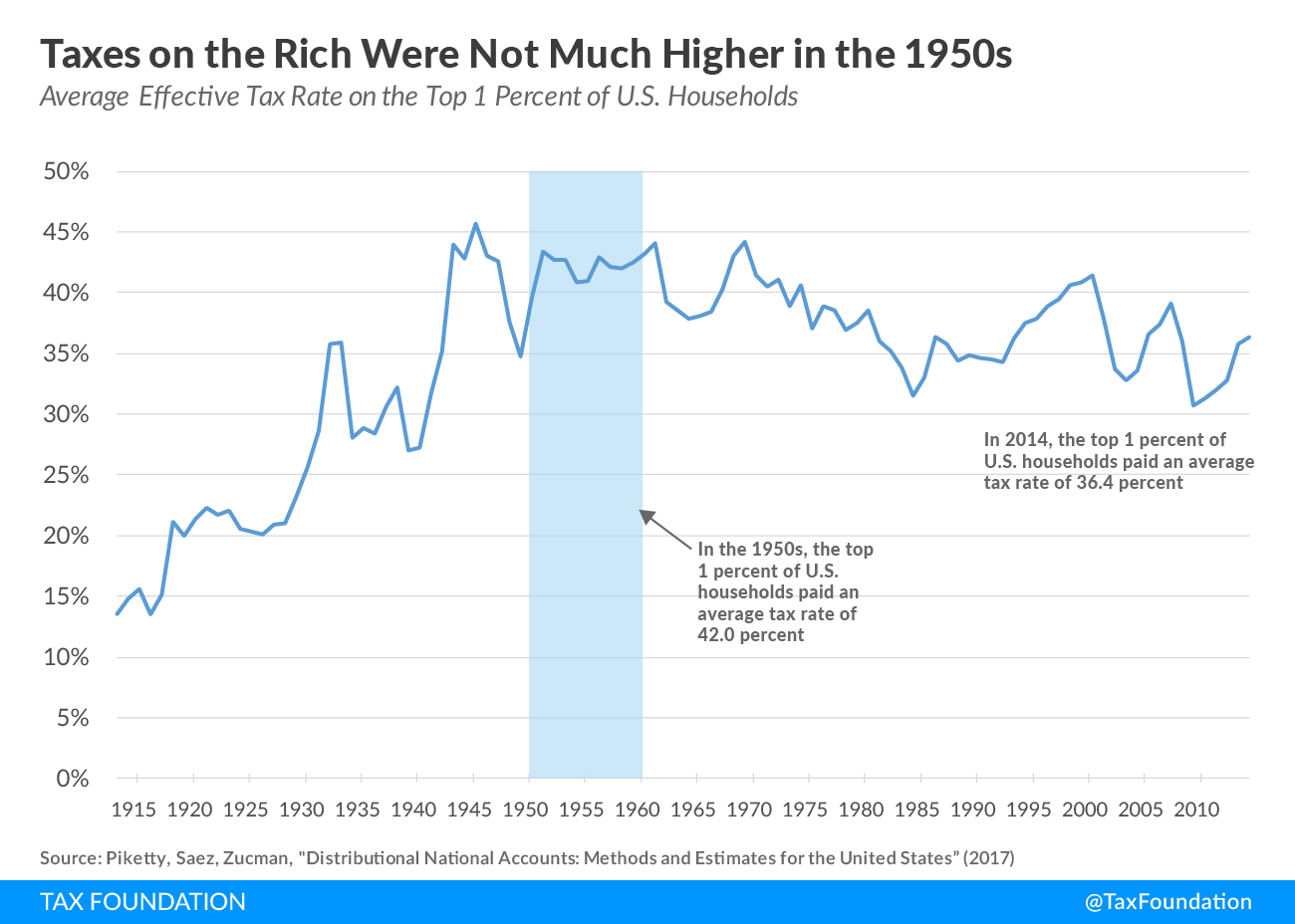
The effective tax rate in the 1950s wasn't actually substantially higher than it is today. [0] A high top-marginal rate is only a small part of the story.

[0] https://files.taxfoundation.org/20170804133536/Average-Effec...

It may be hard to get effective tax rates for high earners above 40%, but it would be eminently feasible to get them back up to 40%, where they stood before Bush and now Trump went off and reduced effective tax rates for high earners so much.

I just mailed the feds my owed taxes for 2017; my high earner effective federal tax rate is ridiculously low (lower, because of the cut off for social security at ~120k, than significantly less well paid people).

I didn’t ask for these tax cuts, and they’re certainly not enhancing my propensity to work, they’re just going to allow me to retire earlier.

But if your point is that income taxes aren’t an awesome way to raise revenue, I’m with you. Land-value-taxes would be almost impossible to avoid, and would have the salutory effect of improving efficiency in dense urban areas.

Would a land value tax be priced on farms as well? I wouldn’t think so, else you risk pricing farmers out of business. Have you noticed how many wealthy people own vineyards? Put some greenhouses on it and call it a farm.

The wealthy are clever, or they can hire some downright clever people to help them. Better solutions are needed.

Of course a land value tax would apply to farms.

If rich people want to move out to rural areas to lower their taxes, that’s fine by me.

The main difficulty with land value taxation is deciding what the actual land value is.

It depends what you mean by successful. The Soviet Union and China were both very successful at taxing the rich. The consequences of doing so were disastrous, however.
How many wealthy in the Soviet Union or China were still there after their revolutions?
I don't know how successful they were at confiscating existing fortunes, but the point is that they were extremely successful at preventing new fortunes from being accumulated.
Equality, comrade.
How many of today’s politicians have the conviction and perseverance of Roosevelt? Especially in the face of donors?
We could increase the estate tax and capital gains taxes. They're much harder to avoid, the focus purely on income tax is the problem.
Or, even easier and more effective, abolish estate and gift and capital gains taxes, and tax inheritances, gifts, and capital gains as normal income to the people recieving them.

Because for some recipients, especially for the non-rich, these are non-repeatable, you do need to add some handling to the regular income tax system to address inconsistent incomes with multi-year smoothing mechanisms to make taxation of those kinds of income fair, but that also makes taxation of variable regular income more fair, too.

Google loopholes in capital gains taxes. Lots of ways to avoid them. The wealthy can hire experts.
I'm familiar but none of them are very good. The only really good way to avoid capital gains taxes is to die and use your estate tax exemption on the securities you hold. Which is why increasing the estate tax rate and decreasing it's exemption in tandem with an increase in capital gains is the best way to tax the wealthy.
Who would pass these capital gains taxes? Politicians, right? The same ones who can be influenced by lobbyists?

When these laws are passed, will assets be sheltered by accountants?

I know a Bitcoin millionaire. He avoided capital gains taxes this year by upgrading his Jeep. The money that would have gone to taxes, he used instead for upgrades, because of a loophole that permits upgrades to be taxed at a much lower rate.

They’re smart, the rich.

And it’s an overstated solution. I don't think people have a sense as to how incredibly large the U.S. budget is - for 2016, the expenditures were nearly $4,000,000,000,000 (trillion). Even if you seized the assets of the top 10 richest (which took them a lifetime to accumulate), you're not even close to covering the U.S. budget for a single year.

The military budget is the elephant in the room that no one will address for fear of appearing as soft or anti-American.

True, but 8 people hold 50% of the world's wealth, and pay less in taxes on a percentage basis than us normal slobs. There's no reason we shouldn't tax them and everyone who has more than they need for 1000 lifetimes at 90%, no matter how long it took them to acquire their wealth. It's obscene.
But there’s a huge difference between making a moral case for taxing the wealthy, and making it possible to tax the wealthy, isn’t there?
Why penalize hyper-productivity?
Wealth inequality is extremely easy to solve - raise taxes on the rich (as well as rent-seeking). The problem is that our politicians, especially conservatives (though liberals are in on it too), have no integrity in this regard. We just need to stop voting in people who won't raise taxes on the rich.

* By the rich, I'm not referring to the doctors, engineers, and lawyers in the upper middle class, I'm referring to billionaires

Yeah and global warming is easy to solve, all you need to do is get everyone on board...

Capital, like water, takes the path of least resistance. There's ample academic literature which shows and explains international tax competition exists, we can't pretend it doesn't. Any country that increases taxes just signals to the increasingly mobile tax base that they ought to go somewhere else. And tax coordination, i.e. countries agreeing on minimum tax levels, is an incredibly difficult political problem. You're literally putting the heart of a country's budget on the negotiation table, it doesn't get more political.

As such, it's not at all extremely easy to solve. It's not just an issue of integrity, it's also an issue of international politics.

It's not an issue of international politics for a country like the U.S. to raise their own taxes. It's literally a matter of tweaking numbers. Of course there would be side effects if U.S. raised them too much or in the wrong way (eg. targeting small business owners instead of billionaires), but we're not even close to that point. Overcomplicating this is just rationalizing the status quo.
Did you notice that those conservatives and liberals are wealthy, or have wealthy backers? Have they been aggressive in raising taxes on the wealthy? Why do you suppose that is?
Sometimes the best solution is to do something hard.
Has it ever worked? Any examples in the long term of sustained taxing of the wealthy?
Perhaps the better question is "what has changed that could make it workable now?". For example, in an interconnected world like today's, some countries actually do have massive power. Take the anti-corruption laws that say a multinational corporation can face stiff penalties at home for corruption that happens abroad - AFAIK, while not perfect, they're not ineffective either.

If, say, US would pass laws that allow them to tax everything that touches/ does business with a wealthy individual - that would make it very hard for said individual to avoid taxes (relocation to other countries doesn't help, and avoiding any business with US is impractical). I mean - what I present here is certainly not a "workable idea", but the gist of it should be that "because it was impossible in the past, it's not necessarily impossible in the future".

> If, say, US would pass laws that allow them to tax everything that touches/ does business with a wealthy individual - that would make it very hard for said individual to avoid taxes

Who would pass these laws; politicians, right? The same politicians who are influenced by lobbyists, right?

You might then outlaw lobbying but the wealthy would just find another way to bring influence, wouldn’t they?

Not sure how you'd define "sustained", but the introduction of inheritance tax in the UK very effectively clobbered most of the surviving minor feudal landowners. Although that was also the period of massive social change and the world wars.
Could that success be repeated in the 21st century? If so, how?
A third world war.
Taxing the rich seems to be one of the hardest things in the world to do.

In the US at least, the rich (top 1%) pay almost 40% of all taxes. Look at the top 10% and it's 71% of all taxes.[1]

Why do you say it's hard to tax the rich?

[1]https://taxfoundation.org/summary-latest-federal-income-tax-...

And if one person owned all the income, that one person would pay 100% of the nation's taxes. How unfair!

The fact that the 1% can pay 40% of all taxes and still be wealthy is an indication of how massive inequality is on the US.

Of course it wouldn't be unfair for one person earning 100% of all income to pay 100% of all taxes!

So let's see if that's happening...

Top 1% pay 40% of all taxes. How much of total income do they earn? Interesting, only 21%. Looks like they already take on a much higher burden than their income alone would suggest.

What we need to look at is their net income after taxes, and there the 1% is still doing much better than the median taxpayer. If you look at the top 0.1% earners, it's obscene, let alone the 0.01%.
From your link:

The only tax analyzed here is the federal individual income tax, which is responsible for more than 25 percent of the nation’s taxes paid (at all levels of government). Federal income taxes are much more progressive than federal payroll taxes, which are responsible for about 20 percent of all taxes paid (at all levels of government), and are more progressive than most state and local taxes.

Does anyone here believe the top 1% and 10% are being taxed enough? The most oft-expressed opinion I’ve seen, even expressed below, is that the rich don’t pay enough as a percentage of their income.
The real question is - what is enough?

Should the top 1% be paying 100% of all taxes? 90%?

If we had a target we'd know how to get there.

Apparently the answer is, more than is being paid now.
100 years ago there wasn't any income tax at all? I think the opposite is actually true, Tax is very easy to apply now and with the crackdown on offshore havens its harder to evade. Top rates are lower than they were in the 70s, but the total tax take isn't low.
105 years ago in the United States, there wasn't.[1]

So it sounds like you believe the current level of tax take is sufficient and we needn't press for more?

[1] https://en.wikipedia.org/wiki/Taxation_history_of_the_United...

Taxing the rich is fine, we just need politicians to show a bit of spine and do it. Most rich folks aren't going to pick up and move because they make their money tied to the place they are now. There's a handful of high-profile exceptions, but that's all those folks are; exceptions. Most rich people will stay put and complain and pay the tax.
In America, half the problem is one political party persistently working to lower taxes. The public is divided and distracted by social issues, and media hyperbole.
And those in that party working hard to lower taxes are... wealthy. They seem to be having some modest success this political season.
You mean, the same politicians who are receiving donations from the wealthy? Those politicians?