Indeed, this fact this makes me proud to be a Jew. (A happy Passover to all whom it may concern).
As a young boy my father used to take me to the Pergamon museum in Berlin - one major exhibit is the Babylonian street of processions (it dates to the neo-Babylonian empire) He used to say - here you see our heritage, we were around the show when Berlin (and all the other great capitals of the world) were still a swamp.
I was born Jewish and was pretty religious for most of my life, but even when I was religious I never understood why we should be proud of this, or why this is a good thing in and of itself.
I would be really interested if you could explain more your way of thinking about it, because to me when my father explains that we should be proud of having the same meal our ancestors did Xthousand years ago I don't feel impressed in the least.
Instead, it just feels like a long streak of spreading a meme.
People often get surprised when I tell them I don't consider myself Jewish anymore or that I don't intend to bring up any children I have Jewish. They often cite their surprise to the fact that Judaism has a long ancestral history. And I really just can't understand this frame of thinking that says Judaism is good because it's been going on for long.
So I would be interested if you could explain why this impresses you :)
Its a personal thing, I am not in a position to persuade anybody. I think that our present is explained by the context of the past, and that you can't understand the present without looking at the past. Now the past is a complex thing that can't be reduced to some simple formula, I still believe that you can still learn out of it, because human nature didn't change to much throughout the ages. Our reality may be quite different from what it used to be, but we are not essentially different from our ancestors, so we can still learn from them (hope that helps). Our experience is similar to the experience of our ancestors, we are part of the same process - it may be distant, but it is still relevant (in my opinion), the accumulated experience of past generations is of great value (because we tend to repeat the mistakes of the past)
I know that I did repeat the same statement several times with variations, but it is as far as I can get.
Also: If something prevailed throughout time, against all odds, then that's pretty impressive to me.
> "Also: If something prevailed throughout time, against all odds, then that's pretty impressive to me."
This is dangerous logic, because you're not comparing it to anything. For instance one argument I've seen for the existence of a god was the fact that many constants and other seemingly 'magic numbers' of our universe are set just as is required to maintain life as we know it. The problem there is that assuming this is true, it's still meaningless since the only way we could ever come to observe this fact was if it was true. This observation is known as the anthropic principle [1].
Basically considering the merit or probability of something happening when you would be unable to observe it not happening is impossible. You could say you're comparing it against the failure of other groups, but this is probably somewhat disingenuous as I think it's reasonable to hypothesize that the oldest persistent ethnic group is likely some group within Africa neither you or I have ever heard of, and you'd probably be unlikely to praise their longevity and persistence in and of itself, even if it too was likely ripe with strife throughout time.
I'm not sure the Anthropic principle can be applied here. There is a broader data set than that which is relevant for that principle, based on my understanding.
"Against all odds" would seem to be the key words here. There are countless other ethnic and religious groups that were integrated into the larger Muslim culture when Islam was first spreading. The same is the case for Christian Europe. In fact, the Romani people may be a good example of what we would expect to naturally happen to a dispersed and oppressed ethnic group. They have no singular culture, principles, or beliefs; they assumed most aspects of the surrounding culture's mode of life and beliefs.
It isn't a stretch to call the survival of the Jewish people an unexplained historical exception. There are countless historians (Jewish and non-Jewish) who have researched and written on the topic.
Or, am I misunderstanding the application of the Anthropic principle as you are applying it in this context?
Who are you comparing Jews to? This is the point. I don't think there's any reasonable comparison. Judaism's pairing of extreme insularity with great economic success in most 'host nations' leaves them without any other group to compare against. Powerless minority groups are certainly not a reasonable comparison.
Oppression and dispersion takes on a different meaning for those of means, even more so when the shared genetic lineage also happens to provide a substantially higher IQ than average for the vast majority of the group.
As you I don't see why someone should be proud about anything inherited. It can be a gift (or a curse), but it is certainly not an achievement.
That being said, for me the Jewish tradition is immensely powerful, even though I'm not a believer in God. Sitting together with your family at the Seder table and talking about what it means to be free vs. to be slave is an amazing experience. It would be very hard to re-create that experience without the frame given by our Exodus narratives and the surrounding traditions.
I'm sure other cultures have their own powerful traditions for keeping values alive and transporting them across generations. But as you are already very familiar with Jewish traditions (probably much more than me), why not make use of this treasure?
>As you I don't see why someone should be proud about anything inherited. It can be a gift (or a curse), but it is certainly not an achievement.
One way to look at this is if you believe achievements are worthy of pride, or that pride is an 'incentive' to achieve, than recognizing how significant everything you do can be is a great way to inspire maximizing achievement... One way to do this may be to recognize that your achievements can have a positive impact on future generations, even in simply creating positive and breaking negative parenting cycles in your family, or how smiling at someone can have a ripple impact elevating numerous peoples days and possibly lives... its possible that training us to be proud of something that is as insignificant as being a product of our parents will nurture a sensitivity to take our ability to impact others with the seriousness and responsibility it demands. Just a thought.
Just to throw in an additional perspective of what I find fascinating about this topic.
I don't think that all long lasting things are particularly interesting. Rocks have been around longer than the Jewish people but we don't celebrate that as extraordinary. It is considered perfectly natural. It is noteworthy when something is unnaturally long lasting; when other peoples/belief system were put under similar pressures the results have been drastically different. Imagine 50 people are dragged under water on a beach by a horrible undertow and held underwater for an hour. 2 out of the 50 survive while the other 48 don't; the 2 who survived are definitely of interest because we would want to know how they survived.
Not if you include those that did not survive in your sample / analysis. From the link "concentrating on the people or things that made it past some selection process and overlooking those that did not".
Well, I can't answer for GP but I can relate to both of you, because I swing back and forth between the two modes.
I was also raised religious (Hareidi) and am now entirely secular, by most counts. And I've spent many hours trying to argue that it's ridiculous to take pride in the fact that some arbitrary tradition lasted for a few thousand years. So a bunch of people did this or that ritual for thousands of years...sucks for them! Why should I? (Never mind that the tradition may have evolved/morphed to the point that Talmud-era Jews would barely recognize it, let alone second temple Jews or earlier.)
Moreover, if I've already rejected the notion that the Torah is the word of God, why would I consider myself Jewish? How does being born to one woman versus another determine my identity and fate? If I don't believe, why am I "in the club" at all? Because the believers say that I don't get to choose my own identity? Shouldn't I be able to just laugh that off?
I went through a phase in which I refused to identify as Jewish, but it didn't stick. There is too much of my upbringing that I _do_ connect with, or remember positively, and feel good about. So I can't quite shake the identity. And lord knows I've tried.
Instead, as the sun sets on Tel Aviv for the last day of Passover, I'm writing a comment on HN and enjoying the challah I just took out of the oven. Let me check...yeah, it took more than 18 minutes to prepare. But what can I say? I'm Jewish, and what kind of Jew celebrates a holiday without challah? Not this one.
I think the point here is that identity, belonging, nostalgia, and a sense of connection to a larger community - not just a generation alive today, but a chain of generations - can be a powerful emotional driver for people. Simply put, the idea that "our ancestors" did this or that and the tradition and identity lives gives many otherwise rational people a feeling of belonging.
And while there's no shame in choosing to forge your own way, independent of the social environment into which you were born, it's no great honor either. It just is. Some people feel imprisoned by the narrative, some empowered, and some just don't care. And some - I suspect more than might meet the eye - are forever caught between a prison of arbitrary rules and the discomfort of floating listlessly through a strange and uncaring secular society.[0]
So if you managed to leave the baggage behind, all the power to you. For others, the baggage is inescapable. And for yet others, the baggage isn't baggage at all, but a source of positive emotion.
[0] I can't remember the exact page, but somewhere in Chapter 9 of Brachot the Talmud briefly addresses this conundrum. Search for "אוי לי מיצרי אוי לי מיוצרי". Hope I got that right...it's been many years.
We're not blank slates. There really are genetic differences. It very well might be that stereotypes about arguing and having opinions etc. are genetically-connected personality traits, who knows? Maybe some science has brought us a smidgen of understanding just enough to be dangerous…
The weird uncomfortable part is understanding that the strange individualistic rejection of culture and interest in just taking the best ideas from everywhere is actually a common experience of secular American Jews. You know what it's like to be a minority, just not part of the same club as everyone around you, so you question things and easily find the conclusion that most of the old traditions and views are nonsense. You're left wondering whether it's okay to find a "tribe" you fit (political or cultural or whatever) or if really the concept of tribes is itself just bad. If everyone else would stop being tribalist, we could all just live in a post-ethnic, post-diversity world or something where no individual has any more claim to any worldview or idea or culture than any other… but that's fantasy too.
The fact is: most people on the planet haven't even had the chance to be in a situation where they truly separate themselves from their traditions and consider the possibility of just not being of the group they grew up identifying with.
Consider the trans-racial ideas of that controversial lady in Spokane… these things are not easy ideas to grapple with.
>I really just can't understand this frame of thinking that says Judaism is good because it's been going on for long.
Im not a rabbi or in kiruv or anything, so take this with a grain of salt...but I would point to Jordan Petersons position about the longevity and survival of the bible stories and his response to atheists around it all sounding made up.
There is a reason these stories survived through the ages. There is wisdom and much to learn from the ideas in the Torah even if you dont buy into their accuracy. It's just too shallow to dismiss it as superstitious ancestors who werent as smart as us.
From a purely pragmatic standpoint, the very fact that we are finite beings in a world that will survive our existence means that our life will face tragedy...and the best way to cope with a tragic existence is to find meaning in life and in our actions.
Most fundamentally is buying into the idea that we can bargain with the future and that decisions we make today matter and have an impact on the future and future generations.
From that context, ritually connecting with the past and exploring how things that happened to your ancestors have an impact on your existence today is about the best way I can think of to get you to internalize the idea that what you do today matters to tomorrow.
The idea of mesorah(transmission from generation to generation) is framed as a way to verify the validity of the stories...but I really think its more along the lines of showing the unbroken chain between the past and the present...so you can internalize the responsibility of the chain between the present and the future...
It sounds like you've decided to start a new chain for your children and sever that connection to your past. For me, I think the responsibility and ramifications of that decision are massive and at the very least deserve a reckoning with the significance of how the decision impacts future generations regardless of what you finally decide...it feels to me that because you werent able to internalize the ideas (regardless of the factual nature of them) of "Hashem took ME out of mitzrayim" or "had the exodus not taken place, we would still be slaves" ...and never connected with the powerful idea that we eat matzah to commemorate what our ancestors ate rushing out Egypt...you either feel the decision for keeping your future generations connected to the past is inconsequential, or the past is blatanly wrong.
Considering you grew up religious, I am assuming you had a modern Yeshiva education...like many others, it sounds like they failed to show you the pragmatic wisdom in yiddishkeit and instead left you feeling unconnected with your brilliant history.
I would encourage you to try to pass on the parts that you did connect with and the pragmatic wisdom in much of the torah and halacha to atleast give your children the chance to make their own decisions.
You can reject the bible and reject religion and put science on a pedestal...but the idea that what you do matters and that you can bargain with the future...and that who and where you are today is a product of decisions your parents and their parents made...that lesson is too important not to pass on.
It would be a shame to be passedover!
> There is wisdom and much to learn from the ideas in the Torah even if you dont buy into their accuracy. It's just too shallow to dismiss it as superstitious ancestors who werent as smart as us.
>From a purely pragmatic standpoint, the very fact that we are finite beings in a world that will survive our existence means that our life will face tragedy...and the best way to cope with a tragic existence is to find meaning in life and in our actions.
Agreed.
> Considering you grew up religious, I am assuming you had a modern Yeshiva education...like many others, it sounds like they failed to show you the pragmatic wisdom in yiddishkeit and instead left you feeling unconnected with your brilliant history.
This is condescending, in my opinion. You're presuming to know why they don't accept the religious narrative. It's great that it speaks to you, but it doesn't speak to them and it doesn't have to. I might be reading too much into this, but it seems you're invoking the common meme that "if you would only have had the wonderful opportunities to learn in this yeshiva or that one, or to appreciate the 'true beauty' of this stream or another of Judaism, you'd agree with my point of view." Maybe, maybe not. Maybe GP had a superior education than you did, and if YOU would have had the education GP had, you'd reject religion too?
> I would encourage you to try to pass on the parts that you did connect with and the pragmatic wisdom in much of the torah and halacha to atleast give your children the chance to make their own decisions.
Maybe the opposite is true? Maybe the only way to give children a fair choice is to NOT indoctrinate them with ideas they didn't choose, and instead give them a blank slate from which to start?
No matter what you do for your children, you're making decisions for them. Raise them religious, you're exposing them to X instead of Y. Raise them secular, you're choosing Y instead of X. There's no way to give them everything, you have to make choices for them.
I doubt there is only one correct way to find meaning in our life and actions (though my take on it is that while paths may differ, an honest pursuit would lead to similar insights regarding the ultimate meaning). I also don't think you have an obligation to remain with a way you don't connect to. The only thing I disagree with is judging a path that doesn't resonate with your specific frequency when obviously (at least as I see it) it brings a net positive to civilization. While I'm not religious,
I can understand how on the surface things can be seen as primitive (especially when practiced at face value) while holding deeper truths underneath.
>Maybe the opposite is true? Maybe the only way to give children a fair choice is to NOT indoctrinate them with ideas they didn't choose
If only that were possible. You're going to indoctrinate them one way or the other (as you correctly concluded in the following paragraph), and since you're going to do so, the best indoctrination I can think of is personal and intellectual integrity, which might lead them to decide to go back to your roots or take a different path, both being fine if they come from the right place.
This is great. I’ve dismissed my Jewish heritage and the teachings of religious texts, but this perspective gives me pause. Maybe I’ve been hasty in my assessment that religion doesn’t offer me anything for making a better future.
I ignored these for the longest time because they were about the bible. Well, they aren’t really. They’re kind of about everything, and now I wish I’d watched them a lot sooner.
> It's just too shallow to dismiss it as superstitious ancestors who werent as smart as us.
This is commonly misunderstand point, as you hint at.
Our ancestors were about as smart as we are -- some smarter, some not, but on average they were far more ignorant of how the world works. There were plenty of brilliant ideas wrapped around less sure knowledge.
I don't understand this infatuation with ones genetic material. Given that I am blond and blue-eyed and live in Scandinavia, I'm probably just as much Vikingish as you are Jewish. Should I be proud of being a Viking?
If your objection is that the Vikings were horrible people that just pillaged stuff. Then I agree, but the ancient Israelites weren't that kind to women and slaves either. If your objection is that the culture didn't survive. Well, the good parts, Christmas, Midsummer (the traditions are pre-Christian) and binge-drinking did...
Even if ancient Israelite culture is objectively superior to Viking culture, you didn't create it, so why be proud of it? It's like being proud of being the heir of a billionaire. :p
Hi, I'd like to chime in.
I'm Avishay, I'm a secular Jew from Israel. I'd like to say it's not an infatuation with our genetic material. Far from it. (enter an obligatory nose joke here)
It's being impressed our ancestors have been holding on to a religious and cultural identity for two thousand years. Years in which they were were a minority in different countries, spoke in foreign tongues, were forced to denounce their Judaism, and sometimes were haunted without even that choice.
It's that as a modern Hebrew speaker, I can pretty easily read a piece of text as the Bible - written thousands of years ago.
And that even though my ancestors were from Syria, Iraq, and Morroco - they shared the same ethos as the jews from Hungary, Germany, and Russia.
It's not just genetic material. It's a combination of genetic material and culture. I don't know if you're Swedish or what, but I can tell you most Swedes I've met love their Swedish culture. Their King (though he's purely symbolic). The lagom of it all.
And you know well of the political movement in Sweden to restrict the definition of "Swedish" to those who have obvious Swedish ancestry. https://www.youtube.com/watch?v=rjand84BBKM
But when you write "it's a combination of ..." do you mean we must compare? Must I prove that a large enough percentage of Viking culture did survive to be able to call myself Vikingish? That seem arbitrary.
Yes, I know of the political movements you talk about. Yes, I think you can be grateful of being born in one of the best places on earth. Yes, you can enjoy have physical appearance that most women of the world consider very attractive. But being proud of it? Nah...
Why be proud of a thing that happened to you by chance?
I was born into a particular family but that's nothing to be proud of, it wasn't exactly my achievement.
I'm Dutch by birth, but I'm not proud to be Dutch.
I'm a European by birth, but it doesn't make me proud either.
What I an be proud about is those things that I've achieved that were not 'normal' for a person of my birth station and privilege level. (And that's not a whole lot, given the fact that I was born in one of the wealthiest countries in the world as a 'white male' which means I had just about all the lottery cards picked just so.)
Is there anything wrong with being patriotic?
By being proud of your culture?
Yeah, I puff my chest when I think of my personal achievements. But that doesn't mean I don't feel a sense of pride when I read I piece of text written thousand years ago in the same language I speak today.
There's nothing wrong with being proud of being a part of something, as long you don't disparage others. But I guess it's easier to think in collective terms when you're born of a minority that for the larger part of history was oppressed.
I grew up in a church, so I was raised to revere the Jewish people and honor their relationship. My step-father now is Jewish and I can never get over that he is related to the people I grew up hearing about. I've been told some Jewish people actually know which tribe of Isreal their people came from, but I never knew how true that is. If it is, I think it's incredible that they could trace their lineage back to Abraham.
In the words of Benjamin Disraeli
"Yes, I am a Jew, and when the ancestors of the right honorable gentleman were brutal savages in an unknown island, mine were priests in the temple of Solomon"
It's not. It's maybe even worse than racist, because most of Disraeli's ancestors probably weren't even members Solomon's kingdom, they likely were mostly Europeans who converted and then adopted the ancestry.
Why is that relevant to if the statement is racist? Yes there is a difference between kicking someone when they're down and kicking while down, but it is still kicking.
And in case anyone hasn't heard: There's reasons pride has been considered a sin. There's nothing redeeming about the emotion of pride. You can have pride in your belief about your ancestors or pride in your accomplishments. Either way, pride is not doing anything positive. There are healthier ways to feel positive about things, and pride can go the hell away, period.
Don't take this the wrong way, but from the outside, this seems condescending.
And secondly it's important to remember your roots, but in my opinion the focus was wrong (or maybe the conversation included this aspect, you just didn't present it): we were around back when Berlin was a swamp and we're still around now, prosperous and developed.
In my eyes that's the real achievement! (look at Iraq, Iran, Egypt, even Greece or India to some degree)
I don't see any condescension (it doesn't diminish the present greatness of the great capitals at all), it is a factual observation (also you might need a sense of humour to see the irony on the part of what used to be a persecuted minority, after all - and I used to be in east Berlin before the frigging wall came down)
Could be. What I do know is that I have Greek friends who express the same feeling and they weren't a persecuted minority. There's a certain hubris about nationalities with a rich past.
It's not necessarily bad, but it's still hubris :)
Greeks were still the majority in Greece and they were a well regarded minority in the empire. They were persecuted after WW1 (see the population exchanges and the Smyrna massacre).
But Greeks don’t view themselves as a persecuted minority, historically. It’s all about the mindset and self-perception.
I didn't got that from the article. As far I understood it, during all this time, multiple iddentities appeared, evolved, split and disappeared, even if all can be traced back to the original Israel Kingdom.
There is little in the way of ethnicity. Ashkenazi Jews are an ethnicity, Jews in general, aren't. They even spoke different languages before Hebrew became a thing in early XX century, and many of them still do.
I think it's a similar quandary with Arabs, minus the shared religion of course.
I'm Tunisian and I consider myself Arab, but many other Tunisians consider themselves (ethnically) Maghrebi and/or Amazigh. Tunisia and the remaining Maghrebi countries are part of the Arab League, though.
I'm sure it's even more complicated for Tunisian Jews :P
Even, in Tunisia, to quote Wikipedia: "In 1948 the Jewish population was an estimated 105,000, but by 2013 only about 900 remained"...
That said, the 2014 Tunisian constitution and its protections for freedom of religion was a huge step forward, and gives me a good bit of hope for the future.
“Ethnicity” is a pretty broad and vague term. People don’t have to speak the same language or be the same race to consider themselves the same ethnicity.
it's not as vague as you think. Ashkenazi Jews literally share a lot of genetic material, for example, when two Ashkenazi Jews get married and want to have a child, they get tested for genetic diseases that only Ashkenazi Jews have.
And a lot of people (people who think they are Jews and also people who think they are non-Jews) are genetically mixed Ashkenazi with non-Ashkenazi.
And Ashkenazi happens one of the "tightest" ethnicities in the connected part of the modern world (Europe, America), since it is historically-long-insular low-population subgroup living within a large population.
An ethnic group, or an ethnicity, is a category of people who identify with each other based on similarities such as common ancestry, language, society, culture or nation
I would dispute the notion of common ancestry is synonymous with common transfer of genes. The former is about descent, within a system of kinship, that may or may not recognize within it's domain an actual realized transfer of genes on the one hand, and may include in it's domain instances when no such transfer might have occurred (adoption/cuckoldry/politically motivated claims of kinship/etc.etc.).
What a bizarre comment. Saying "Jews, in general, aren't an ethnicity" is almost an oxymoron - for it is precisely the identity shared between this group of people, that justifies the existence of words such as "Jews". There is an evident sense of shared identity between different populations of Jews, based on common history, culture, customs and traditions - this is the very definition of ethnicity, and this why we refer to all of them as "Jews".
That's an interesting interpretation. I assume you mean as decendents of Abraham, Isaac and Jacob? I had never considered Catholics or christianity an ethnic group. Because to me it implied shared genetic features.
You are confusing Judaism - the religion, with the Jewish people - an ethnorelegious group. Many modern Jews are atheists - they certainly don't believe in Judaism, yet nobody would doubt that they are Jewish, nor would they deny this themselves. Similarly - a Jew can become a christian or a muslim yet ethnically still remain a Jew. The same cannot be said about christians or muslims.
>a Jew can become a christian or a muslim yet ethnically still remain a Jew
I completely agree with your comment, and not only that but also find your view on the quote interesting as well.
A lot of Jews would say that any Jew who becomes a Christian is no longer Jewish (by ethnicity or religion) even if said "Jewish Christian" still abides by and observes many Jewish customs and holidays.
A lot of Jews are still mad that the greatest man among them started the most successful and enduring sect of Judaism ever, and then had the gall to welcome foreigners.
I may still be confused, because without the term Jewish people, it would seem that many adherents to the Jewish faith which are not ethnically Jewish would not be considered Jews?
I would argue that there are also many atheist Catholics (e.g. in Italy) who would disagree that they were not also part of an ethnorelegious group.
Judaism is very different than most religions in that it doesn't try to spread, but is instead quite insular. If you want to convert it's a big deal with study, testing, and culminating with a literal certificate of conversion - that can be revoked. It's also very unique in that Jewish Orthodoxy considers it 'genetic'. If your mother was a Jew, you are a Jew - regardless of whether you consider yourself e.g. an atheist.
The majority of Jews today (in the ballpark of 75%) are Ashkenazi Jews which is a sort of 'race' in that they share a very recent common ancestor -- which is also why so many Jews share common physical features. All of this is very different than other religions, even other Abrahamic religions. So it is not inconsistent that state that Jews are an ethnic group, but other religious groups are not.
Only in narrow areas, such as modern State of Israel (which is a blip in Jewish history, and not the world government of Jews), which very special circumstances.
It's complicated.
Also, you can be a non-Jewish woman, marry a Jewish man, and have Jewish children, who an Orthodox Jew might call non-Jewish children, but those children and their descendants and neighbors may never think are "not Jewish"
You have things reversed. What you see today is an extremely rapid reformation upon reformation of Judaism. This is the blip in Jewish history. However, what has led up to today is the product of what we would consider orthodox Judaism, which of course was simply called Judaism.
For instance, in the past interfaith marriage was not only frowned upon but something that would likely result in individuals facing exile from the Jewish community. This, for instance, is why most Jews today share so many distinct physical and other characteristics. In searching for some interesting numbers I came upon this article [1] which you might find interesting - it discusses the ongoing "reformation" of Judaism. The reason I put reformation in quotes is because I think it's "reforming" in the way that most religions are today - it's fading. And I think a century it will probably make no more sense to refer to Jews as an ethnic group than it would to refer to Irish Americans as an ethic group today. However, as of today Jews most certainly remain an ethic group by most all facets of the word.
There are multiple ethnic groups that follow the Jewish religion – Askhenazim are ethnically quite different from Mizrahim for example – both culturally and genetically. Now, there is some cultural and genetic commonality between the two groups, but is it sufficient to say they are the same ethnicity? Well, Italians and Spaniards traditionally share a religion (Roman Catholicism), speak related languages, and share some biological ancestry – does that make them one ethnic group? From a linguistic perspective, Italians and Spaniards arguably have more in common than Askhenazim and Mizrahim, since Italian and Spanish belong to the same branch (Romance/Italic) of the same language family (Indo-European), whereas Yiddish and Judeo-Arabic belong to completely different language families–Indo-European vs. Afroasiatic–despite sharing influence from Hebrew and Aramaic.
> Now, there is some cultural and genetic commonality between the two groups, but is it sufficient to say they are the same ethnicity?
Of course, because both groups view themselves as belonging to the same group of people, with shared customs, history, religion and tradition, that dates back to the Kingdom of Israel. What you don't seem to understand is that ethnicity is a social concept - the criteria isn't "how much two people have in common", but whether a shared identity exists between them. You should ask yourself what makes you refer to both Ashkenazim and Mizrahim as "Jews", and what makes them refer to themselves as such, even among people who don't believe in Judaism.
> Well, Italians and Spaniards traditionally share a religion (Roman Catholicism), speak related languages, and share some biological ancestry – does that make them one ethnic group?
If they share the same ethnic identity then of course.
Ethnicity seems to me to be a sort of taxonomic hierarchy. Some ethnic groups are more closely related to each other than others. Ethnicities can be grouped together into families of closely related ethnicities, which in turn can often be further grouped into broader families of less closely related ethnicities; ethnicities can often be further subdivided into sub-ethnicities. Are Jews a single ethnicity, or a family of related ethnicities? You could ask the same question about the Han Chinese, or about Italians; it is somewhat arbitrary, and the question is influenced by politics – Italian nationalism emphasises the notion of a single Italian ethnicity, separatist movements such as Sicilian nationalism or the Lega Nord emphasise regional ethnic identities instead.
You want to focus on subjective questions of identity, but it isn't clear to me that all Jews have the same subjective sense of identity. Does a secular Zionist in Tel Aviv have the same subjective sense of identity as a Satmar anti-Zionist in Kiryas Joel? Certainly their "subjective sense of identity" has completely different ideological foundations. They likely wouldn't agree on who is a Jew either, since their different ideological foundations would lead them to different positions on issues such as conversion standards and patrilineal descent.
Yes - both a secular Zionist Jew in Tel Aviv and a Satmar Jew in the US (both are, by the way, most likely Ashkenazi) would see themselves as belonging to the same broad group of people with shared customs, culture and history - the Jews. This is why we refer to both groups as "Jews".
This doesn't of course mean that their "subjective sense of identity" is identical in its entirety, but that's pretty much the case with every ethnicity.
Not strange at all, integration is an exception more than the norm. The various chinatowns, italian quarters, irish quarters etc should be a testament to that: communities always tried to stick together thorough time and space, now and in the past. There are comparatively few cases of succesful long term non violent integration.
> There are comparatively few cases of succesful long term non violent integration.
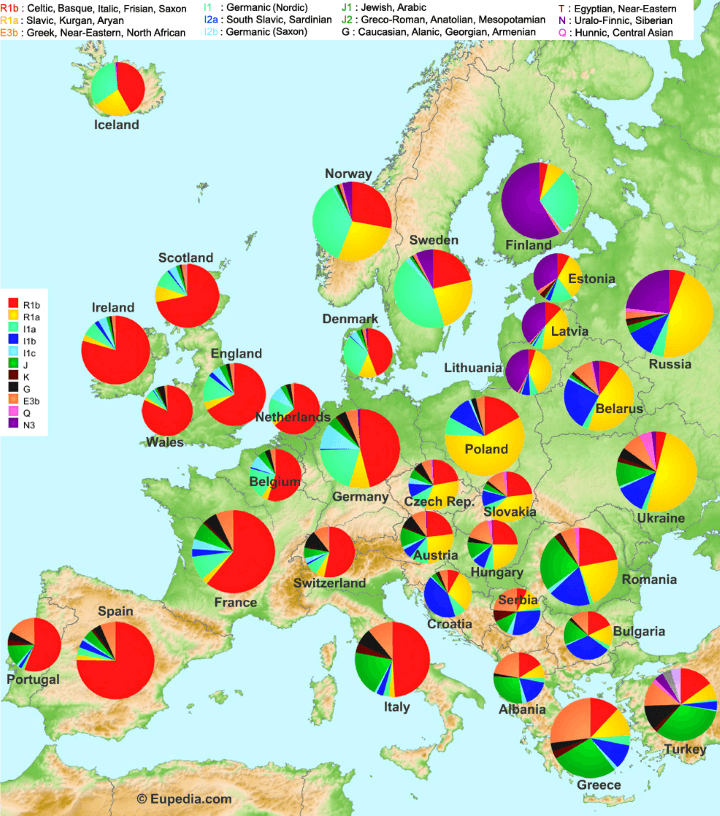
I beg to differ. I live in Eastern Europe, at the crossroads of different migration waves, and I'd say we've been quite successful at integrating people over the millennia. Just look at this widely circulated genetic map of Europe (http://brilliantmaps.com/wp-content/uploads/2015/04/genetic-...), you can see that Romania (the country from where I'm from) is pretty diverse, and that happened because we're at the crossroads between "mainland" Europe, the Asian steppes, Anatolia/the Middle East etc.
And looking past genetics, I can give you countless examples of Transylvanian Saxons and Hungarians who, once they had passed the Carpathians into Wallachian and Moldavian lands, ended up by giving up their religion and language and completely assimilated (yeah, it took them a couple of generations or more, but the process was generally irreversible). The local Jews were also quite well integrated in terms of customs and everything, in fact one of the most famous Yiddish songs ("Roumania Roumania - https://www.youtube.com/watch?v=vuj-qjyUjxY") mentions Romanian foods like "mamaliga" or "pastrama" (which we stole from the Turks, but everybody from the Balkans did that) in a melancholic way, like it also belonged to them, the Jewish people who used to live here.
The amount of blood that the eastern European ground soaked up during the course of these great migrations, and recurrent sectarian violence in the Balkans into the present day stands as a strong counterpoint.
> The amount of blood that the eastern European ground soaked up during the course of these great migrations
Any source for that? I'm pretty interested in the history of the Middle Ages and as such I've learned recently that some historians have even started to question the long-held believe that the famous Mongol invasion of 1241-1242 was that bloody. Yeah, they did ransack a couple of towns in Transylvania and present-day Hungary, but that mostly happened because those people put up a fight, on the other side of the Carpathians (Wallachia, Moldova) there are no visible "destruction markers", so to speak (like burned villages and such). A couple of centuries earlier the Pechenegs and the Cumans did cause some bit of a stir in their wake, but that was comparatively short-lived, as they were very rapidly (again, comparatively speaking) integrated by the Hungarians in their kingdom (there was even a king of theirs called Ladislaus the Cuman) and also by the Wallachian/Romanian population which was not part of any established State: to this day "Coman" is still a a pretty popular family name among Romanians, and some big name-places bear Cuman/Turkic names, like the county of Teleorman (meaning "crazy forrest") or the plains of Baragan (meaning "winter storm" or something of the sorts).
It's difficult to peer into the internal history of the Eurasian steppe and its largely pre-literate past for the early periods. So we're largely forced to rely on the accounts of the literate peoples around the periphery, whether that be Greek, Roman, Byzantine, Persian, or Chinese who dealt with and recorded the results of incursions from these outside peoples from the heart of Eurasia. For whatever poorly-understood reason, peoples seem to have boiled out of either Scandinavia or Mongolia periodically, pushing along the adjacent tribes, who pushed on their neighbors, in something like a butterfly effect, until this knock-on effect pushed a tribe over the border into the territory of some settled people.
Invasion by the "Germans" is the explanation Caesar gives for the migration of the Helvetii; it's debatable how accurate he was being, and how motivated to find political justification for his actions, but something induced them to pack up and move for greener pastures. A similar explanation may be found for the movement south through the Balkans and into Asia Minor of the Celtic tribes that became the Galatians. There is perhaps more evidence of this effect in the series of great migrations towards the end of the Roman empire, where the Franks, Burgundians, Vandals, and Goths all were forced westward in front of the Huns and Alans, who were themselves pushed westward by other steppe tribes of central Asia, perhaps ultimately terminating in the Xiongnu and their conflicts with Han China. There appears to be another wave of migration some hundreds of years later, corresponding with the migration of the Slavs, Bulgars, Avars and others into eastern Europe and the Balkans, the expansion of the Rus, the rise of the various central Asian Turkic khaganates, and the expansion of Tang China. Then there is of course the expedition of Batu and Subotai, in which atrocity and total war was a favored tactic, and only a succession crisis after the death of Ogodei Khan spared the rest of Europe. Then there is German colonization under the aegis of the Teutonic Knights, the crumbling of the Byzantine Empire under assault from the Turks on the one hand and the Venetians on the other, incessant warfare as the Ottomans expanded and contracted northwards through the Balkans, culminating in the early 20th century "Baltic Question" tinderbox as that empire fell apart and led to hundreds of millions of deaths throughout eastern Europe and atrocity on a scale to rival Genghis.
It's a history of blood and sword; not perhaps categorically different than the history of most places, but amplified by virtue of being the crossroads of so many moving peoples.
jews still lived in jewish quarters, married mostly other jews and aggregated around jewish structures; being integrated is a little more than liking local dishes; beside that "integration" ended up in violence anyway even before wwii, when romanians started persecuting them.
I've actually made a map of the Jewish Bucharest buildings that were nationalized by the communists after WW2 (available here: http://bucuresti.maglina.ro/nationalizari/# - works better on desktop, not so sure about mobile/tablets), you can see that while there was a concentration of buildings in what people now call the "Jewish neighborhood" (which was not called like that back then) those properties were quite largely spread over the entire city (the Jews made 10% of the Bucharest population before WW2).
> beside that "integration" ended up in violence anyway even before wwii, when romanians started persecuting them.
WW2 and the 1930s were very difficult times (and not only for the Jews). I like to look at those times as the exception rather than the norm.
weird because we've been relatively paceful only in the first world and only in the last 30 or so years. jugoslavia was just torn in an ethnic war; spain, ireland and russian client state were host to terrorost movement up until a couple generation ago, with many issue yet unresolved and likely to resurface. before the first world war there were a host of proxy wars around africa and middle east, class cleansing in the east, before that full on wars in the americas, before that france england and germany were in a state of constant skirmishes, with spain under siege by the moors and italy cities changing state flag every couple of generations. china was in warring state mode too until unification, then class warfare, then religious warfare, then the great step ahead.
humans have been a bunch of assholes, we living in a niche of limited peace on a few locations shouldn't give us the peace of mind that everyone else understand the value of integration. note that a person or a family by itself is likely to integrate, it's significant migration that end up into more or less pronounced isolationism.
again, just have a look at all the chinatown and italian quarters. the actual border may be fuzzy, but the sense of identity is definitely there. and while wwii was an exceptional time, smaller conflict are still very present and the failure integration models are popping up every day stronger.
I think it's easy to forget that we've had relative peace in the west since WWII only because the two major powers built nuclear arsenals large enough to end all life on the planet in a matter of minutes.
Even with all the carnage of WWII, I have very little doubt we'd have been back at it 10 years later if it weren't for the specter of nuclear armageddon hanging over everyone's heads.
You'd be surprised. We did horrible things to our Jewish communities. But... in a strange way.
Current Romania was formed out of regions that were occupied by different empires. The Old Romanian Kingdom was formed out of the bits formerly under Ottoman control. In 1918 the kingdom expanded to include regions formerly under Austria-Hungarian and Russian control.
When far right sentiment flared during WW2, the Jews in Basarabia (ex-Russian territory) were persecuted, even butchered. The ones in the Old Kingdom weren't.
In a weird way, they were "our Jews". They were considered different, yet still a part of our community.
That is one weird conclusion. The fact that there are still traces left from past migration waves is hardly evidence of failed integration.
How many generations does the ancestoral language usually survive? Two? Three? Integration succeeds en masse all the time, especially where religion doesn't interfere.
It's just that nationalist wars make more headlines than all the kids I went to school with who didn't even properly speak the language of their own mothers (something I find rather regrettable).
Ethnic ghettos are as much or more imposed by external oppressors than internal separatism.
The USA is full of Chinese, Italian, Irish etc descendants, most of whom do NOT live in those ghettos. After a generation to learn the local language and culture, descendants leave the ghettos for success in the wider world.
As a young boy my father used to take me to the Pergamon museum in Berlin - one major exhibit is the Babylonian street of processions (it dates to the neo-Babylonian empire) He used to say - here you see our heritage, we were around the show when Berlin (and all the other great capitals of the world) were still a swamp.