This headline is such clickbait. Netting out all fossil fuels is silly. Natural gas is alive and well and growing quite quickly, while coal is suffering.
Why would you call it silly? The headline basically implies "total fossil fuel generation has stopped growing, while renewables have grown substantially," which is both accurate and interesting. The fact that the coal/gas mix has shifted toward gas doesn't change the fact that total fossil-based generation capacity has basically leveled off.
> "The headline basically implies "total fossil fuel generation has stopped growing, while renewables have grown substantially," which is both accurate and interesting."
It's not accurate, it's bullshit. Look at the graph here, which is based on the official US government figures:
According to your own link, "In 2016, fossil fuels accounted for 81% of total U.S. energy consumption, the lowest fossil fuel share in the past century." Of course you'd need additional data to show that the absolute amount of electricity generated from fossils, and not just its share of the pie, had declined.
The sums of the fossil fueled columns (1-5), by yearly GWh, are:
2007 2992238
2008 2926731
2009 2726451
2010 2883361
2011 2788867
2012 2775025
2013 2745968
2014 2750572
2015 2727246
2016 2654468
Total fossil fueled generation is well below where it was a decade ago. The rapid rise of natural gas generation has been more than offset by an even faster decline in generation from other fossil fuels, coal in particular.
> "Total fossil fueled generation is well below where it was a decade ago. The rapid rise of natural gas generation has been more than offset by an even faster decline in generation from other fossil fuels, coal in particular."
That's the problem I'm trying to highlight. The decline of coal is the ideal opportunity for renewables to rise to become a greater portion of the energy mix. Instead, we see natural gas taking its place. Natural gas is abundant and cheap, and causes less pollution than coal, but is still a polluting source of energy. Renewables now have to fight against a new, stronger incumbent, rather than taking the place of a dying one.
You originally said that the claim "total fossil fuel generation has stopped growing" was bullshit. Those numbers show it's not bullshit.
Renewables have been rising. See the same table I linked before. Maybe you'd prefer if all that declining coal generation had been replaced by non-combustion sources instead of mostly gas. So would I, but global solar manufacturing capacity in particular has grown so rapidly and recently that it wasn't even theoretically feasible until just a few years ago.
Gas plants are cheap to build and currently have low fuel costs too. But even at today's low fuel costs, most of their operating expenses come from fuel. As renewable and storage construction costs continue to decline, their very low marginal costs provide ample opportunity to steal more share from gas, even if gas prices stay low. It's already happening in California.
Fossil fuels and renewables are just categories. If you take away those categories you'll see that the growth in solar, wind and other sources that are classed as "renewables" are not significantly outpacing the growth of natural gas. The reason this is significant is because the growth of natural gas is as a result of those who see it as a long term investment. The new natural gas power plants/generators were almost certainly built to return a multi-year profit to their investors. Don't let the drop in coal distract you from the growth in natural gas, it represents a long term shift in the energy mix of the US, and will be almost certainly harder to shift than the coal industry.
What you should be asking is, why are individuals investing more in natural gas rather than renewables? If we were being honest with ourselves, the problem is still battery technology. Investment in electricity storage is costly, and the batteries we have today become less effective the more they get used, resulting in regular replacements being required to maintain storage capacity. There are groups working on the grid storage problem, but it's far from resolved. Without it being resolved, there's a ceiling beyond which solar and wind are not likely to grow, as the most important factor in grid electricity is reliability, and storage is the only way to make a grid with the majority of energy coming from wind and solar to be reliable.
Yes, actually. It looks like the increase in petroleum and gas in the last 5 years is more or less nullified by the drop in coal, while renewables is steadily increasing. What do you see?
I see that the drop off in coal is masking the growth in other fossil fuel sources. It should be renewables that take the place of coal, not natural gas and petroleum.
Of course renewables are much lower, as that table shows. But meeting current demand with new natural gas generation is still a big improvement over old coal generation.
How do you think we get additional usage of fuel types? By growing the generation capacity.
The point is, there's no sign of the expansion of natural gas usage slowing down. Install base of power plants/generators running off natural gas is growing.
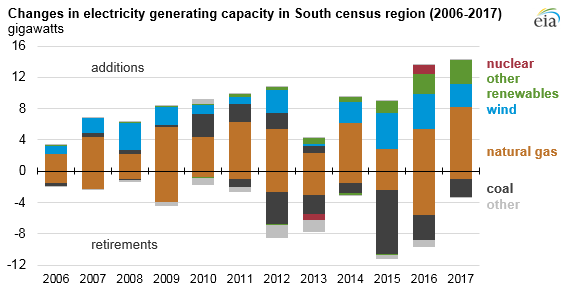
I haven't got all the figures to hand, but consider this report, which covers changes in electricity production in the southern states of the US:
Your objection is that natural gas shouldn't be considered non-renewable?
Or that the comparison happens at too high a level?
If you'd like to write about the shift from coal to natural gas, that's probably worth drilling down to one level below this comparison, but that doesn't make this comparison invalid or misleading.
When you define "new" in such a way that you can only count renewables then it's really not "new" is it?
Unless you can come up with some stats that prove that all of the non-renewable production that was added was directly replacing old non-renewable production, and all of the renewable production was added just to meet new needs, then you have no case.
Last year I ate 100 pounds of food. This year I ate 120 pounds of food. Last year I ate 50 pounds of vegetables and 50 pounds of meat. This yea, I ate 50 pounds of vegetables and 70 pounds of meat.
Is it fair to say that my meat consumption has increased by 20 pounds? Or is it unfair on the grounds that I've not mentioned a big shift from potatoes to carrots within the 50 pounds of vegetables? I mean, my potato consumption is way down, but my carrot consumption is way, way, way up. My carrot consumption has gone up by a bigger percentage than my pork consumption, for sure. Except... it doesn't matter.
My meat consumption went up, and my vegetable consumption remained flat. That's new meat consumption. Shifts from potatoes to carrots and pork to beef are irrelevant to the subject at hand.