Hacker News new | ask | show | jobs
by michaelbuckbee 3089 days ago
It's like any sort of tech: the first version is too expensive and then the price drops some % every year until we all have "supercomputers" in our pockets.

Plain Solar Panel (non roof) installation has gone from $52k to $20k in the last decade [1] which is craziness.

The other aspect of this is longevity. Setting all solar power generation aspects aside an asphalt roof will generally last 20-25 years. Tesla roof tiles appear to last much longer (infinite warranty, etc.) and are maybe more comparable to a slate roof which would be 10x the cost of an asphalt roof.

As a reference point, I grew up in a house built in the 1920s and just confirmed via Google Streetview that it still has it's original slate roof.

1 - https://news.energysage.com/solar-panel-efficiency-cost-over...

3 comments

Moore's law is the exception, not the rule.

Does Tesla have any sort of public lifetime estimates?

Actually, no. Moore's law is really a general trend that is apples to pretty much everything, just with different constants. As our knowledge and tech advances, everything gets cheaper and easier. This is also known as "Economies of Scale".
No. In basically no other industry does "performance" double every two years. Agricultural output doesn't double every two years, drugs aren't twice as effective every two years, and cars aren't twice as fast every two years. Semiconductor manufacturing is the exception, not the rule.

As for the different constants point -- you can model anything as an exponential function with a small enough coefficient. Moore's law is significant because it doubles every two years.

Economies of scale is in reference to mass production (scale). Making 1000 widgets is cheaper than making 10 widgets on a per widget basis. This is fundamentally different from the predictions made by Gordon Moore.

It's also like to point out that Moore's Law hasn't applied for a while now. Ultimately, we'd be at >5nm, and that's nowhere near ready.

They are touting an "infinite warranty" for the integrity of the tiles (which doesn't include the electronics portion).
Does the warranty include labor?
In addition to the other replies, a slate roof is nowhere near ten times the cost of asphalt shingles. It's more like 3x, and that's only if you price the cheapest asphalt shingles.
I had a damaged slate roof. Bids to repair it, replacing most of it, were north of $100k. An asphalt roof with 30 year shingles was under $5k. Ten times isn’t enough.

I have a slate roof now, and pay a few hundred a year for replacement of broken skates. For historical-commission reasons, I’m much more likely to do Tesla-style tiles than anything else... and electricity here is 22¢/kWh.

Average cost to replace a 2,000 sf slate roof is ~$30,000. Someone was likely trying to rip you off.

Lifespan is kind of a leading question as many buildings simply are not going to last. Still, the high end for slate is very high. "There is a chapel in England, built during the 8th century, which has one of the oldest slate roofs known. After 1,200 years of service, the moss-covered roof is still in good condition, demonstrating the permanence of the material."

Is slate particularly popular in the US?

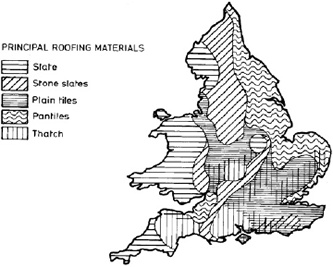
In the UK most tiles are made of clay which are cheap and pretty durable. My neighbourhood is Victorian and I guarantee some of the houses here still have their original tiles. Some towns have slate roofs (e.g. the Lake District), but it's more expensive and a local aesthetic/tradition, more than anything else.

Virtually nobody uses shingle roofs. To give an idea of the historic distribution, which is still pretty accurate: http://www.buildingconservation.com/articles/claytile/pic_12...

Replacement prices, for example: https://local.which.co.uk/advice/cost-price-information-roof...

An entire slate roof on a big house is around £12k max. I'm surprised that the difference isn't that much compared to clay, but I imagine most of the cost is labour.

Depends on the style of home (Spanish, traditional, modern, etc). I see clay tile, slate, and asphalt mixed in the same neighborhood pretty frequently. Of course, the higher the home value the less likely it's going to have asphalt (or at least asphalt that looks like asphalt).
20-25 years is at the limit of what I could imagine staying in one house with any certainty. How does the extra longevity justify the cost unless I plan to never ever move again?
It goes to the home's value (aka you'd get more when you sell it). I kind of think of it like brick. Brick has a much longer maintenance cycle than vinyl or wood siding.
The is true in theory, but in practice the housing market isn't 100% efficient.

You'll no doubt recoup some of your value, but not all of it.

Part of our bubble is that at times it's been "more than 100% efficient", so to speak.

Witness dozens of TV shows, "You guys had $50K for your reno budget. Your original value was $250K, and you spent $50K and now your house is worth $350K!"

Your example doesn't show excessive value capture for the upgrades in the home. Rather, for the extra 50k in bank loaned money, the buyer is choosing not to engage in renovation for reasons typically related to: inconvenience, time restrictions, lack of vision, etc.
So you don't have to replace it again before selling it, or take the hit from someone deducting the cost of a new roof off of an offer, the first is typically better for you as a seller. It also adds value to the house in multiple dimensions: they don't have to replace the roof when they sell it, and a solar roof reduces their electric bill.
resale value?