Hacker News new | ask | show | jobs
by EvanAnderson 3125 days ago
Here's my anecdote: In 2006, while sitting at my desk playing a video on the hard disk drive of my Thinkpad T22, I held a single neodymium magnet (harvested from an old hard disk drive) about 6 inches from the left side of the unit (where the ~40GB-ish Travelstar 2.5" PATA disk was located). The video froze, Windows XP blue-screened, and the hard disk drive started emitting a ~10Khz whine. I jerked my hand away from the PC immediately when the whine started.

BIOS would no longer detect the disk on that machine, or any other I tried it on (on both USB-to-PATA and honest-to-goodness motherboard PATA controllers). The drive spun up but made a repeated ticking sound (I assume seeking back and forth looking for servo tracks).

I sent the drive to Kroll Ontrack (because, stupidly, I had billing data that wasn't backed-up on the drive). The report I received back indicated that 80% of the drive's sectors were unreadable.

As an aside: The data I was looking for was ASCII text and Kroll Ontrack was completely unhelpful in just sending me a bitstream image of the drive so I could grovel thru looking for data I needed. Being plain ASCII, their "file carving" tools didn't locate any of the data. (They sent me a "preview" of the data they'd located, and while it got lots of Microsoft Office-format files, it didn't have any ASCII text files). I offered them a 3x multiple of the rate they asked for file-level recovery to simply send me the bitstream image of the disk that they'd already made. They wouldn't do it, and wouldn't even let me pay to talk to somebody who understood what I was saying. I ended up taking a major loss on the billing data I destroyed. I'll never recommend them to anybody.

I won't ever play with neodymium magnets around spinning rust media again.

6 comments

Most likely mechanism for this incident was:

1) external magnet messed up heads movement closed control loop (internal drive's magnets + voice coil + positioning marks on the platters), and as a result head actual position became different from what controller thought it was.

2) control loop tried to correct itself, repeatedly failing, all while head kept moving across the platters, while controller was still thinking it's elsewhere.

3) controller was writing to disk, so it overwrote data in highly irregular tracks that followed erratic head dance. some of that overwrote positioning markers.

4) when recovering, even though 99.9% of data was still there, controller failed to position the head on erased markers, so reported "unreadable sectors"

From 6 inches away? Unless this was a hockey-puck sized magnet I'm calling it a coincidence.

> (harvested from an old hard disk drive)

Okay, this is making even less sense. "Hard drive magnets", in a drive, are millimeters from the spinning platters. I refuse to believe that the same magnet, moved 6 inches away from the computer caused catastrophic damage.

I will definitely concede that the 6" number may be an incorrect memory. It certainly may have been closer, but it wasn't right on top of the unit.

If it was a coincidence it was certainly well-timed. I don't have the Thinkpad anymore, but I do still have some 2.5" PATA drives. It might be interesting to test this and make a video.

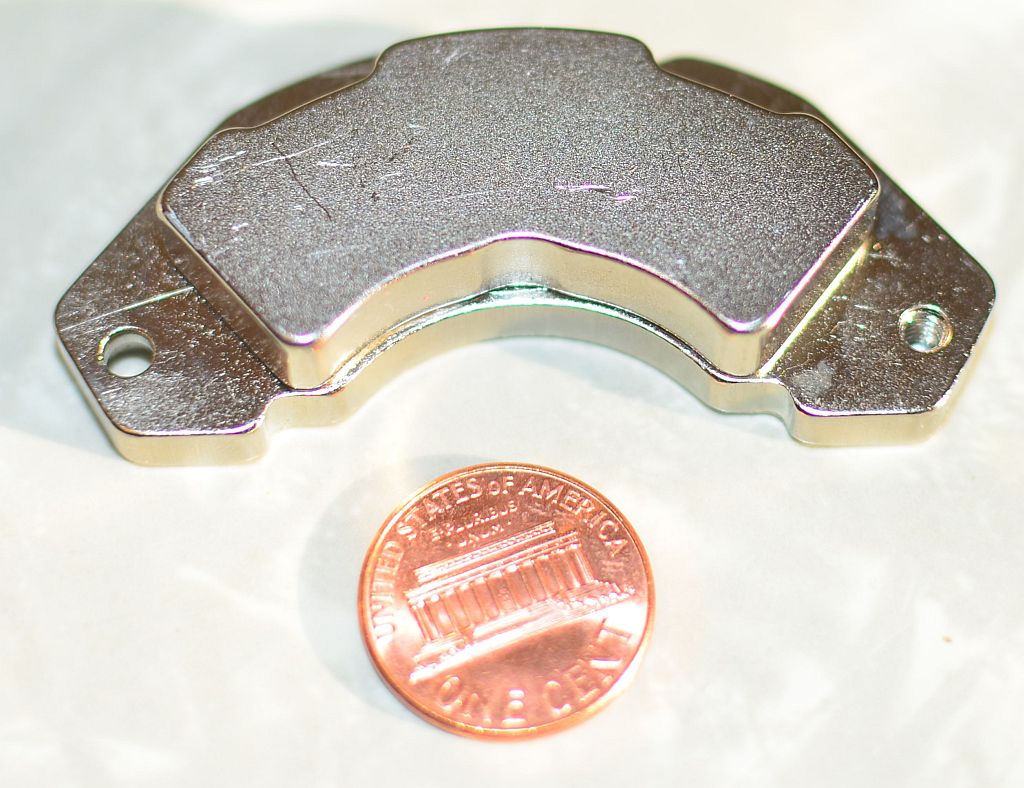
Here's a picture of the magnet in question (it holds stuff to my refrigerator now), w/ a penny for scale: http://mx02.wellbury.com/misc/20171203-Magnet_of_doom.jpg

This magnet was pulled from a Micropolis 9GB SCA-II 3.5" low-profile drive dating from roughly 1998 (I had a crap-ton of these drives and, as they died, I pulled their magnets, so I have a bunch of these). These particular magnets will stick to each other thru my 3" thick butcher block table. They are physically larger (substantially thicker) than the ones I've pulled from newer drives.

Edit:

I assume that the data and servo tracks written to the drive are done so in the presence of the magnetic flux of the magnets supporting the voice coil. I always just assumed that adding a substantial new source of magnetic flux (the magnet in my hand) either induced a current or magnetized some component in the drive.

>> They are physically larger (substantially thicker) than the ones I've pulled from newer drives.

Not really, they look very close in size to current Enterprise Drives (https://imgur.com/2HjuuKM), Of course I have removed the Metal backing plate from mine

Now consumer drives do have smaller magnets (that is one way to save cost)

Here is a photo of the 4 styles of magnets I still personally have, the smaller magnets are either out of consumer drives and 2.5in drives manufactured in the last 7 years https://imgur.com/59XjVPm

And just for fun a small assortment of my collection because why not

https://imgur.com/bW6ycRI

I've only had the opportunity to tear down a few consumer drives in the last few years. I haven't seen inside an enterprise-class drive in a few years. (I've stopped dealing with hardware directly for my Customers, and I haven't purchased much hardware for personal use over the last few years.)

I've found scavenged hard drive magnets to be very useful for odd jobs. One served several years holding up the fallen head-liner over the drivers seat in one of my crappier cars.

But it will mess up the power flow. Misbehaving powesupplies destroy HDDs.
So a magnet held 6 inches away from the PC did more damage than the one inside the HDD literally inside the PC?
Yeah, I hope people realise that everybody has these magnets IN their computer. You might have a NAS in which case you have several of these magnets much closer than 6 inches to the other drives and power supply and nothing happens.

Magnets near your or even on the computer do nothing.

Magnets induce a current when moved relative to a conductor. The magnets you mention aren’t moving.
When you swap drives, they are. Yet people don't have mysterious data loss when swapping drives out of their bays.
>> moved relative to a conductor

Yes. The magnet is stationary and the spinning drive plate is moving the data, the conductor, very rapidly relative to the magnet. (imho the real issue is the large metal box surrounding the drive plates. It's hard to feel a magnet from inside a metal house.)

So what you're saying is that nobody can hot swap drives in a NAS without destroying neighboring drives? I don't buy that either.
I agree that it makes no sense. A magnet outside the case is not going to do anything to the platters.

kees99 posted a possible explanation, where the magnet moves the voice coil, which ends up destroying the drive by writing data in the wrong places.

This can't happen either. Early hard drives (and I mean early: the 80s) needed precise head alignment (in respect to the how far the head is from the center of the platter) in order to read or write data in the correct location. If you've heard of "low-level" formatting, that's when a on-platter layout unique to the head and head movement mechanisms of the host drive is created.

Modern drives, however, are designed to "follow" the tracks that are cookie-cutter imprinted onto the platters. We use this design now as it's far easier to design a head that reads tracks and makes slight adjustments to stay on track, vs a head that needs to move to an absolute exact position.

In other words, modern drives are designed to combat this exact problem.

I stack hard drives and they keep working.
Absolutely. Hard disk drives don't stick to your refrigerator (like a naked magnet does) either. My layman's guess would be that the fields generated by the magnets in opposition in the voice coil are somehow "balanced", so that the net magnetic field produced by the drive is negligible.
It's simpler than that. They're held in an iron ring. This confines the field nicely, the permeability of the iron is quite high.
Why wouldn’t they send you the image??
It was around Christmas, and a lot of people seemed to be out of the office for vacation. My sales rep was not technical and didn't understand what I meant when I asked for the "bitstream image" or "raw image" of the drive. I kept pressing, leaving voicemails in which I said stuff like "Look-- you don't know what I'm asking for. Send this to somebody in your engineering department and they'll know what I mean. I want to give you more money than you're asking for to get this."

Eventually I got a call back from somebody saying that they understood what I was asking for but couldn't send it to me. At that point I got fed-up and paid the minimum bench fee and asked for my disk back. I probably should have pushed the issue further, but my need was timely and I'd already started reconstructing the data from other sources.

That sounds really frustrating to say the last! Thanks for sharing. Interesting stuff.
You didn’t hold a magnet 6 inches away from your HD.

You held a magnet 6 inches away from a plate spinning at 5400 rpm.

Out of curiosity, what was the brand and model of that HDD? Would like to dive deeper into its construction, etc.
It was a Travelstar (I believe still under IBM ownership at that time) 2.5" PATA drive. I don't have the exact model handy. I took a look in my "dead disks" shoebox and I don't believe I even have the drive anymore. If I run across it I'll drop a comment on here.
>I won't ever play with neodymium magnets around spinning rust media again.

That is your take away? Not that "I ensure all my data is backed up using the 3-2-1 Method at a minimum" it is "never play with magnets"?????? Really?

People never cease to amaze me when it comes to data security.

That was my "take away" to "playing with magnets around spinning rust media". It has nothing to do with my attitude toward data backup, or with playing with magnets in general. I have no desire to induce further failures in any other spinning-rust media.

It was a failure in following disciplined practices, in this instance, and it caused me monetary loss. It was a good lesson. I am happy with my attitude toward data security and data loss, and it's certainly not codified in the statement "never play with magnets".