|
|
|
|
|
|
by pishpash
3126 days ago
|
|
|
It's not just that, right? You make it sound the same as hitting the diffraction limit in optics:
http://hyperphysics.phy-astr.gsu.edu/hbase/phyopt/imgpho/ray..., but at the Raleigh criterion and under, the waveforms can still be quite different depending on the source distance, and furthermore you can definitely tell the difference of those waveforms from that of a single source. What I've read about Bose-Einstein condensates seems to imply that in the condensate form, the probability waves not only become unresolvable but also synchronized in phase, AND the energy behavior of the aggregate is markedly different since they "all" (or at least according to Bose-Einstein statistics) occupy the same quantum state:
https://www.youtube.com/watch?v=shdLjIkRaS8 Is the transition from Maxwell-Boltzmann statistics to Bose-Einstein statistics a sharp transition or not? In other words, are condensates a descriptive marker or a suddenly different state? |
|
|
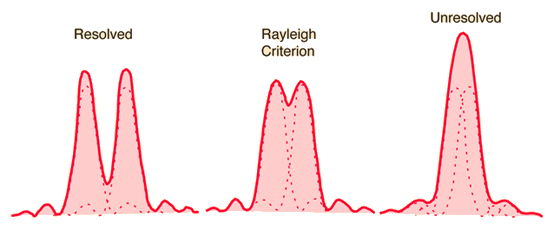
But those atoms themselves are still made up of electrons, protons and neutrons which have half integer spin, and at even smaller scales of quarks and gluons. If you probe the condensate with high enough frequency without thermalizing it you would be able to resolve those details, but at the macroscopic level of the condensate those details are not resolvable (is that what you were getting at?).
When you cool an atomic cloud below a critical temperature there will be a condensate fraction and non condensate fraction. If you are just looking at the condensate fraction then you can use Bose-Einstein statistics.
At zero temperature with 100% of the atomic cloud as condensate ( in reality we can never get to zero temperature, but we can get pretty damn close), the Gross–Pitaevskii equation ( https://en.wikipedia.org/wiki/Gross%E2%80%93Pitaevskii_equat... ) is a good model for the dynamics of the condensate. If you want to go above zero temperature and include interaction with the thermal cloud (the non-condensate fraction), then you can use the SPGPE, the stochastic projected Gross–Pitaevskii equation.