Hacker News new | ask | show | jobs
by janwh 3127 days ago
I do understand why people would want to speed up their podcasts backlogs—I'm currently about 50% in, working my way through >500 hours of 5by5's Back To Work with Merlin Mann. I've tried speeding that up but one thing in particular causes me to stick with 1.1x at max: it's the connection with the hosts. It's just information (both useful and less so) condensed to be hastily consumed but it discards the dedication the hosts have put into it. Playing off of each other. The inside jokes, the subtle differences in tone and timing.

Maybe I'm just not as good in processing such social interactions at a faster pace than real-time. But I love "sharing a laugh" as if it's happening right now. That feeling completely goes away when the audio is sped up.

3 comments

> I do understand why people would want to speed up their podcasts backlogs—I'm currently about 50% in, working my way through >500 hours of 5by5's Back To Work with Merlin Mann.

I listen to a lot of podcasts, and if I had a 500-hour backlog in one, I would conclude that I care about other things more, and either unsubscribe and delete it, or stop downloading episodes by default. I used to auto-download Fresh Air, for example, but when it started backing up, I dialed things back, and now listen to 25-50% of episodes. I also used to listen to The Talk Show, but decided there were other things I would rather do.

Humor is a trick to help making information stick in your head. Not a new trick; advertising uses that trick all the time.

There's no way that with speed listening or reading everything sticks equally as listening or reading a 1.0x speed multiplier. It may feel like you got more done, but in reality you did not. You're essentially fooling yourself, feeling like you accomplished more than you did.

I do the same, but with movies/series. I "watch" them on a second screen without being all the time focused to it. Except if its a really good movie/serie. But if it isn't a good one, why watch it in the first place?

Do you have any reason to believe this besides intuition? Anecdotally you'll find lots of people who say they retain a lot more at 2x speed than 1x, including me. Just look around this thread. Here's one study on this I found with a quick search: https://link.springer.com/article/10.1007/s11528-015-0841-2

My own intuition tells me that everyone probably has a maximum (and maybe minimum) speed that they're comfortable with, and there's no reason to assume that a podcast host's preferred speaking rate is the same as an audience member's preferred listening rate.

Speeding up your primary focus is not at all comparable to consuming something as a secondary focus. I agree that "watching" something in the background is terrible for comprehension and retention.

Perhaps I am biased because although my English is quite decent it isn't my native tongue.

I'm not sure if we're discussing the same thing here. I am talking about learning.

Yes, there's also a lot of people who believe speed reading allows them to read quicker. Sure, it might seem that way, but does the information stick? Do you think anecdotal evidence to test if information was learned counts as evidence?

Dr. Barbara Oakley and Dr. Terrence Sejnowski didn't mention your proposed learning method in their Learning How to Learn course [1]. They also debunked speed reading in that course. If your proposed learning method works well, they should incorporate it in their course. However, it seems to go against the principles of chunking and overlearning.

[1] https://www.coursera.org/learn/learning-how-to-learn

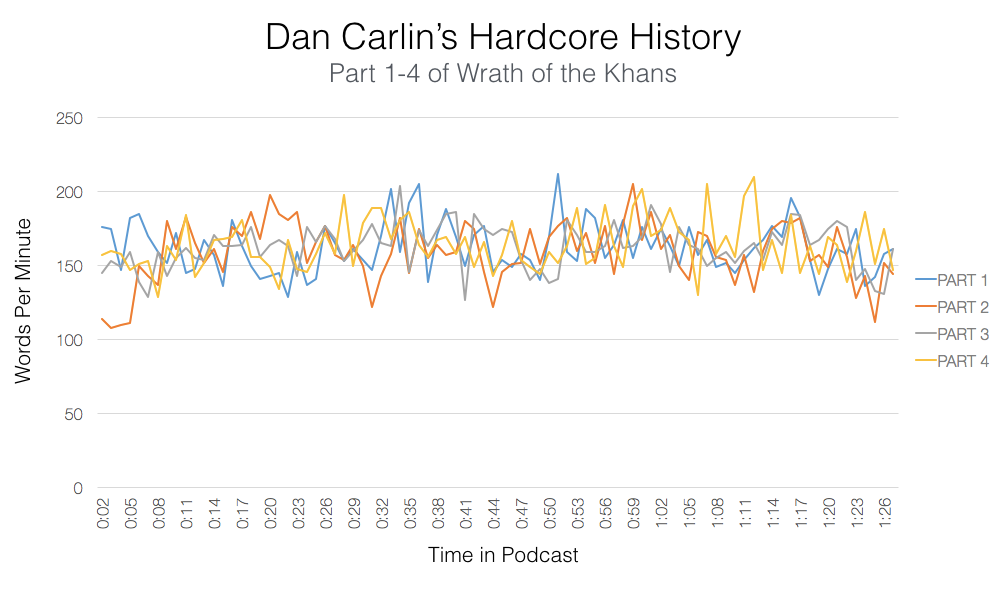
I can't find a definitive source, but the average adult reading speed seems to be around 300 wpm. Popular podcast Hardcore History hovers around ~175 wpm (https://cdn-images-1.medium.com/max/2000/1*_PUpCqAQyCQ-Whf02...), so you'd need to almost double the speed to reach a normal reading pace. So I don't think arguments against speed reading really apply to this.

Of course it all depends on the host. If you find a podcast where the host is already reading at 250 wpm, you'll probably have a hard time catching everything at 2x speed.

Maybe they're catered to the lowest common denominator (the elder).

I've been thinking a bit more about it and I don't remember audio-speedreading being mentioned in the Learning How To Learn course (which I followed, and I hold both teachers in high regard). I think I am biased from the text-speedreading shenanigans.

> Of course it all depends on the host.

Point taken.

My theory is it also depends on the reader. As I grow older, I find it is more difficult to follow things. Sure, my vocabulary still slightly increases but I also think things through more, am more experienced, and eventually I'll end up with Alzheimer's. Hence my suggestion it is catered to the elder. Certainly not for HFAs. (I used to talk very quick as well as child. It was annoying as fuck to everyone, not in the least my parents.)

Reading is not listening though, i'd imagine there's differences in how our brain parses them. This is a very interesting, but exceedingly complex issue.
There's a lot of articles and studies about that, here's a decent one: https://www.thecut.com/2016/08/listening-to-a-book-instead-o...

I think reading and listening are not as different as they seem.

I agree.