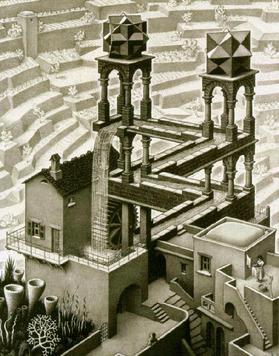
| I don't doubt there are weaknesses, or even fundamental lack of interpretability for classification spaces that overlap (i.e. have a "morphing sequence"). One example that sticks out from my childhood is this image: What do you see here? https://seeklogo.com/images/A/Antarctica-logo-9202568406-see... My entire childhood I saw a weird face (without thinking too much about it). This is the logo of a brazilian beer brand. When I was a teenager I saw an ad with two penguins, and then it clicked. Optical illusions are well documented too, some classic examples: http://www.optics4kids.org/osa.o4k/media/optics4kids/womanil... https://obasandbox.files.wordpress.com/2012/07/carolines-vas... http://i.telegraph.co.uk/multimedia/archive/01120/blackballs... But it's quite probable we'd found any glaring adversarial issues by now. After all artists can conduct a semi-whitebox, mostly blackbox adversarial optimization of illusions (I'm sure some process like this is how they came up with the Old/Young lady illusion). Note however that even those are particular errors like incorrect brightness estimation, or near-complete dichotomy (it's not that either the young or old interpretation are incorrect in some sense). An epsilon-failure seems much more difficult to come up with. The distinction seems mostly in the ability to apply basic logic on top of pure pattern recognition, sort of greatly enhancing the decision boundaries through recursive thought. Eventually logical features (a quick "proof" of sorts) win. You "prove" that what you're seeing indeed can't be a rifle, it must be a weird turtle. This logical approach probably has gradations in power. In general it might even be algorithmically undecidable whether an image is logically valid. Generalizations of Escher illusions: https://upload.wikimedia.org/wikipedia/en/e/e8/Escher_Waterf... come to mind. In practice we cut off the decision process when we've found main logical features and connections, so unless the image inspires superficial uncertainty a deep logical inconsistency could slip by (that a more intelligent person may not miss by universally applying a deeper consistency check). |