Hacker News new | ask | show | jobs
by j10t 3163 days ago
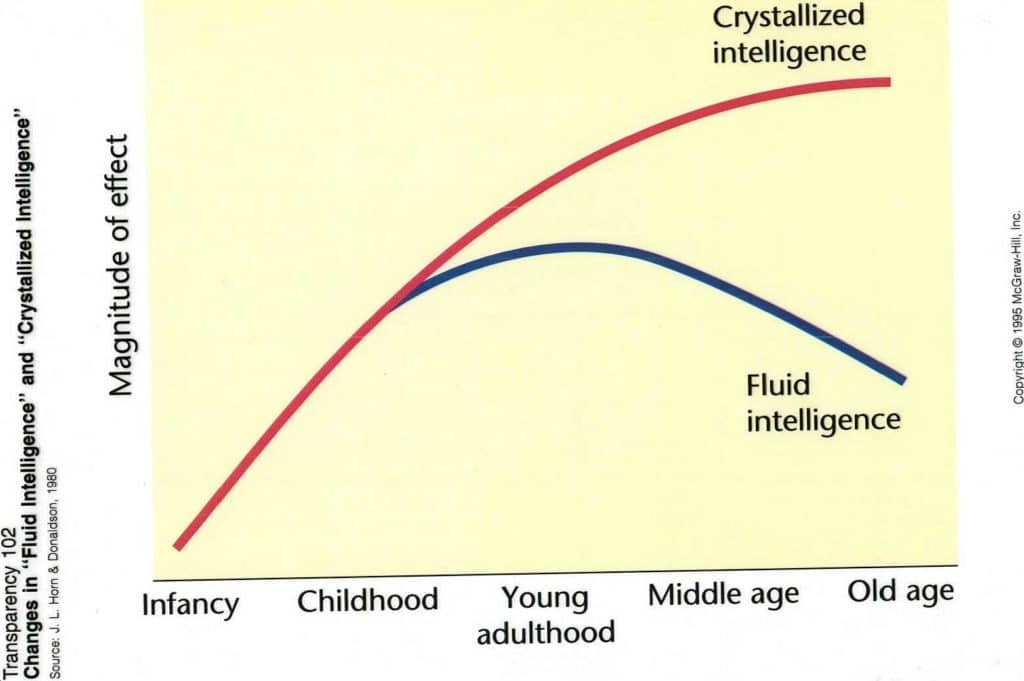
There is substantial scientific evidence showing age-related cognitive decline begins relatively early in adulthood. The science is not controversial.

http://examinedexistence.com//wp-content/uploads/2013/12/cry...

This is a simplified view but communicates the idea.

Some might say crystallized intelligence is under-valued in tech. That might be true. But then we should discuss that, not through the lens of social justice against age discrimination.

7 comments

There's a reason the axes are left unlabeled in this graph. If you look at a paper that gives values over time for these quantities you'll find that this 'effect' mounts up to about 3 IQ points over the range discussed in the article in a population with an SD of 12 [0].

As a basis for discrimination, this is nonsense: on an individual basis you learn next to nothing about an individual's IQ if you know their age. Of course, there may be better studies out there - I'm not an expert and so don't know of them.

[0] http://www.sciencedirect.com/science/article/pii/08876177950...

The graph on page 11 is particularly interesting.

It looks like fluid IQ peaks around 24 then rapidly declines until around 30. Between the 30 and 50 the decline somewhat levels off.. i.e, doesn't decline a much during that period and crystallized IQ increases slightly.

After 50, fluid IQ resumes a rapid decline at a steady rate until about 75 where it really begins to tank.

But you are right, for the timescale in question the IQ difference is pretty small. I'm sure everyone reading this is very smart so a difference of 3 or 4 points shouldn't concern them all that much :)

A couple of things I wonder about, lack of physical activity (I've read) helps hasten cognitive decline. Sitting in a chair for 20 years as opposed to being active for 20 years, wonder what difference it makes? Perhaps sitting in a chair and thinking more than offsets the difference?

Also I wonder about so many world leaders being well over 50 or 60, for example Supreme Court Justices in their 80's. What would happen if a long resume didn't matter so much and we had a slightly younger (not 24 god forbid!) group running government? Just a hypothetical question.

But from that graph, if you are going to hire a 30 year old over a 45 year old (because "younger people are smarter") it appears you'd actually be better off with the 45 year old in sum (crystallized and fluid) intelligence plus whatever experience bonus.

On behalf of all old people: Fuck that, and fuck the idea that cognitive performance alone should determine whether someone in our industry can eat.

Because as much as we love to tout that every programmer is living with a house and a mortgage and a happy family, I happen to know for a fact that some are struggling to eat.

Eh. Not exactly an objective viewpoint, I know. But to maybe drain away some of the energy I just threw into that: Being old is our shared destination. It'll happen to you too. It'll happen to me. How is this a productive outlook?

I've known some amazingly productive old people. I learned from one of the best in the gamedev industry. He was my mentor, and basically a mini carmack. When I hear statements like this, I cannot fathom how people believe this myth that old people are inherently less able to kick your ass at programming.

I really hesitate to bring this up, but there's this dopey argument that HN trolls love to bring up, where they point to a certain area of science and say "Look! Black people are inherently dumber. The science says so." Yet the one black man that I was fortunate enough to work with in our industry -- one, out of six companies, there was only one -- was the most effective, cool coworker I was fortunate enough to know.

It's incredibly easy to point to some science and say "Oh, I'm objective." But I invite you to re-read http://www.paulgraham.com/bias.html carefully, and realize that if what you say is true, then our industry is populated with stellar outliers. That's the definition of bias, right? They have to be stellar to overcome it.

So why would you want argue that the stellar people that managed to get through the gauntlet of discrimination should be looked down upon?

> I've known some amazingly productive old people. I learned from one of the best in the gamedev industry. He was my mentor, and basically a mini carmack. When I hear statements like this, I cannot fathom how people believe this myth that old people are inherently less able to kick your ass at programming.

I'm increasingly old (and hope to live to be really old) but we should try to keep our personal self interests out of the conversation. We need a strong social net that works for everyone, not equal opportunity at work for old folks (or insert demographics here).

I'm not advocating we remove existing laws. I just want scientific findings to be free of chilling effects.

Personally, I'd expect older people to do better than younger people. I fear that we can't fix the human brain rotting(?) away if we deny it is happening.

We need a strong social net that works for everyone, not equal opportunity at work for old folks (or insert demographics here).

Disagree. The point of a social net is to catch those who fall, not those who dont.

I'd take this one step further though. Equal opportunity programs seem to be harmful in our industry. The moment we try to enforce a hiring quota, everyone else starts to feel resentful. That causes real difficulties in a team-based setting. I'm not sure whether those difficulties outweigh the good brought by the programs, but it's hard to argue that they're objectively good.

Rather than an equal opportunity program, it would be better to rid of our own mistaken idea that old people are less intelligent.

Personally, I'd expect older people to do better than younger people. I fear that we can't fix the human brain rotting(?) away if we deny it is happening.

I made no such argument. Again: The old people that populate our industry are the stellar outliers. They're the ones who are smart in spite of the brain rotting (such an endearing term we've chosen). Even if that's true in the general case, it doesn't matter that the average old person is less intelligent. Our industry isn't filled with average old people.

> We need a strong social net that works for everyone, not equal opportunity at work for old folks

Why set these two things at odds?

It’s hard to imagine a better way to avoid having large numbers of destitute old people to worry about than finding a way to enable them to take care of themeselves. That is, providing opportunities for employment. If that makes you uncomfortable, consider the alternatives before you reject it... e.g., higher taxes — perhaps much higher, depending on demographic trends — to pay for warehousing indigent old people Naturally, budget pressures will make it debatable whether these warehouses are actually humane, so you’ll have that to deal with as well. (You may think twice about exactly how hard your standard are once you realize you’ll be entering the same system.)

By the way, if you want to be scientific you won’t want to draw strong conclusions about employing old people from the fact that fluid intelligence begins to decline fairly early in adulthood. First, fluid intelligence is just one component of general intelligence in that model. The other component increases or is basically flat up to retirement age. Second, these measures of intelligence are not that great for predicting job performance in general much less for the small overall decline associated with aging. Here’s some reading if you’re inclined to dig into that a bit [1]. Also, keep in mind an employer isn’t choosing from a random selection of people, where the weak effects of age-related IQ differences might nudge you between two otherwise equivalent prospective hires. They are choosing between a group of carefully selected, screened, interviewed, tested candidates with a career of experience (however long that is for each individual). To make age itself a significant factor in a hiring decision is to believe you are profoundly incompetent at hiring since you must believe your other information gathering techniques are pretty much worthless.

[1] https://www.ncbi.nlm.nih.gov/pmc/articles/PMC4557354/

I must be missing the point, but isn't programming literally cognitive performance?

As you age, your speed and ability to learn new things gradually decline ("fluid intelligence"), but what you've already learned and mastered ("crystallized intelligence"), can remain very strong until the end :)

But have heart! Many people have demonstrated that complex skills (playing musical instruments, and even reading and writing) can be learned well past the age of retirement.

This isn't responsive to my comment. One helpful thing to do is to paste a quote you disagree with or want to ask about.

I think you're asking "Since programming is cognitive performance, is it reasonable to discriminate against those who can't do the work?"

My answer would be yes, if they can't do the work. But out of all the old people I've worked with, only one was a detriment to the team. How many of your coworkers were? How many were old?

The problem with discrimination is that it's easy to believe. People want to believe it. That's why it's easy to say something glib like "don't be afraid, you'll still be able to learn complex skills." That seems rather like saying don't worry, you'll still be able to be a person, since people learn complex skills.

Here's a riddle: How old do you think Satoshi was? He was writing oldschool C++ in 2008. That means he probably learned his trade in the 90's.

Read tMcGrath's sibling comment. "Gradually decline" refers to 3 IQ points over time. You probably have team members who are > 3 IQ points apart.
I think it's sad that the myth that you have to be some sort of genius to be in this industry persists. It's just not true. Most jobs consist of simple work, no matter how complex the people doing it tell themselves it is. Experience is far more important than raw intelligence for more advanced work.
That's what bothers me about AI. When people say AI is a long way from [human quality or skill], it's missing the point. In most work, and even in our field, the work that most people do doesn't require human level intelligence.
This argument is kind of pointless. Hiring for almost all tech jobs is based neither on some kind of "crystallized intelligence" nor on a hypothetical cognitive potential. Rather, jobs are usually matched with people who have the right skills. When a candidate with the right skills for a job gets rejected it's reasonable to ask whether age discrimination was a factor.

One counter argument that I would be willing to consider is that sometimes older workers who have neglected to update their skills are explaining their rejection as ageism when in fact they simply can't demonstrate that they have the relevant skills and expect to be hired based on their past (and by now, not so relevant) experience.

This argument is kind of pointless. Hiring for almost all tech jobs is based neither on some kind of "crystallized intelligence" nor on a hypothetical cognitive potential. Rather, jobs are usually matched with people who have the right skills.

Not in my experience. It's all about whether a candidate can come in and learn quickly. The skills are nearly irrelevant.

Which makes sense. What are the chances that you're going to be versed in every technology a new company uses?

Also, the idea that old people need to have exact skills is harmful. Our industry changes so rapidly that the old people are the most likely to have resumes that don't reflect their potential. Nobody believes them when they say they can learn just as quickly as everyone else.

I'm not sure what your experience has been, but mine (more than 20 years of working in several jobs, doing quite a lot of hiring myself) is that there are two main tracks:

1. hiring promising interns and graduates - no relevant skills but the hope is that they're so smart they'll be able to learn quickly

2. hiring people with very relevant skills - either they've already done the exact same thing at another company or they've done something adjacent and quite similar and can probably handle the switch.

The 2nd track is the bigger one by a wide margin, for the simple fact that people are only 20-something-recent-graduates once in their life time, but tend to move to new jobs several times during their career.

I'd like to posit that the reason you've seen more of the latter is because you've hired for more of the latter. I assure you, if you were to look for well-rounded, motivated developers that didn't have the immediate skills you need, you'd get the same work done. Usually more effectively, since the people who don't have the skills usually feel they have something to prove. Their work turns out better.

Unfortunately, there's not really any way to prove this. I wish there were, since it'd be quite nice to demonstrate it. All I can do is say what I've seen.

I don't think that I'm inherently biased against promising candidates with no skills. Heck, I used to be one myself. Perhaps it's just that in the fields and company types I've worked at most (startups) that's not usually what you look for. The promising recent-graduate scenario is much more common in big corporations where people plan for long, linear careers. In the startup world the average time for someone to be at the company is 2~3 years, and the roles usually get filled only when there's a burning need to get the job done right now. So it could be that I'm not aware of what the correct proportions between the different tracks are.
It reminds me of a quote. The British number theorist G.H. Hardy, in A Mathematician's Apology, one of the most widely read books about the nature and practice of mathematics, famously wrote: "No mathematician should ever allow himself to forget that mathematics, more than any other art or science, is a young man's game."

Basically, the claim is that people over the age of thirty being productive in math is an anomaly. However, I've never used any advanced mathematical concepts as a programmer so I doubt my quote has any validity here. I imagine things are different in data science but I only concede because I have no idea what data scientists do. It just feels like magic.

> Basically, the claim is that people over the age of thirty being productive in math is an anomaly.

It can be speculated that young people often don't have a family and are eager to prove themselves to the world - so they have both the environment and the motivation to work extra hard.

By the same token, alcohol consumption has been shown to lower IQ over time, so should we value sober job candidates?

"People who have been drinking large amounts of alcohol for long periods of time run the risk of developing serious and persistent changes in the brain. Damage may be a result of the direct effects of alcohol on the brain or may result indirectly, from a poor general health status or from severe liver disease."

https://pubs.niaaa.nih.gov/publications/aa63/aa63.htm

"Crystallized intelligence"?

Patience and attention to detail is what make a good programmer.