Hacker News new | ask | show | jobs
by theyregreat 3172 days ago
Using even more fossil fuels is a nonstarter because CO2 levels aren’t leveling off, much less going down. Only consistent, severe international economic incentives and disincentives can motivate rapid deployment of renewables to hold-out / recalcitrant countries, of which there are many, at present. It’s absolutely vital for the species’ survival. To do otherwise is stupidity, insanity or both.
6 comments

What if moving baseline energy from coal to LNG is a greater net reduction in carbon intensity per unit of energy than moving LNG to wind and solar? If you look at the stats on CO2 tonne equivalents from the DoE, the US has been way out front in meeting what were supposed to be its Kyoto and Paris targets. The stats on CO2 equivalents per unit of GDP are even more impressive.

Germany has been heading backwards because their insistence on abandoning working nuclear baseload has increased their need to burn coal, despite their significant investments in solar and wind.

Coal is the greater problem. In the short term, undermining coal power with either non-combustion energy sources or NG is an improvement. Building new NG plants and transport facilities doesn't have a large carbon footprint. The life cycle footprint of electricity from gas is dominated by actual gas consumption. Even if electricity from NG has a life cycle GHG footprint that's as about as bad as coal, due to lax control over fugitive emissions, NG emits far less mercury, acid gases, and harmful particulates.

If renewable energy costs continue to decline as expected, RE will be able to deeply cannibalize NG demand too after coal is gone. If batteries continue to make cost progress, even an increasing portion of "windless night time" demand will be up for grabs from renewables. That will in turn decrease gas demand from power plants and all the associated emissions. Plant load factors for natural gas will fall when competing against renewables just as coal plant load factors did when competing against cheaper NG and renewables. If all goes well, NG will end up as a stranded asset in more and more locations, as is already happening to coal.

I hope to see stronger regulatory action to curtail emissions intensity of electricity generation, but the great thing about improving economics of lower-emissions alternatives is that the pressure against emissions stays there regardless of who has the political upper hand. The Clean Power Plan undermines coal only if the Clean Power Plan has the political support it needs. Falling prices for renewable electricity and natural gas undermine coal regardless of who's been elected:

http://www.utilitydive.com/news/luminant-to-close-2-more-tex...

Fortunately the quickest way to get people to agree with you is to call them stupid and insane. You should become our spokesperson.
One can definitely catch more flies with honey than vinegar, but one can also just speak honestly and frankly when one is not trying to catch flies.
Wait I thought the quickest way to get people to agree with you was to blame immigrants?
I never thought about it before but wouldn't bringing more people into the first world increase global carbon output?
It will and that has been my point. That the majority of the world population does not live in the western world and uses 1/100 if electricity per person once they start using more the world is
A shunned upon line of thought on HN, it seems.
Yeah, we should explain things nicely instead, since that has worked really well so far.
Energy is often traded in long term contracts. Yes, this means that the establishment of shale gas networks are going to be with us for a while. But by the same token, that becomes a much stronger disincentive to continue using coal, the mining of which comes with its own set of environmental and health damages.
In fact it's a starter. Replacing Chinese or German coal use with natural gas imports, would be a massive improvement. If you could instantly swap all global coal use for natural gas, global CO2 emissions would drop considerably.

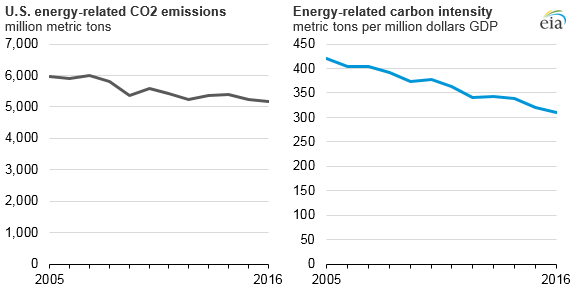
That's why US energy-related CO2 levels have been falling for a decade. It's due to natural gas. The decline began perfectly timed to the latest natural gas boom, which has played the lead role in wiping out 1/3 of US coal consumption.

https://www.eia.gov/todayinenergy/images/2017.04.10/chart2.p...

I have been trying to explain this to people so many times, but they just don't want it. Germany is the worst, at the same time they shut down nuclear, they also refuse gas. Now they just use nuclear from France and dirty coal.

Overall this great energy plan is gone create fare more CO2 for the foreseeable future.

They definitely deserve immense credit for the renewables build-out the last decade. Having more than doubled their energy production from renewables from ~15% to over ~35% in that time. Accounting for 2-4% more per year, hopefully it's near a tipping point where it begins to hammer down coal consumption there. Throw in some natural gas on top, maybe Germany chops coal use down by 1/2 in the next 10 years.
Which will cause massive hunger and poverty, therefore death, to millions of people in poorer nations completely dependent on cheap plentiful reliable fossil fuels.

To achieve what exactly? What catastrophic predictions are you claiming are accurate that would be changed by the immoral policy you advocate?

Your sentiment is a good one, but your conclusion is mistaken IMO. For poor countries the old model of centralized fossil fuel infrastructure is not cheap, and its certainly isn't reliable.

The future of third-world energy security is distributed. Expect to see the same transformation as we've seen with telecom; third-world telecom largely skipped the copper and fiber in the last mile and even some of the backbone, and went straight to wireless. Likewise, these countries will benefit from skipping the expensive coal mines, coal trains, pipelines, power plants, and even some transmission infrastructure, and going straight to micro-grids. They may end up ahead of us in some ways.