|
|
|
|
|
|
by jonloldrup
3183 days ago
|
|
|
That's a bold statement. Read Forbidden Archeology, and you'll see quite a few oddities in the archeological realm. Such as metal spheres with odd, precise features, that are very very old ( http://4.bp.blogspot.com/-oiiiI75kDic/TdRv4ZsspWI/AAAAAAAAAC... ) (Yes, you can now give me the defaults:
"if this was true we would have heard of it"
"if he says something that is unconventional, he's probably a retard/arbitrarily biased"
etc. etc.
yes, go ahead) |
|
|
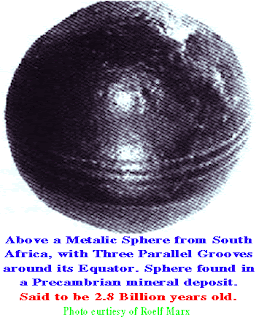
https://en.wikipedia.org/wiki/Klerksdorp_sphere
> As proposed by Cairncross, the grooves represent fine-grained laminations within which the concretions grew. The growth of the concretions within the plane of the finer-grained laminations was inhibited because of the lesser permeability and porosity of finer-grained sediments relative to the surrounding sediments. Faint internal lamina, which corresponds to exterior groove, can be seen in cut specimens. A similar process in coarser-grained sediments created the latitudinal ridges and grooves exhibited by innumerable iron oxide concretions found within the Navajo Sandstone of southern Utah called "Moqui marbles".
> Similarly, the claims that these objects consist of metal, i.e. "...a nickel-steel alloy which does not occur naturally..." according to Jochmans are definitely false as discovered by Cairncross and Heinrich. The fact that many of the web pages that make this claim also incorrectly identify the pyrophyllite quarries, from which these objects came, as the "Wonderstone Silver Mine" is evidence that these authors have not verified the validity of, in this case, misinformation taken from other sources since these quarries are neither known as silver mines nor has silver ever been mined in them in the decades in which they have been in operation.