Even if they miss 2022 the next window at 2024 is still incredible. Who would have seriously believed we'd fly something of that size to Mars by that time and have a manned mission two years later?!
I suspect the ambitious timelines are political. Musk has repeatedly stated that others would need to work on a lot of the Mars colony infrastructure. SpaceX only appear to be working on the supporting infrastructure for flights (e.g. propellant plant).
By telling the world that they'll be ready to fly in five years, they're making a statement that other organisations/companies that want to get involved with this effort need to start working on developing the other parts right now.
If the schedule ends up being more like 2028 for the first flight, they stand a much better chance at flying the right stuff there.
That's a good point. This talk sends a pretty clear message to the market - we expect to be flying serious amounts of stuff to Mars in under 10 years, so if you want to start a business in the area, now is a good time.
And the trick is, the more people he can convince of that, the better chances we have the Mars colony will happen.
It's worth remembering too that Bigelow Aerospace put their development on hold some years ago because the launch industry wasn't moving fast enough to actually deploy their habitats.
I expect we'll see them spinning back up on the immediate future. :)
Question: Why do the autonomous cargo missions need to be done in the ideal launch window? It doesn't seem like the systems required to operate and navigate in space should require much energy, once your are up to cruising speed (and there's no air resistance in space to slow you down). Does it matter if the cargo takes 6 months to deliver the cargo instead of 3? Am I missing something?
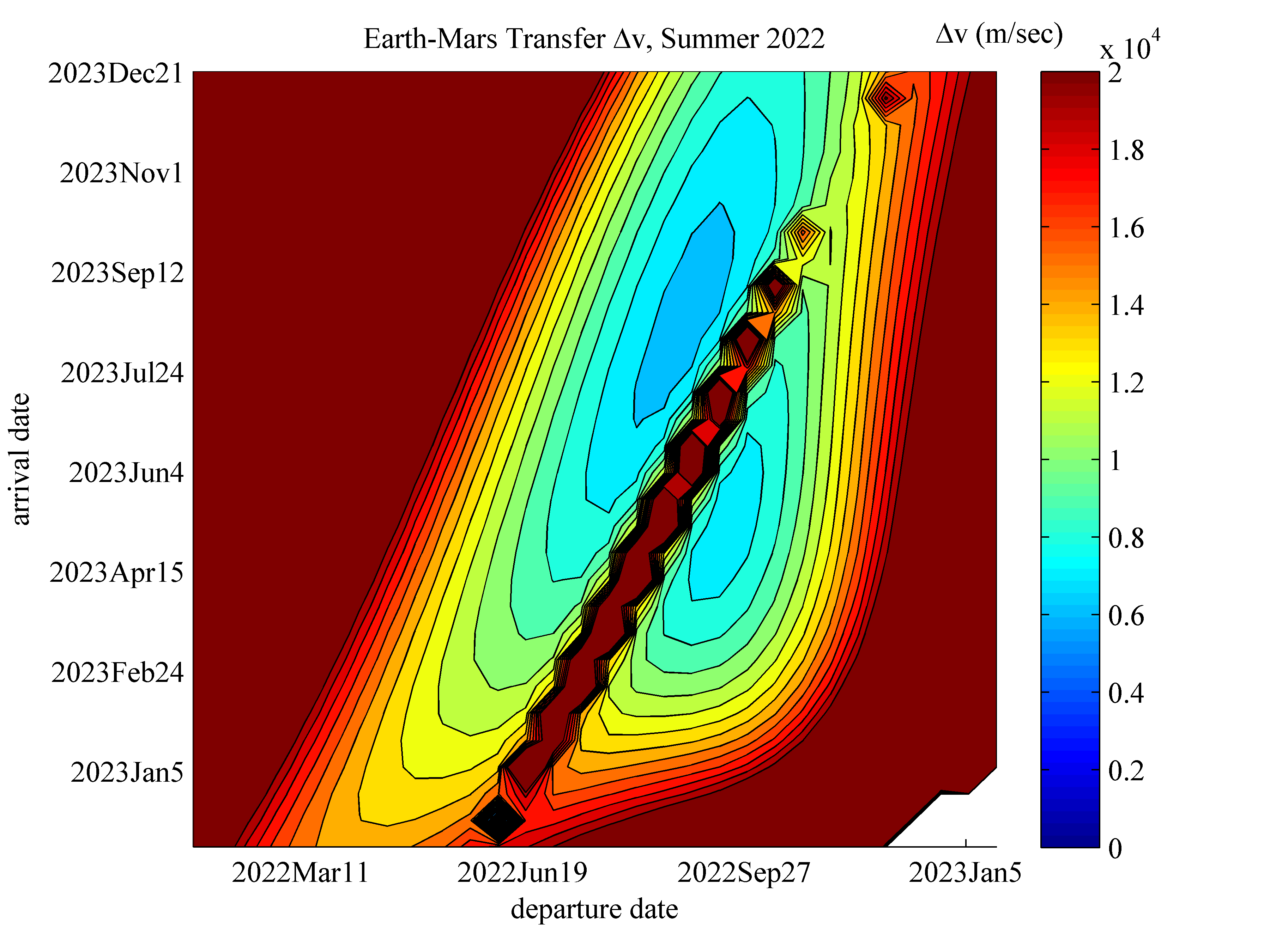
It is indeed an energy issue, but for the orbital change, not system operations. Every kilogram you have to spend on fuel is a kilogram you can't use for cargo instead. You can use porkchop plots[1] to determine ideal launch windows (least ∆v = least fuel needed). Late summer of 2022, for example, is a good window[2].
For manned missions, you're more interested in the least '∆t' (time spent traveling) since crew sanity/health is more important than fuel. (Yes, astronauts are exceptional and willing to endure a lot of discomfort, but the less time they have to spend in a small tin can, the better.)
Longer exposure of components to radiation? Deterioration of fuel and fuel-touching components (wouldn't be able to get by on relatively inert monopropellant like on tiny probes, probably)? Best guesses.