Hacker News new | ask | show | jobs
by JumpCrisscross 3203 days ago
> Care to clarify who gets to decide who is and isn't a Nazi?

Given the strict definition of "waving swastikas and advocating for violence against Jews" works in the scenario at hand, I'm not yet terrifically concerned about over-reach.

2 comments

> waving swastikas

The only reason people wear swastikas in America is because of the strong free-speech protection that this thread is discussing the erosion of. If we banned swastikas (like Germany) then people would stop wearing them (like Germany), but we'd still have the same hate speech you're discussing censoring.

> advocating for violence against Jews

That's a pretty broad standard. If a politician supports evicting Israelis from disputed settlements in the West Bank, is that "advocating violence against Jews?" The answer "Yes according to some people, No according to others." So again, I ask: who are you trusting to decide? President Trump? Congress? You personally? To be clear, the offer currently on the table is "some middle-managers at Cloudfare, as directed by the fickle hand of social media."

> If a politician supports evicting Israelis from disputed settlements in the West Bank, is that "advocating violence against Jews?"

Someone chanting "death to Jews" and waving Nazi flags leaves little unambiguous. I'm usually a slippery slope fanatic when it comes to free speech, and I still am as it relates to First Amendment concerns, but private companies choosing not to do business with people who self identify as Nazis, wave Nazi flags and chant "death to Jews" while saying that employees of said companies are also Nazis is pretty clearly their right. Courts aren't computers and the law isn't code; judges can understand "they are Nazis."

You're answering the question "Is it okay to censor stuff that's super-duper bad", which no one is asking. The question at hand is who gets to distinguish bad-enough-to-ban from the not-bad-enough-to-ban. That you've replied twice without answering suggests, I think, that there's not an easy answer. Not that there's any shame in that! The founders couldn't come up with a good answer either. The first amendment essentially says, "Restricting speech is so difficult to get right that we don't trust Congress to do it."

Meanwhile, the point this article is making is that (in practice, if not in law) the current answer to the question of who decides what to censor is "middle managers at network infrastructure companies, based on what their social media departments suspect might hurt their brand." If you think that's an acceptable answer, great, but I don't think you can go on thinking of yourself as a "slippery slope fanatic when it comes to free speech" in that case.

> That you've replied twice without answering suggests, I think, that there's not an easy answer

There isn't. But we don't need an answer, not yet. The justice system is a lazy evaluator. This case has an easy answer--they are Nazis. If someone sued, the ruling would be quick. If the next case is more complex, reality will illuminate the nuances.

Common law systems are complex. They're also de-centralised and empirical. You don't always need a standard ex ante. We have a cultural standard regarding genocide, its advocacy, and Nazis. Existing norms and laws suffice.

(Philosophically, your question is interesting. It's practically irrelevant, though, until a matching case threatens to arise.)

But you're saying that we should just ignore the examples of super-duper-bad speech because of the difficulty of deciding where the line is. And that is a really hard problem, but it doesn't take away from the fact that people are engaging in super-duper bad stuff like calling for genocide and plotting and committing political murders.
Yes, and maybe allowing that would be less bad than allowing censorship to creep its way into acceptability.
I'd like you to expand on this. I'm sure you're familiar with the idea of a chilling effect, and can understand how accepting the open advocacy of genocide, ethnic cleansing, or terrorism would negatively impact the freedom of those who are intended to be on the receiving end of such policies.

How many or how detailed must threats against others' wellbeing become before you consider them unacceptable?

https://en.wikipedia.org/wiki/Chilling_effect

Plotting and committing political murders are already crimes, let's not conflate these with abhorrent speech.
No, let's. Organizing for the murder of a large number of people is as bad as or even even worse than calling for the deaths of individuals.
Given the current political climate of people being labeled as Nazis simply because they disagree, I would suggest some level of worry.
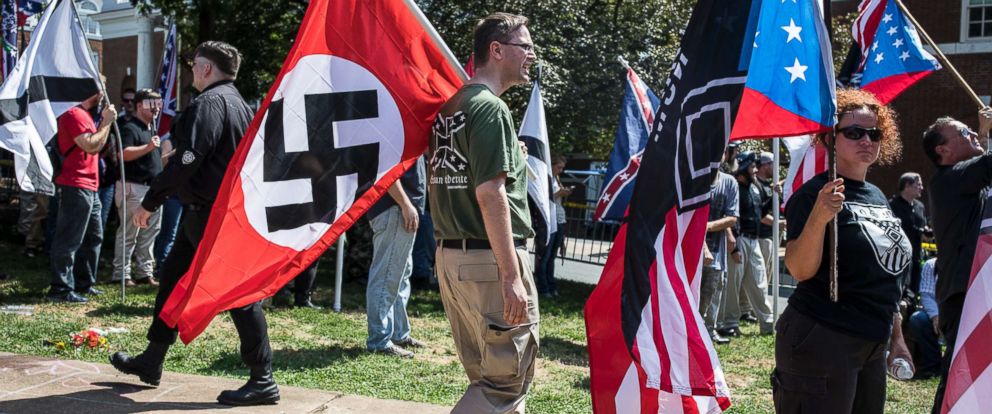
These people are nazis. They're not being labeled, they showed up and said "yes we're nazis look at this flag". Like the false equivalence between crazies saying every political figure is nazis and people that are calling themselves nazis with pride is ridiculous.

We're not operating in a grey area, one group is waving nazi flags, chanting blood and soil, and killing people; the other isn't. Pretty open and shut.

---- spot the grey area http://a.abcnews.com/images/International/nazi-flag-charlott...

I'm not speaking of the people who show up in public wearing Nazi paraphernalia and carrying Nazi flags. That's so easy any idiot can correctly identify them as that is exactly how they wish to be identified. I'm speaking of the people who show up in public with signs supporting free speech, unity, and love for all people that are then screamed at by idiots in masks labeling them as Nazis. Before they are beaten while police stand by and watch.

Simply because they have a different point of view.

Or any politician that openly disagree with certain politicians that have been in office for quite some time. It's a known tactic that has been in effect for a long time now. If you find yourself losing a debate, compare your opponent to Hitler.