Hacker News new | ask | show | jobs
by ux-app 3207 days ago
are you sure your numbers are right? I'm looking at my last electricity bill and we used 450kWh in one month. And it's not summer here so no A/C and our water is gas heated. We're a household of 2+2 young kids. We turn off lights when not in use, medium sized, reasonably new fridge, no always on computers etc.

hard for me to imagine how anyone could find a 12x reduction in usage! I need to know your secret :)

4 comments

That's absolutely crazy. Do you have electric heat? If not you should probably spend twenty bucks on a kill-a-watt clone and check which of your appliances is consuming several hundred watts all day long.
>Do you have electric heat?

nope gas heating. and it's a modest 3 BR home.

according to this[1] Australian Government website about energy usage, for 3 people in my postcode (5075), no pool + mains gas, average daily consumption is 15.8 kWh, which matches almost exactly my last bill (avg was 15.3kWh).

I think some people are underestimating their usage. We're definitely not a wasteful household, we don't run the drier much, appliances are off when not in use, lights off when no one in room etc.

>If not you should probably spend twenty bucks on a kill-a-watt clone and check which of your appliances is consuming several hundred watts all day

yup already did that a couple years ago. Turns out there are no unusually bad appliances in the house.

---

[1] - https://www.energymadeeasy.gov.au/benchmark

Then what appliance uses all that electricity? I'm really curios!
nothing out of the ordinary I think. 2 computers on for about 8 hours/day. Dishwasher, TV on for 2 hours/day. iPad, home lighting.

I think some people in this thread are severely underestimating their energy usage. I wonder if people are just ballparking their estimates based on some rough data from years ago or if they're actually looking at last month's bill when saying they're using < 100kWh in a month.

Maybe for a single person who is never home that would be reasonable, but I can't imagine families being able to survive on so little.

edit: so this was driving me a little crazy and so I had to do some extra digging. My guess is that people not aware of their true usage. According to this [1], the average US household uses > 900kWh of energy/month. We're at half that so clearly not going overboard.

[1] - http://insideenergy.org/2014/05/22/using-energy-how-much-ele...

It may be crazy, but that is below average for a U.S. single-family home in many parts of the country. Old houses tend to be very inefficient, and many new houses are grotesquely large.

My family used 330kWh last month (also 2 adults+2 kids), including moderate use of AC; our energy efficiency report said we're using less than 1/2 the average of our neighbors.

Yours looks a little high, but be assured average power usage for 2+2 in Germany is 3000-4000kwh/year. So lower than your 5400 but max 2x reduction :-)
Just to clarify, I'm only one person. But that certainly doesn't explain a 12x difference.
Just to preface this: where are you getting the 12x reduction from? He spends 40 euros at 0.26, that's 150 kWh per month. That's 1/3rd of your usage, not 1/12th. And he's living alone, you with four. If anything, you're more efficient than he is per person.

Anyway if you want a reduction, just identify all the model numbers of anything plugged in and check specs and approximate usage.

It's insane how large the efficiency spectrum is, and how efficient things have become in recent years.

For example, modern 6ft fridges get so efficient they use about 8 kWh per month. Meanwhile, very old fridges can still use upwards of 40 kWh per month. We've seen a reduction of something like 75% in the past 15 years, that's pretty massive.

The most efficient washing machines now use about 10 kWh a month, while I can easily find washing machines for sale that use 25 kWh per month that were produced as recently as 2012 by LG.

And that's the difference in age. Differences in tech/model are also vast. In Europe we have a pretty decent energy labeling system for consumers for a decent approximation.

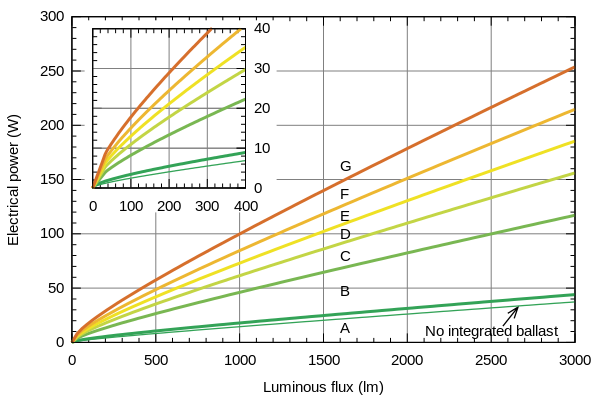
For example, here's lightbulbs [0] where you can see, for a certain amount of light (e.g. 3k lumens) the best bulbs use 50W while the worst use 250W. That's a 5x difference. You can easily drop 80% of your lighting electricity usage if you still have old bulbs.

The big items like washing machines, vacuum cleaners, microwaves, dryers, fridges, particularly old ones, all typically draw 2 kW or more at various times, so that's probably low-hanging fruit, assuming you have changed your bulbs.

A big TV is another one, not as high-powered but a lot of people keep em on for very long times, sometimes just as music players or on the background, and some TVs are really inefficient. Mine is alright but still draws 220 W. Contrast that with say the 2017 Macbook, which has a 42 Wh battery and lasts 10h. i.e. it draws about 4W. If you use your Macbook for 5h each day before/after work, you'd use about 0.6 kW per month, or about $1.5 typically. But if I have my TV on for 5 hours (I've used it as a music player like this but stopped due to electricity) it'd draw 33 kWh a month for about $80 a year.

If I compare the utility between these devices, it's crazy I spend 55x as much energy on my TV per hour of usage than a modern laptop. It's just that electricity is so damn cheap. The comparison to a phone is even crazier.

[0] https://upload.wikimedia.org/wikipedia/commons/thumb/f/f4/EU...